 Downcoded
$5.18 Million Got Its Own Compliance Tip
MLN Connects published a provider compliance tip this morning telling comprehensive outpatient rehabilitation facilities that their improper payment rate was 45.4 percent on $10.8 million. Both numbers come from the FY 2024 CERT report. The FY 2025 report has been out since November: 20.7 percent, $5.18 million, and the smallest line on the Part A ex-IPPS table.
The Aug 20 edition of MLN Connects, out this morning, spends its Compliance section on comprehensive outpatient rehabilitation facilities.
"In 2024, the improper payment rate for comprehensive outpatient rehabilitation facility (CORF) services was 45.4%, with a projected improper payment amount of $10.8 million. Learn how to bill correctly for these services."
Both numbers come out of the FY 2024 Medicare Fee-for-Service Supplemental Improper Payment Data, released in November 2024. That report is now a year old. The FY 2025 supplemental has been out since November 2025.
In the newer file, CORF's improper payment rate is 20.7 percent. Its projected improper payment amount is $5,181,451.
The Chart CMS Is Working From
The Nov 2025 supplemental prints an appendix table (G3) that ranks every Part A service type outside hospital inpatient PPS by projected improper payments. CORF sits at the bottom of it. The chart below is the same table, drawn to scale.
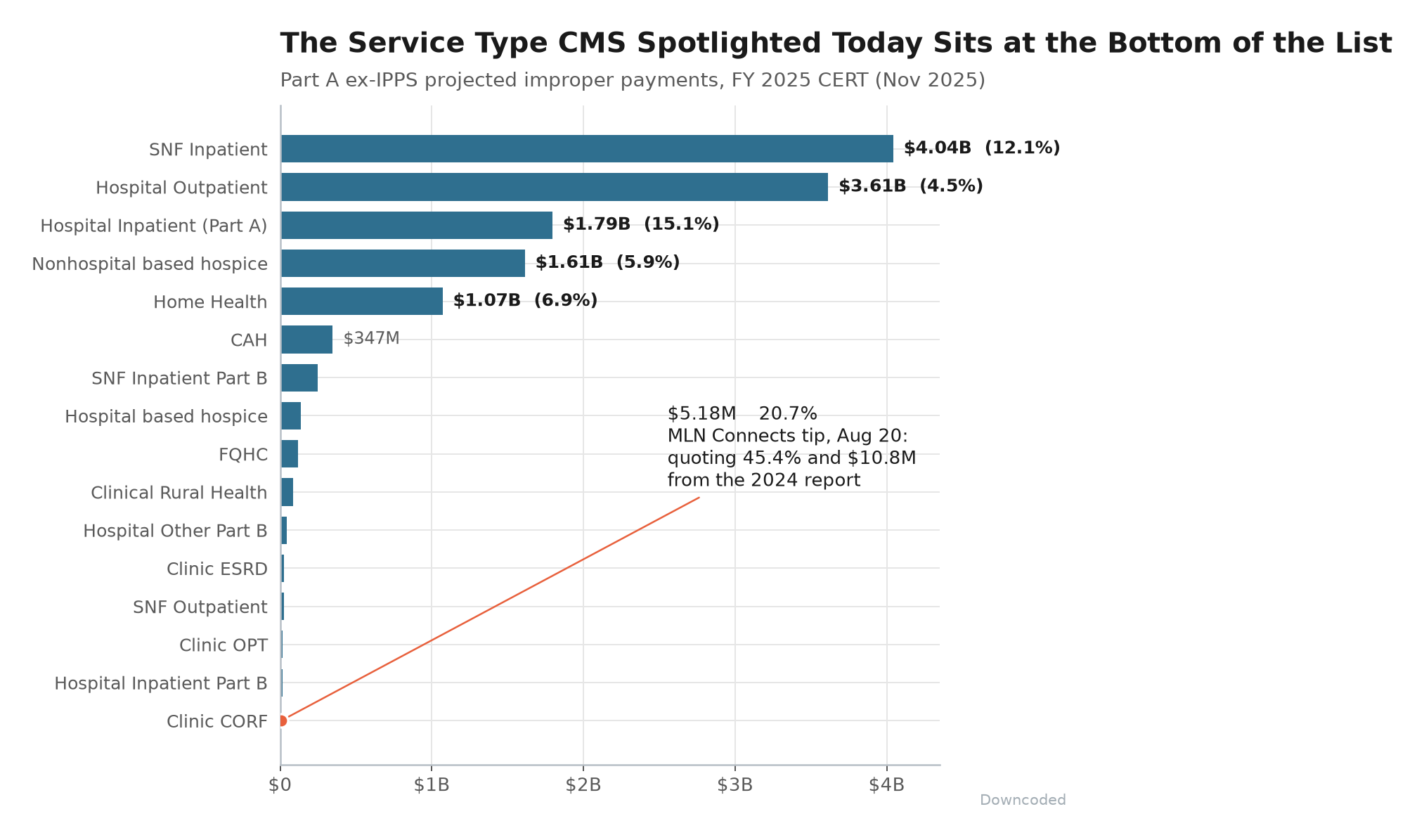
Two lines carry most of the money. SNF Inpatient projects $4.04 billion at a 12.1 percent rate. Hospital Outpatient projects $3.61 billion at a 4.5 percent rate. Together they are $7.65 billion, or 58 percent of Part A ex-IPPS improper payments and about 26.5 percent of the entire Medicare FFS improper payment total. Hospital Inpatient (Part A, freestanding) prints another $1.79 billion at 15.1 percent. Nonhospital hospice, $1.61 billion at 5.9 percent. Home health, $1.07 billion at 6.9 percent.
CORF is $5.18 million.
That is 780 times smaller than the SNF Inpatient line, and CMS's own "percent of overall program improper payments" column rounds it to 0.0 percent. The unrounded number is 0.018 percent of a $28.83 billion program. If the entire CORF book of Medicare business billed nothing correctly for a year, it would not close the gap on a single point of the SNF Inpatient rate.
Where the Number Came From
The 45.4 percent rate the tip quotes is not made up. It is Clinic CORF's row on Table G3 of the FY 2024 report, projected improper payments $10,823,888, 95 percent confidence interval 27.3 to 63.5 percent.
That was the number the CORF Services provider compliance tip page went up with. The tip page has not been updated since.
The FY 2025 report changed the row underneath it. The rate fell 24.7 percentage points, from 45.4 to 20.7. The dollars fell 52 percent, from $10.82 million to $5.18 million. The error mix went from 84.3 percent insufficient documentation, 14.5 percent other, and 1.2 percent incorrect coding to 100 percent insufficient documentation. Every CORF sample flagged in the newer file failed on records, not coding, not medical necessity.
That last point is the one the reader can actually use. If the tip page's advice is "denial reasons and how to prevent them, payment and documentation requirements," the current file agrees with the advice more than it agrees with the headline.
The advice is a documentation drill. The improper payments are a documentation problem. That much is consistent across both reports.
The rate and the dollars, the reason a CORF's admin would open the tip in the first place, are the old ones.
What CMS Has Cycled Through in Three Weeks
The pattern is not new this morning. The Aug 6 MLN Connects ran a glucose monitoring supplies tip at 25.2 percent and $278.5 million, both 2024 numbers; the FY 2025 file puts glucose monitors at 17.3 percent and $203.4 million, a 7.9 percentage-point rate drop and a $75.1 million dollar drop. The desk covered that lag on Aug 8 through the catheter side of the same file (a Chart Note on urological supplies at 74.1 percent and $885.8 million, still not the subject of a compliance tip anywhere in the Aug 6, Aug 13, or Aug 20 editions).
Three editions in a row. Three prevent-denials tips in three of the smallest categories. Nothing on the top of the chart above.
Final Thoughts
If you run compliance for a CORF, the tip is fine. Documentation practices at insufficient-documentation-heavy service types are the same drill they were in November 2024 and they are the same drill now.
Read the payment and documentation requirements the tip page lists and check them against the last set of denial letters your MAC sent. Nothing on that side has moved against you.
If you run compliance for a health system and you were waiting for CMS to signal where to spend attention this week, the MLN edition that lands in your inbox is not the signal. The signal is the file it is drawing from, still fresh, still uncited in any of the three most recent editions. The two lines at the top of the chart are 58 percent of the money that flowed the wrong way in FY 2025.
Thanks for reading.