 Downcoded
Amazon and Google Want the Prior Auth Pledge in Their Own Plans
CMS and the Labor Department announced on October 21 that five large employers signed a statement asking their third-party administrators to extend the 2025 Prior Authorization Pledge to self-funded plans. The January 1, 2027 API mandate reaches five categories of payer, and an ERISA plan is not one of them, which matters because 71 percent of covered workers now sit in one.
Five companies put their names on a one-page document on October 21. Not one of them sells health insurance.
Amazon, Axon Enterprise, Google, Meta and Oracle signed the Employer Statement of Support for Electronic Prior Authorization, which CMS and the Department of Labor announced together that morning. They signed it as plan sponsors, and what they signed is a request pointed at the companies that administer their health benefits.
The ask is narrow, and it names the one gap in prior authorization reform that regulation has not been able to close.
What Five Plan Sponsors Asked For
The thing being extended is the 2025 Prior Authorization Pledge, the voluntary commitment CMS secured from health plans at a June 23, 2025 roundtable. CMS lists six commitments under it:
- Standardize electronic prior authorization on FHIR-based APIs
- Reduce the volume of medical services subject to prior authorization
- Honor existing authorizations through an insurance transition
- Improve transparency and communication on decisions and appeals
- Expand real-time approvals for most requests by 2027
- Have a medical professional review every clinical denial
Read the markets that pledge covers and you can see the hole from across the room: Medicare Advantage, Medicaid managed care, the Marketplace, and commercial plans. A plan the employer funds itself is none of those, and the June 2025 release does not use the word self-funded anywhere.
So the signatories wrote the sentence themselves. They "urge" the pledge participants "to make the technical improvements and other capabilities they are developing under the Prior Authorization Pledge immediately available to self-insured ERISA health plan sponsors."
The Market the Rule Was Never Written For
Here is where it gets structural. The January 1, 2027 Prior Authorization API requirement comes from CMS-0057-F, and that rule applies to a closed list of impacted payers: Medicare Advantage organizations, state Medicaid and CHIP fee-for-service programs, Medicaid managed care plans, CHIP managed care entities, and QHP issuers on the Federally Facilitated Exchanges.
Count the ERISA plans on that list. There are none, and there was never a plan to put them there, because CMS does not regulate how a private employer funds its own benefit.
That exclusion used to be a rounding error.
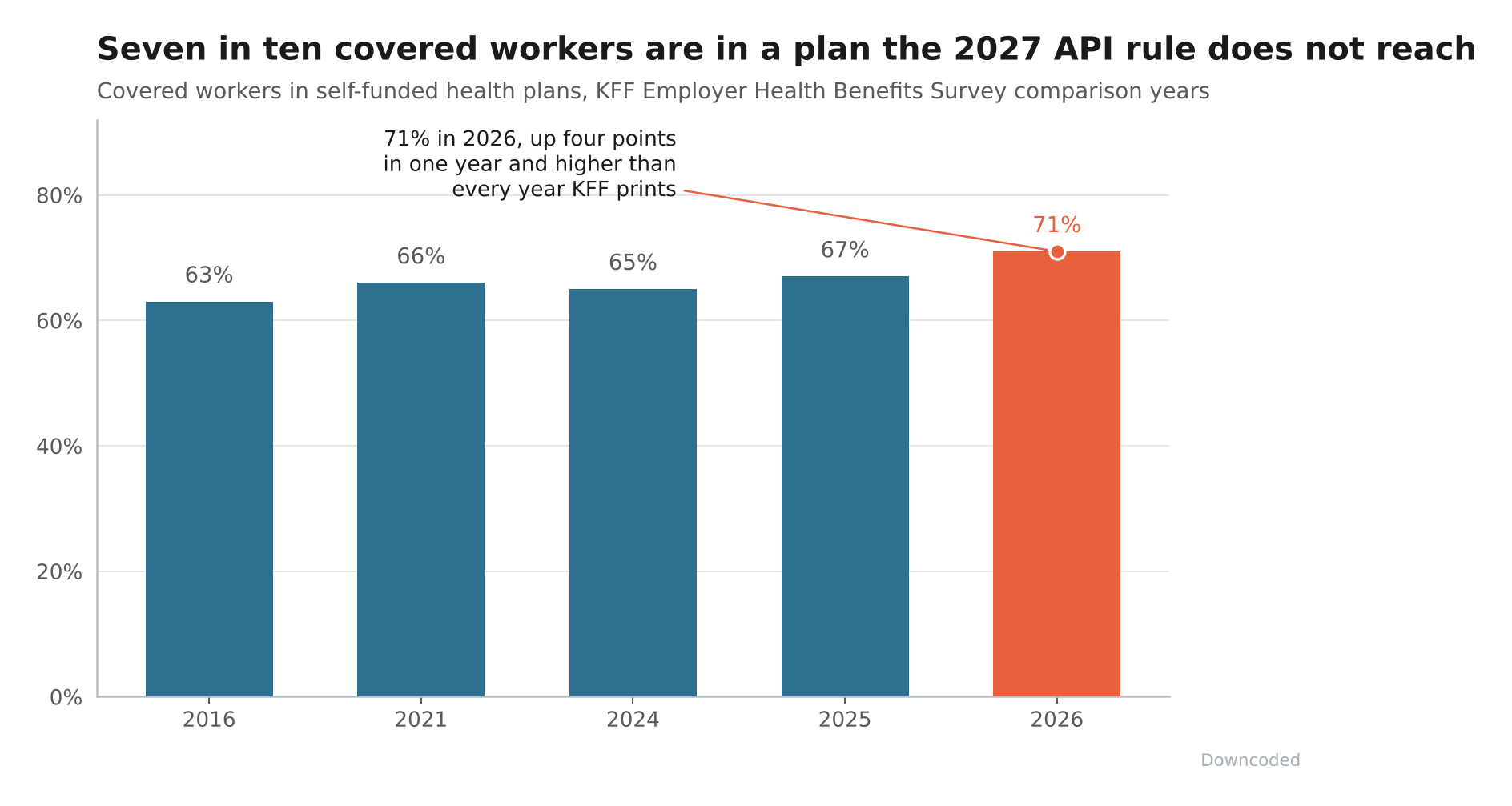
It is now the majority of the commercial book: 71% of covered workers are in a self-funded plan in 2026, up from 67% last year and higher than every comparison year KFF prints (chart below). At firms with 200 or more workers the figure is 85%.
CMS put its own version of the number in the announcement, citing Census data: more than 53% of Americans, over 180 million people, get coverage through an employer that sponsors a self-funded plan.
The Sentence That Does the Work
"When a payer shortens its prior authorization list, who decides whether your self-funded patient gets the shorter list?"
The statement answers that, and the answer is the most operationally useful thing in the document. The five sponsors split the pledge into two piles.
The electronic plumbing arrives on its own. Their words: those reforms "would result in improved prior authorization processes for self-insured employers if their plans are administered on these new platforms, which we expect to be available immediately."
Your patient's card says the carrier, the carrier's platform carries the FHIR endpoints, and the self-funded plan rides along.
The list of services is a different pile. Changes to what actually requires an authorization "could be adopted on a plan-by-plan basis," which is the statement's way of saying a scope reduction is plan design and plan design belongs to the sponsor.
Two things follow for your shop:
- A payer's announced prior authorization cuts are a claim about its own book. Whether they reached the self-funded group whose claims you are working is a separate fact, and the employer owns it.
- The escalation path on a self-funded denial runs through the plan sponsor's benefits team, not only the administrator's provider line. These five put in writing that they expect to be asked.
Final Thoughts
A statement of support is not a rule and nobody should read it as one. It has no effective date, no compliance obligation, and five signatures where the pledge itself drew plans covering nearly eight out of ten Americans.
What it has is the right address. CMS values the manual process at roughly $34,000 and 700 hours per provider per year, and for seven in ten covered workers the person who can shorten that bill is a benefits director at their employer, not a medical director at a payer. Getting employers to say so out loud is the part of this that was missing, and now there is a document and a mailbox for the next one to use.
Thanks for reading.