 Downcoded
CCSQ Spends an Hour in Public This Afternoon
The CMS center that owns national coverage policy, the LCD process, and your lab's CLIA certificate holds an open webinar at 3pm ET today, and registration is a link in a newsletter. Its coverage group walks in carrying 316 live national coverage determinations and exactly three open analyses.
One CMS center describes itself as the focal point for all quality, clinical, medical science issues, survey and certification, and it monitors Medicare, Medicaid, and CLIA.
That is the entire remit of the Center for Clinical Standards and Quality in a single sentence of CMS's own prose, and it covers a startling amount of what lands on a revenue-cycle desk.
At 3pm ET today, CCSQ gets on a webinar that anyone can join.
Dr. Dora Hughes, Chief Medical Officer of CMS and Director of CCSQ, is the listed host, with what CMS calls the CCSQ leadership team. The invitation ran in the November 12 MLN Connects, the registration is a plain Microsoft Teams event link, and there is no credential, no membership, and no fee between you and the room.
"What is actually sitting on the desk that owns your coverage policy?"
One Center, Four Divisions, And Your CLIA Certificate
The piece of CCSQ that revenue cycle collides with most is the Coverage and Analysis Group, which CMS says leads the evidentiary review process for all clinical topics. It runs on four divisions:
- Policy and Evidence Review, which leads evidence review and policy development and oversees national coverage determinations.
- Evidence Development, which owns Coverage with Evidence Development policy, protocol reviews, and investigational device exemption and clinical trials policy.
- Policy Coordination and Implementation, which oversees the local coverage determination process with the MACs and implements NCDs and national coverage rulemaking.
- Business Operations, which maintains the site that announces coverage decisions, supports MEDCAC, and manages the technology assessment contracts.
Read that third bullet again, because it is the one most people get wrong. The LCD process you argue with at the contractor level is coordinated out of the same center as the national one.
And the same center holds the Quality, Safety and Oversight Group, which is where CLIA lives. The certificate your lab renews and the NCD your lab bills under come from the same org chart.
Two things it does not hold, worth knowing before you send a question to the wrong inbox: the National Correct Coding Initiative belongs to the Center for Program Integrity, and HCPCS Level II coding belongs to the Technology, Coding, and Pricing Group inside the Center for Medicare.
What the Hour Is Standing On
We pulled the full national coverage report out of the Medicare Coverage Database this morning and then pulled every document in it one at a time.
The report lists 345 NCDs. 29 of them carry RETIRED in the CMS-supplied title, which leaves 316 live documents, from artificial hearts to colorectal cancer screening.
Here is the part worth carrying into the webinar.
75 of those 316 have no posted effective date at all (chart below). The field is not blank: it reads that this is a longstanding national coverage determination and the effective date of this version has not been posted.
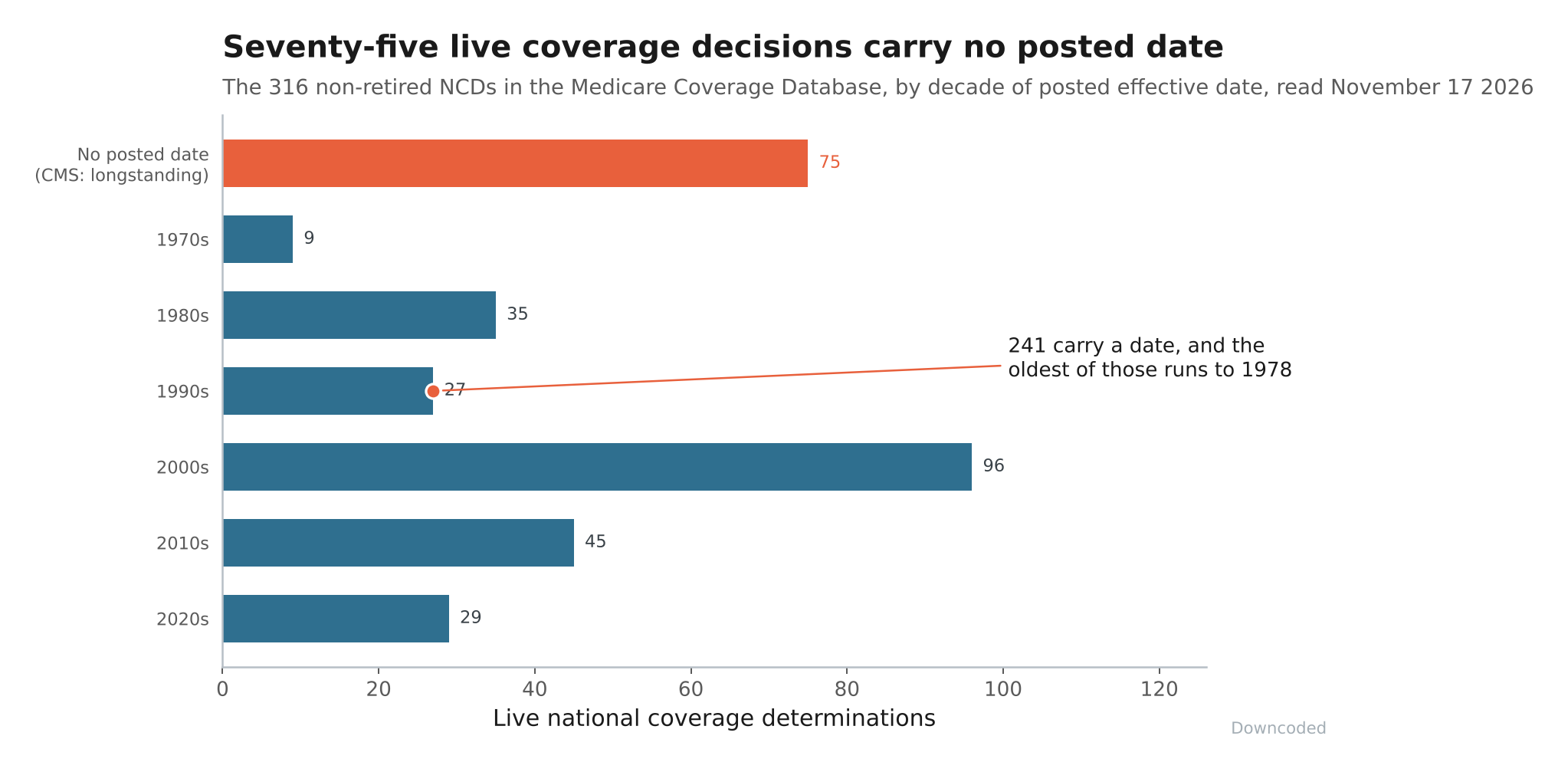
That undated block is bigger than any single decade except the 2000s, which alone produced 96 of the live set. The oldest dated one runs to 1978, and 71 of the 241 dated documents were effective before 2000.
So the standing national coverage record is largely a 20th-century artifact that is still adjudicating 21st-century claims, maintained by a group of four divisions whose leadership is on an open line in a few hours.
Three Things Are Open Right Now
The national coverage analysis docket is the forward half of that record, and it is unusually quiet. Of the 298 analyses CMS has ever opened, 294 are closed.
Exactly three are open today:
- CAG-00471N, Leadless CRT Wireless Stimulation Endocardially, a new analysis, last updated July 17.
- CAG-00436R, Screening for Hepatitis C Virus in Adults, a first reconsideration, last updated September 23.
- CAG-00430R3, Transcatheter Aortic Valve Replacement for Aortic Regurgitation, a third reconsideration, last updated September 14.
A nice tell about reading the raw feed rather than a summary of it: the WiSE analysis appears twice under two different titles, so the report shows four open rows and three open analyses. None of the three shows an open public comment period as of this morning.
The local side is just as still. The MAC what's-new feed has carried nothing since November 6, which is eleven days of quiet across twelve jurisdictions.
Quiet is the point. A coverage desk with three open analyses and a dormant local feed is a desk with room to talk about what comes next, which is exactly what the hour is advertised to cover.
Final Thoughts
Nobody is going to read you a billing policy at three o'clock, and a stakeholder webinar is not a comment period. It is the cheapest hour of direct access to the people who own the coverage record that an afternoon in revenue cycle can buy, and the price of admission is a link in a newsletter most of the industry deletes.
The standing record is 316 documents deep, a quarter of it older than its own paperwork, and it decides what your claims mean long before a MAC ever sees them. Somebody from your shop should be on the call.
Thanks for reading.