 Downcoded
CMS Wrote the Test Your Price File Has to Pass
The agency maintains an open-source validator for hospital machine-readable files, public domain and free, and shipped seven releases of it this year to keep up with its own new rule. It also publishes every enforcement letter it has sent since 2021, and April 2026 is the biggest month in that file.
CMS mailed 196 hospital price transparency warning notices in April.
That is the largest single month in the five and a half years of enforcement records the agency publishes, and April 1 is the day the CY2026 requirements became enforceable. The two facts are one fact.
Here is the part worth an hour of your week. CMS also gives away the tool that would have told you, before the envelope, whether your machine-readable file was going to draw one.
The grader is a public-domain npm package
@cmsgov/hpt-validator is what the agency calls a validation library for CMS Hospital Price Transparency machine-readable files. It is published under CC0-1.0, the public-domain dedication, which means there is no license to read and nothing to sign.
The command-line version installs in one line: npm install -g @cmsgov/hpt-validator-cli, then cms-hpt-validator <filepath> <version>.
It takes CSV or JSON, gzipped or not, and it accepts v2.1, v2.2 and v3.0 as the schema argument, so the version your file claims is the version it gets graded against. Output comes back as a table or as JSON if you want to wire it into a build.
CMS hosts the browser versions too, at cmsgov.github.io/hpt-tool: an online validator, and a generator for the root-level .txt file most compliance reviews trip over first.
None of it is an abandoned demo. The library has shipped seven releases so far in 2026, the most recent on August 18, and the CLI tracks it version for version.
CMS links both repositories, plus the data dictionary repo holding the CSV templates and the JSON schema, from its own price transparency landing page.
What the file has to say now
The CY2026 OPPS final rule landed in the Federal Register on November 25, 2025 and took effect January 1.
It rewrote §180.50 in a way your data team felt. The estimated allowed amount came out.
In its place, whenever a payer-specific negotiated charge runs off a percentage or an algorithm, the file now carries the 10th percentile, median and 90th percentile allowed amounts plus the count of allowed amounts behind them.
Those numbers have to come from 835 electronic remittance advice data, or an equivalent remittance source, computed over a defined lookback period. That is a claim of yours the file is now quoting back at you.
The same rule added the attestation language, the name of the chief executive, president or designated senior official who owns the encoding, and your organizational Type 2 NPIs.
Then it gave everyone a quarter of grace: effective January 1, "we will delay enforcement of the requirements until April 1, 2026."
April is already in the file
CMS publishes the enforcement record as a public use file, updated monthly, and the July 2026 release carries 13,355 actions against 5,258 distinct hospitals going back to January 7, 2021. Every row names the hospital and its street address.
April holds 196 warning notices and 121 corrective action plan requests. Both are the largest month of their kind anywhere in the file, and the CAP number is nearly eight times what March produced (chart below).
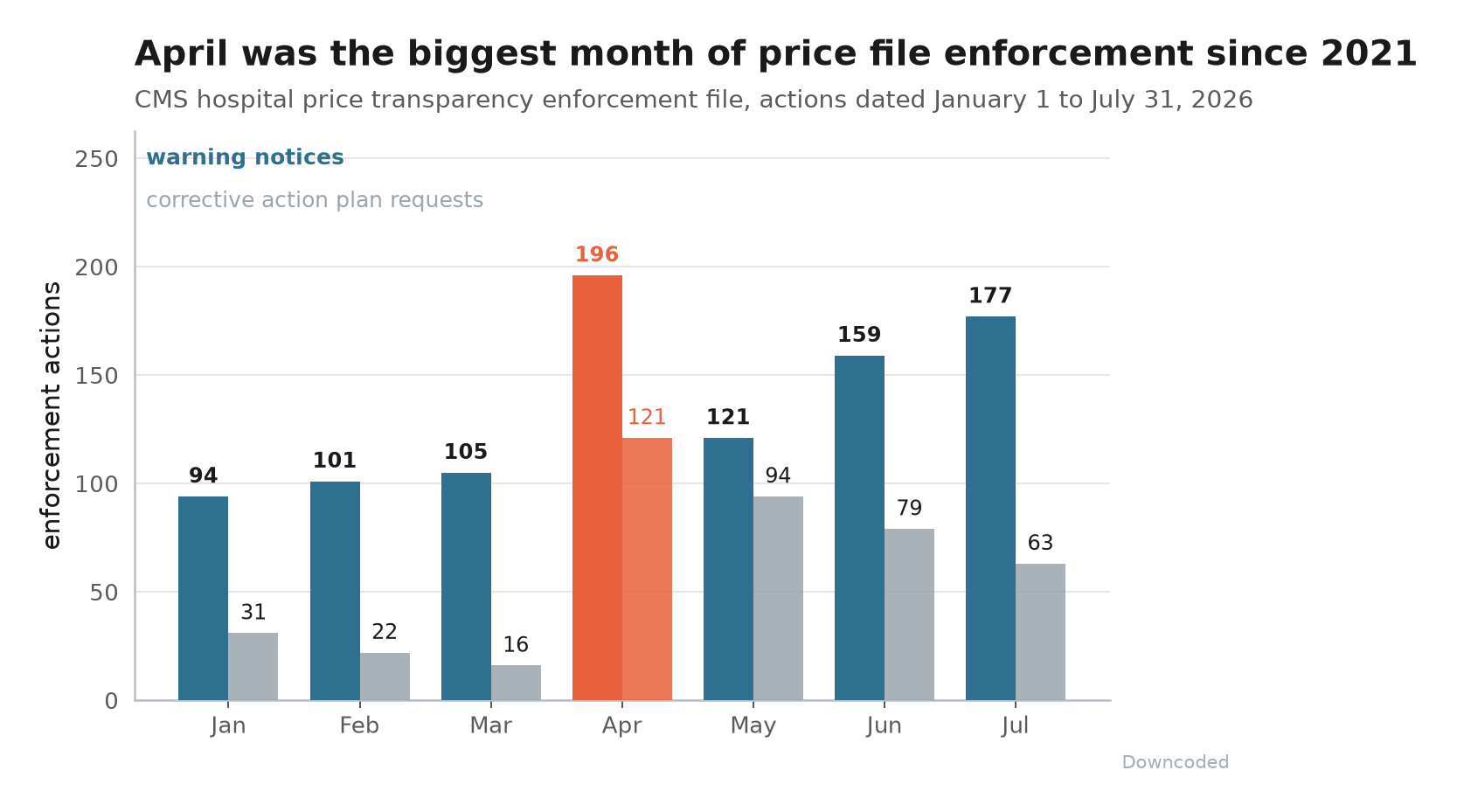
Through July, CMS has warned 953 hospitals this year across 50 states. The same seven months produced 779 warnings in 2025 and 266 in 2024.
So the reviewers are reading more files, faster, against a longer list of required elements. Your file is somewhere in that queue.
What a letter actually costs you
Start with how rarely any of this ends in a fine.
2,973 hospitals have received at least one warning notice since 2021. 1,663 went on to a corrective action plan request. 28 have ever received a civil monetary penalty notice, on 29 notices total, which is a rounding error against the warning count.
The rule even discounts the fine now: 35 percent off, beginning January 1, when a hospital waives its right to an ALJ hearing under §180.90.
Where it gets expensive is the clock. Of the 752 hospitals in the file with a warning notice and a later "Met Requirements" record, the median gap between the two is 722 days.
Two years of correspondence, resubmissions and internal escalation, on a file a free validator reads in seconds.
Final Thoughts
Agencies do not usually hand out the answer key. CMS wrote the schema, wrote the validator that checks work against the schema, put both in the public domain, and then published the name of every hospital it has written to and what happened next.
Running your own file through it before the reviewer does is the cheapest hour in the compliance calendar. The 953 hospitals in this year's file are evidence of how many people have not booked it.
Thanks for reading.