 Downcoded
Fifty Units of Fluorouracil Where One Used to Do
CMS posted the October 2026 HCPCS file on September 10. It terminates fifteen codes on September 30, including a leucovorin code that has been in the book since 1982, and brings nine of the drugs back the next morning under new numbers with smaller billing units. The quantity on the claim has to move by 2x, 10x, 20x or 50x depending on the drug.
In January 1982, Medicare gave leucovorin calcium a billing code and set its unit at 50 milligrams.
J0640 has carried that unit for forty-four years. On September 30 it stops working.
CMS posted the October 2026 Alpha-Numeric HCPCS file on September 10, three weeks ahead of the quarter it governs. The transaction report inside the ZIP runs 9,154 codes and marks 77 of them changed: 45 added, 15 terminated, and 17 edited in place without moving.
The fifteen terminations are where the exposure is.
Forty-Four Years and Out
Three of the codes dying on September 30 are older than most of the file. J0640 (leucovorin calcium) dates to 1982, J9190 (fluorouracil) to 1984, J9181 (etoposide) to 1987.
Generic oncology workhorses, all three, and none of them retiring because the drug went away.
Age isn't the reason either. 1,300 of the 9,154 codes in the October file carry an added date before 1990, and they are all still there on October 1.
At the other end of the list is C9310, leucovorin calcium (Avyxa), added July 1, 2026 and terminated September 30, 2026. One quarter, start to finish.
Same Drug, New Number, Smaller Unit
Now, the mechanism. Nine of the fifteen terminated drug codes reappear on October 1 as new codes describing the same drug at a smaller billing unit, and the multiplier is different for every one of them (chart below).
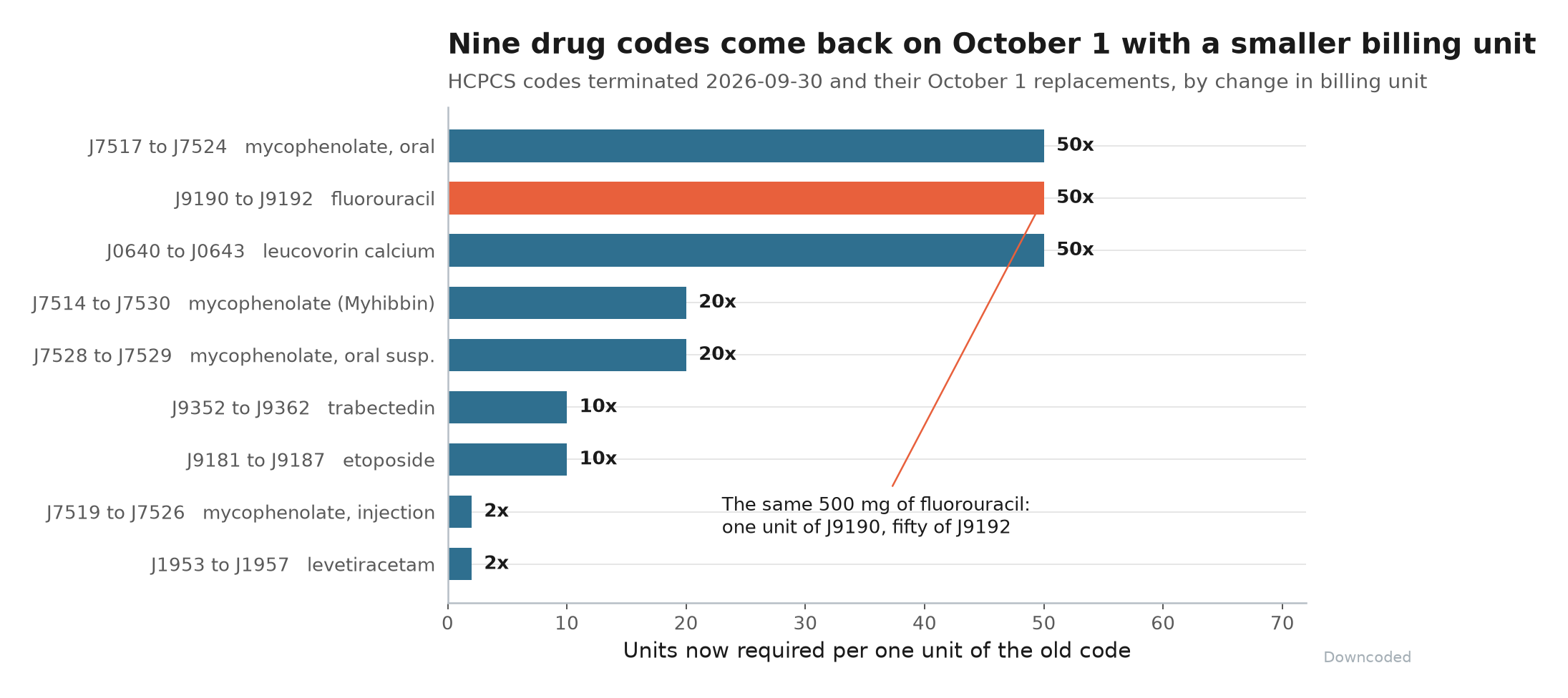
- J9190 fluorouracil went from 500 mg per unit to 10 mg on J9192, so one old unit is now fifty.
- J0640 leucovorin went from 50 mg to 1 mg on J0643, also fifty.
- J9181 etoposide went from 10 mg to 1 mg on J9187, ten.
- J1953 levetiracetam went from 10 mg to 5 mg on J1957, two.
Four different conversion factors across nine drugs, plus J1941 Furoscix moving from 20 mg to 1 mg on J1947, which neither quarterly pricing file prices and which is therefore off the chart.
Where it gets interesting is the coding file's cross-reference field. It is blank on all fifteen terminated codes.
The file that takes J9190 away does not point anyone at J9192.
What a Carried-Over Quantity Costs
The dollar math is the quiet part, because the new codes are valid codes. A claim that bills the right code with last quarter's quantity is a clean claim.
Take trabectedin, the highest-priced pair on the list. One unit of J9352 carried a payment limit of $410.479 in the July file, and one unit of J9362 carries $41.844 in the October file.
Same drug, same dose. A quantity carried across unchanged pays 89.8% less per unit.
Fluorouracil is worse in percentage terms and smaller in dollars: 500 mg was one unit of J9190 at $2.024, and is fifty units of J9192 at $0.039 apiece. Bill it as one unit and you collect 1.9% of what you billed last week.
We priced the October fluorouracil codes off the payment limit file on the ninth. The code set is the half of that change the pricing file never shows you.
To be fair, CMS repriced carefully. Apply each multiplier to the October limit and seven of the nine pairs land within 8% of what the same dose paid in July, which is inside one quarter of ASP drift.
The dose economics barely moved. All of the risk sits in the units field.
Final Thoughts
Go looking for the transmittal and you find the wrong one. The only entry on the 2026 index that opens "October 2026 Quarterly Update to Healthcare Common Procedure Coding System (HCPCS) Codes Used" is R13943CP, and it finishes that sentence with "for Skilled Nursing Facility (SNF) Consolidated Billing (CB) Enforcement."
The code set changes themselves ship as a spreadsheet inside a ZIP on the quarterly update page, which is where anyone who wants the list has to go get it.
Fifteen days out, the useful question isn't whether your code master picked up J9192. Your clearinghouse will tell you soon enough if it didn't.
The question is whether anything between the pharmacy dispense record and the 837 knows that a 500 mg dose of fluorouracil is now fifty of something.
Thanks for reading.