 Downcoded
How 24 ACOs Got Paid Before the Month Started
CMS published the Shared Savings Program's 2025 results on Tuesday, and inside them is a 24-ACO model that zeroes out the primary care claim and wires a county-average rate per member per month instead. Twenty-two of the 24 earned shared savings in their first year.
A line in the technical FAQ for Medicare's newest primary care model tells a practice exactly what its primary care claims will pay. CMS "will apply a 100 percent fee reduction of the claims-based payment."
Zero. Every qualifying code, every assigned patient, all year.
"What does a practice's revenue look like when Medicare has already paid for the month?"
Twenty-four ACOs found out in 2025. CMS posted their first-year results on Tuesday, and 22 of the 24 earned shared savings.
Twenty-Two of Twenty-Four
We put the Shared Savings Program's performance year 2025 results on this morning's radar: 472 ACOs, $4.9 billion in performance payments, $2.5 billion net to Medicare, and the gap between the press release's 2026 participation headline and the 2025 numbers underneath it.
Here is what that item had no room for. Broken out inside the same results is the Innovation Center's ACO Primary Care Flex Model, finishing its first performance year with 24 participants.
92 percent of them earned shared savings, against roughly 80 percent program-wide.
The per-patient math is the part worth stealing for your own deck (chart below). PC Flex ACOs generated $652 in gross per capita savings where the program generated $690, and left Medicare $186 per capita where the program left $234.
Run CMS's own definition, which is that net per capita savings "represent the savings for Medicare only," and the ACO's share is gross minus net. That is $466 per assigned beneficiary for PC Flex against $456 program-wide, or 71 percent of gross against 66.
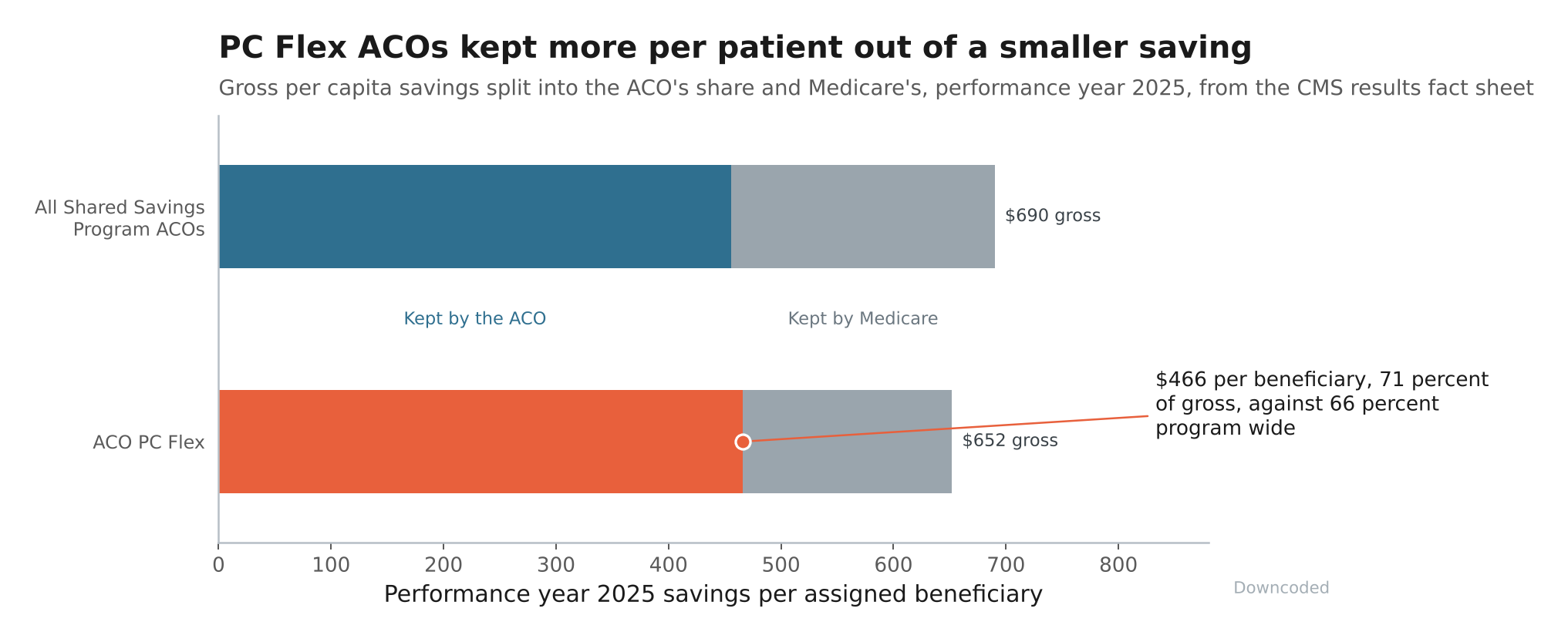
CMS names the reason: 88 percent of PC Flex ACOs sit in ENHANCED, the track with the highest shared savings rate in the program.
All Twenty-Four Are Small
Every participant had to be a low revenue ACO under 42 CFR 425.20, meaning its participants' Parts A and B fee-for-service revenue runs under 35 percent of total Parts A and B spending on its assigned beneficiaries. That test selects physician groups, health centers and rural clinics.
The PY2025 roster, off the Innovation Center's own participant notice:
- 349,513 aligned beneficiaries across 676 tax IDs and 18,538 provider NPIs.
- 4,596 primary care physician NPIs against 9,262 non-physician provider NPIs, which is two nurse practitioners, PAs and the rest for every primary care doctor on the list.
- 1,013 FQHCs, 58 rural health clinics and 8 critical access hospitals.
- Service areas in 37 states, and CMS says the group reaches beneficiaries in all 50 and DC.
Thirteen of the 24 organization names carry Aledade. The others are names their own states would recognize: Physician Partners of Western PA, Saint Francis Accountable Health Alliance in Oklahoma, C3 MSSP Enhanced in Massachusetts and Oregon, RIPC Population Management across Connecticut, Massachusetts and Rhode Island, NeueHealth Collaborative Care, ElevateCare Network, OBHS ACO1.
Year two held. PY2026 runs 23 ACOs and 359,720 aligned beneficiaries, up 10,207 on one fewer participant, with 1,225 FQHCs on the provider list against 1,013 a year earlier.
Exactly one ACO left and none joined.
The Claim Comes Back at Zero
The mechanism is the part a billing office has to actually operate:
- CMS builds a County Base Rate out of the county's average primary care spending rather than the ACO's own history, which the agency calls "a critical feature" of the design.
- The ACO receives a monthly Prospective Primary Care Payment a few days before the month begins, risk-adjusted on the same CMS-HCC version that adjusts its benchmark.
- Qualifying claims take the 100 percent fee reduction. Qualifying means an eligible beneficiary, a provider billing under a primary care or non-physician practitioner PECOS code, and a HCPCS code named in the participation agreement. Everything else pays normally.
- FQHC and RHC claims for their own ACO's assigned patients are "considered primary care services and zero-paid," while their claims for everyone else's patients pay normally.
- Practices keep submitting claims and keep billing secondary payers and patients, because beneficiary cost sharing does not change.
So the money moves off the claim and onto a per-member-per-month rate nobody bills for (chart below). At the median county the aged-and-disabled base rate is $47.45, with a $32.92 add-on for a patient whose primary care runs through a health center and $42.83 for a rural health clinic.
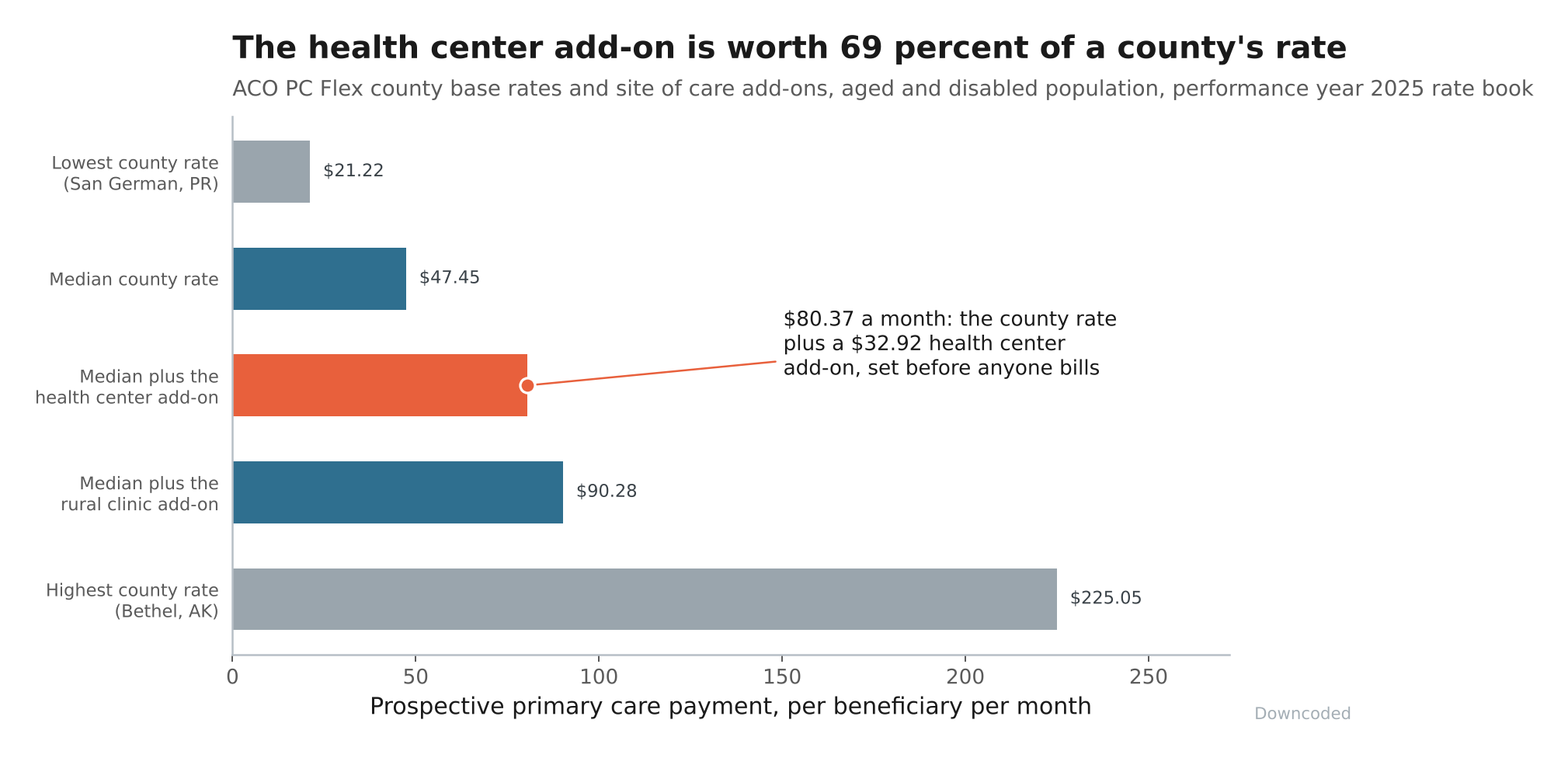
The spread across the rate book carries the argument: $21.22 a month in San German, Puerto Rico and $225.05 in Bethel, Alaska, a 10.6x range decided by geography instead of by what anyone coded. Another 645 of the 3,225 counties carry an enhancement on top, and enhancements are never recouped.
Two operational details worth holding onto. A PC Flex ACO in a two-sided track has to post two repayment mechanisms, one for shared losses and one for money owed under the model.
And a beneficiary who declines CMS data sharing is carved out of the fee reduction entirely, so those claims pay fee-for-service as usual.
Final Thoughts
CMS says it does not intend to open another application round, so these 24 are the cohort and the test ends with them. If you go looking for the numbers yourself, know that the link on the model page labeled as the PY2025 results summary currently serves a different model's factsheet; the actual figures live in the Shared Savings Program fact sheet dated November 17.
What travels is the design. The CY2027 fee schedule hands ACO clinicians a higher-paying office visit for added complexity and lets approved ACOs reduce or eliminate beneficiary cost sharing from April 1, and the direction in both is the one PC Flex has been testing: decide the primary care money in advance and stop routing it through the visit.
A cohort of low revenue ACOs built largely out of health centers beat the program's hit rate in its first year, paid by a stream that lands before anybody opens a chart. That is the number the rest of the program is going to get asked about.
Thanks for reading.