How a Pediatric Dialysis Raise Turned Into an Attestation
The 30 percent pediatric add-on Medicare has paid on every child's dialysis treatment since 2024 expires on December 31. The permanent adjusters replacing it pay $30.21 more on a peritoneal treatment and $31.11 less on a hemodialysis one, and the money meant to cover the gap now arrives only if the facility files a low-volume attestation by the same date. A commonly owned adult unit five road miles away can block it. On a fifteen-patient program the paperwork is worth $378,118.
"Medicare has paid 30 percent extra on every pediatric dialysis treatment since January 2024. What is there on January 1?"
A table.
It sits in section 60.A.6 of the Medicare Benefit Policy Manual, which CMS rewrote on Thursday in Transmittal 14043, and it has three columns: CY2011 through 2015, CY2016 through 2026, and beginning CY2027.
The pediatric case-mix grid is four cells wide, two ages by two modalities, and it has been recalculated exactly once since the prospective payment system started. Now it has been recalculated again, and the direction is not the same in all four.
A child under 13 on peritoneal dialysis moves from 1.063 to 1.410. The same child on hemodialysis moves from 1.306 to only 1.503.
Thirteen to seventeen runs the same way: peritoneal 1.102 to 1.436, hemodialysis 1.327 to 1.536.
Set those against the CY2026 base rate of $281.71 carrying the transitional add-on, and against the CY2027 base rate of $297.52 carrying nothing, and the four cells split two and two (chart below).
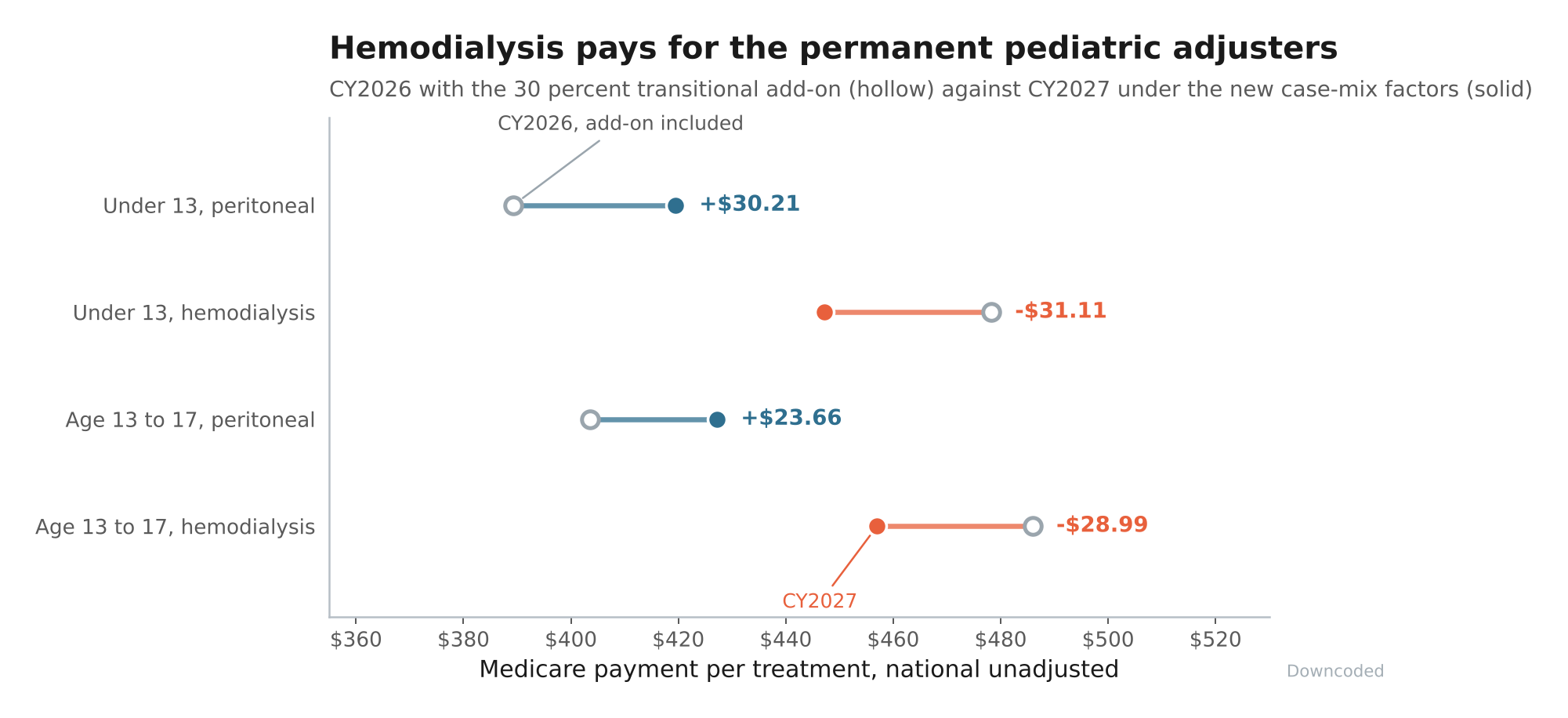
Peritoneal gains $30.21 and $23.66 a treatment. Hemodialysis loses $31.11 and $28.99.
At three treatments a week, the payment maximum, that is $4,853.89 a year off a single under-13 hemodialysis patient, and roughly the same amount onto a peritoneal one.
What the Add-On Was Standing In For
The Transitional Pediatric ESRD Add-on Payment Adjustment has never been permanent. CMS built it in the CY2024 rule at 42 CFR 413.235(b)(2) as a three-year instrument, explicitly to buy time while revised cost reports produced pediatric-specific data worth regressing.
The 30 percent came from a propensity-score analysis finding that facilities serving only pediatric patients run 40 percent higher costs per patient. CMS said at the time the analysis had wide variance.
The replacement comes from a logarithmic regression on 2022 and 2023 cost reports, and it lands at 32.98 percent. Which is inside the old confidence interval, so the agency treats the two findings as agreeing.
The arithmetic does not agree. A 30 percent add-on multiplied the whole per-treatment amount; a 33 percent cost differential run through the CY2011 multiplier formula does not reproduce it, because the formula also carries the separately billable weights and the adult average case-mix factor.
CMS says so itself, in the plainest sentence in the rule:
"these proposed updates would result in functional adjustment factors for pediatric ESRD patients below those established for purposes of the TPEAPA."
And immediately after, the part that tells you where the rest went: "low-volume facilities would receive higher payments for treatments furnished to pediatric ESRD patients, while high-volume facilities would receive somewhat lower payments relative to current policy."

The rest of this brief is for subscribers.
The impact tables, the code-level detail, and the rest of the analysis sit past this line.
$50 a month, or $500 a year.
Already a subscriber? Sign in