 Downcoded
How a Write-Off Turns Back Into a Patient Balance
CMS refreshed the Medicare enrollment file on Monday. Dual eligibles are now the smallest share of Medicare the agency has ever published, and 74% of the twelve-month decline sits in the one dual category that carries no federal bar on billing the patient for the coinsurance.
CMS refreshed the Medicare Monthly Enrollment file on Monday. The May 2026 rows put Medicare up 1,221,844 beneficiaries year over year and the dual eligible population down 231,564.
Split that second number by category and almost all of it sits in one row (chart below).
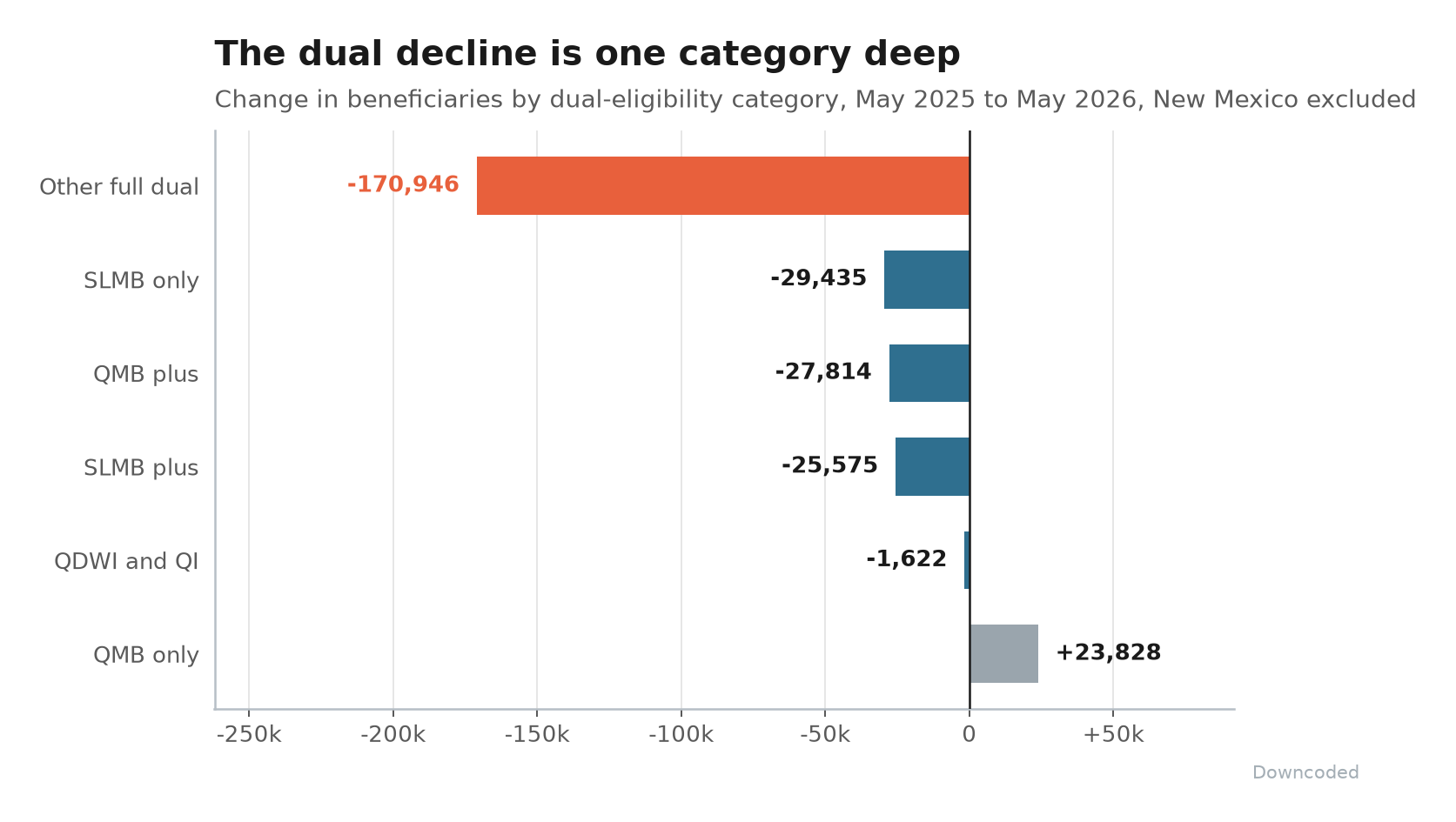
Other full dual lost 170,946 people in twelve months. That is a 10.4% decline in the category and 73.8% of the entire drop.
And the category that barely moved is the one your billing system cares about most.
The Rows That Held
Same twelve months, same 56 states and territories:
- QMB only gained 23,828, up 1.33%.
- QMB plus lost 27,814, down 0.42%.
- Together the QMB rolls went from 8,445,684 to 8,441,698. A net 3,986 people out of 8.4 million, or 0.05%.
So the population covered by the federal balance-billing prohibition is flat. The population that was absorbing coinsurance without that protection is the one draining.
Two Patients, Two Different Rules
For a QMB, 42 U.S.C. 1396a(n) settles the question. Under (n)(2) a state can decline to pay any of the Medicare cost sharing once Medicare's payment already exceeds the state's own plan rate. Under (n)(3)(A), Medicare's payment plus whatever the state paid, including nothing, "shall be considered to be payment in full for the service." Under (n)(3)(B) the beneficiary "shall not have any legal liability to make payment to a provider."
That is the write-off you already take, and (n)(3)(C) attaches a sanction to billing anyway.
Other full duals sit outside all of that. Subsection (n)(3) applies by its terms to "a qualified medicare beneficiary," and they are not one.
What covers them instead is 42 CFR 447.15, which limits Medicaid participation to providers who accept "as payment in full, the amounts paid by the agency plus any deductible, coinsurance or copayment required by the plan to be paid by the individual."
Notice the condition in that sentence. It binds you as a participating provider being paid by the agency.
When the patient's Medicaid ends, there is no agency payment, no crossover claim, and nothing making Medicare's 80% payment in full. The remaining 20% lands on a patient statement and it is legally collectible.
The Trend Line, and One State to Skip
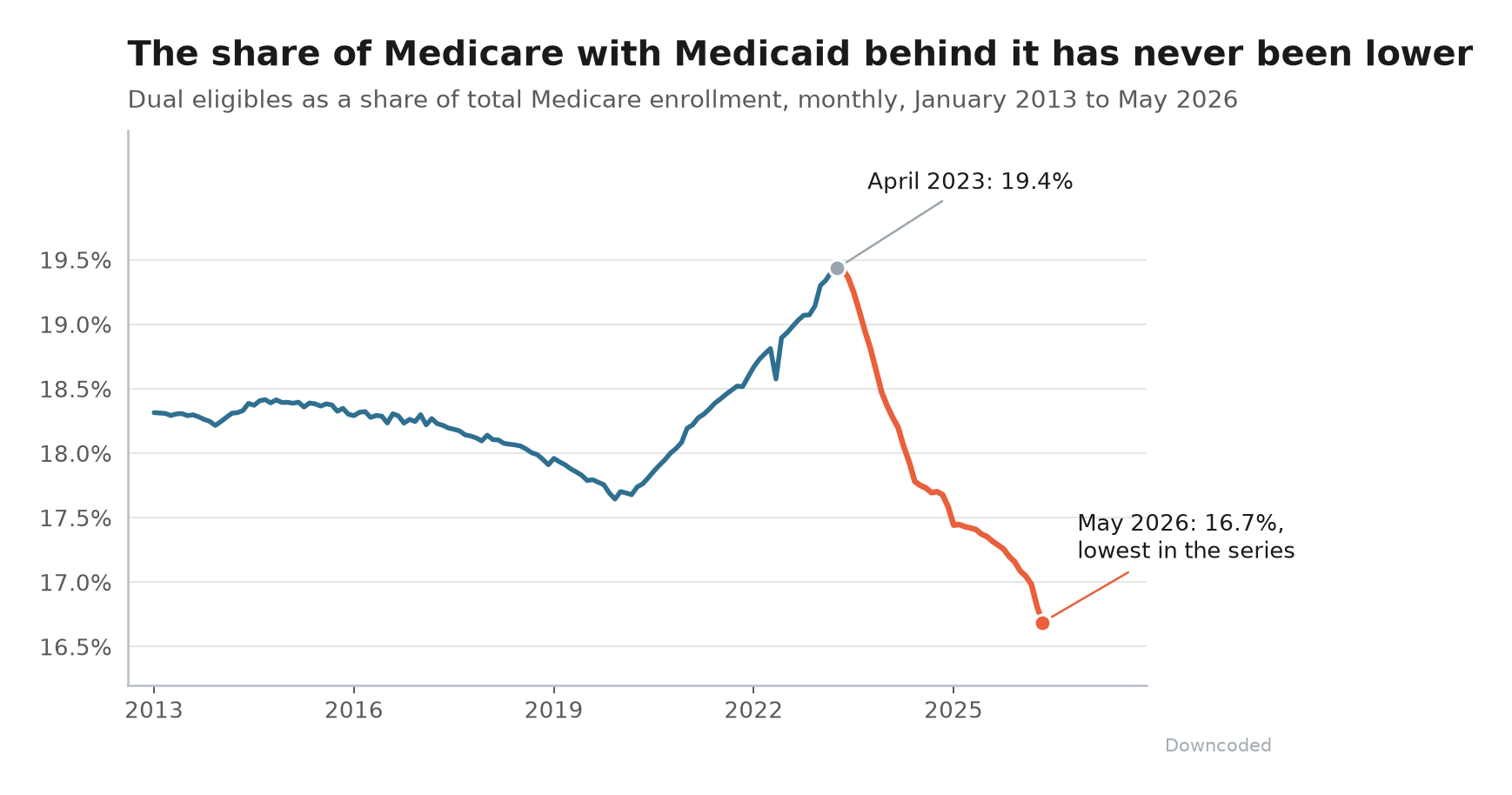
Duals are now 16.7% of Medicare enrollment, the lowest reading in a file that starts in January 2013 (chart below). The April 2023 peak was 19.4%.
Two things worth having before you quote that number:
- New Mexico's April file breaks. The state reports 105,840 duals in March and 41,543 in April, a 60.8% one-month collapse across every subcategory at once, while its total Medicare enrollment rises by 236. Every figure above holds New Mexico out for that reason, and CMS has published no erratum. Run the same check on Illinois, Texas, New York and Indiana and nothing similar appears.
- The decline is broad. Of the other 56 states and territories, 42 are down year over year and 14 are up. New York (-38,852), Texas (-37,442) and Illinois (-31,600) lead it. Florida (+16,816) leads the other direction.
The file reports status. It does not report the reason for the status, and no CMS document we could find on the run date names one.
Final Thoughts
The comfortable reading of a shrinking dual population is that the write-off pile shrinks with it. The rows say something narrower: the protected population held, and the unprotected one is what disappeared.
Which makes this an eligibility-verification problem before it is a collections problem.
A stale QMB flag on someone who is now plain Medicare writes off money you are entitled to collect. A missing flag on someone still QMB is a statement you are barred from sending, with a sanction attached to sending it.
Roughly 170,000 people crossed that line in a year, and not one of them called to tell you which side they landed on.
Thanks for reading.