 Downcoded
How an Eye-Tracking Test Got Its Own G Code
Until Thursday, the three letters asd in Medicare's payment files meant atrial septal defect. CMS established HCPCS G0685 effective October 1 for an algorithm-based assessment of autism likelihood from eye-gaze data, priced it at $135.93 in the hospital outpatient department, and left the physician office side to the MACs. The device the descriptor describes has been FDA-authorized since 2022, and in March it got the age range that makes the code worth having.
Search Medicare's October payment files for the string "asd" and until this week you got one answer: 93580, transcatheter closure of an atrial septal defect.
There is a second answer now.
CMS established G0685 effective October 1, and the long descriptor is worth reading in full: "Algorithm-based assessment of likelihood of autism spectrum disorder (asd), derived from validated analysis of eye-gaze data or other technology."
A toddler watches a video. A sensor records where the eyes go.
Software scores it, and Medicare has a code number for the answer.
The Device Behind the Descriptor
"Eye-gaze data" is not a generic phrase. One regulatory category covers it, and the category is small.
FDA product code QPF, 21 CFR 882.1491, "Pediatric Autism Spectrum Disorder Diagnosis Aid," holds six authorizations from two companies in its entire history.
Cognoa's De Novo opened it in June 2021. Four of the other five belong to EarliTec Diagnostics, for a device called EarliPoint.
EarliPoint cleared first in June 2022 as an aid to diagnosis in children 16 through 30 months, for use in specialized developmental disabilities centers. The science came out of a Yale and Emory collaboration, and the clinical record landed in two papers published the same day in September 2023, one in JAMA and one in JAMA Network Open. Ami Klin, who directs the Marcus Autism Center at Emory, is the company's chief clinical officer and co-founder.
The pivotal study was prospective, double-blind and multi-center: 500 children enrolled at six United States sites, 475 evaluable, measured against expert clinician diagnosis as the reference standard.
Then, on March 5 of this year, FDA cleared the device under a new name, EarliPoint Assessment, with the sentence that changes the billing math.
"The subject device expands the age range from 16-30 months to 31-95 months of age."
Sixteen months through 95 months. Seven years old.
And the numbers held across the new band.
In the 31-to-under-96-month group the device reported 77.1% sensitivity and 78.6% specificity against expert diagnosis; pooled across both studies, 80.2% and 81.3% on 676 children. Accuracy across the full range came in at 80.8%.
The Code Showed Up Twice, a Month Apart
The physician fee schedule got it first. Transmittal 13929, issued August 27, carried G0685 into the October MPFSDB update as a new code, short descriptor "Algorithm assessment for asd."
The hospital outpatient side followed on September 29, two days before the effective date, in Transmittal 13978. That one priced it: status indicator S, APC 5734, which is Level 4 Minor Procedures, relative weight 1.4870, payment rate $135.93, minimum unadjusted copayment $27.19.
Worth noting what CMS did with the descriptor. It named eye-gaze data and then added "or other technology," so the code is written for the category rather than for one device, and the questionnaire-and-video route into the same FDA category fits it too.
Worth noting what is absent, as well. The code does not appear in CMS's published HCPCS application summaries for the first 2026 non-drug cycle or the second 2025 cycle, and it is not on the agenda for the November public meeting.
CMS wrote this one itself.
Where CMS Filed It
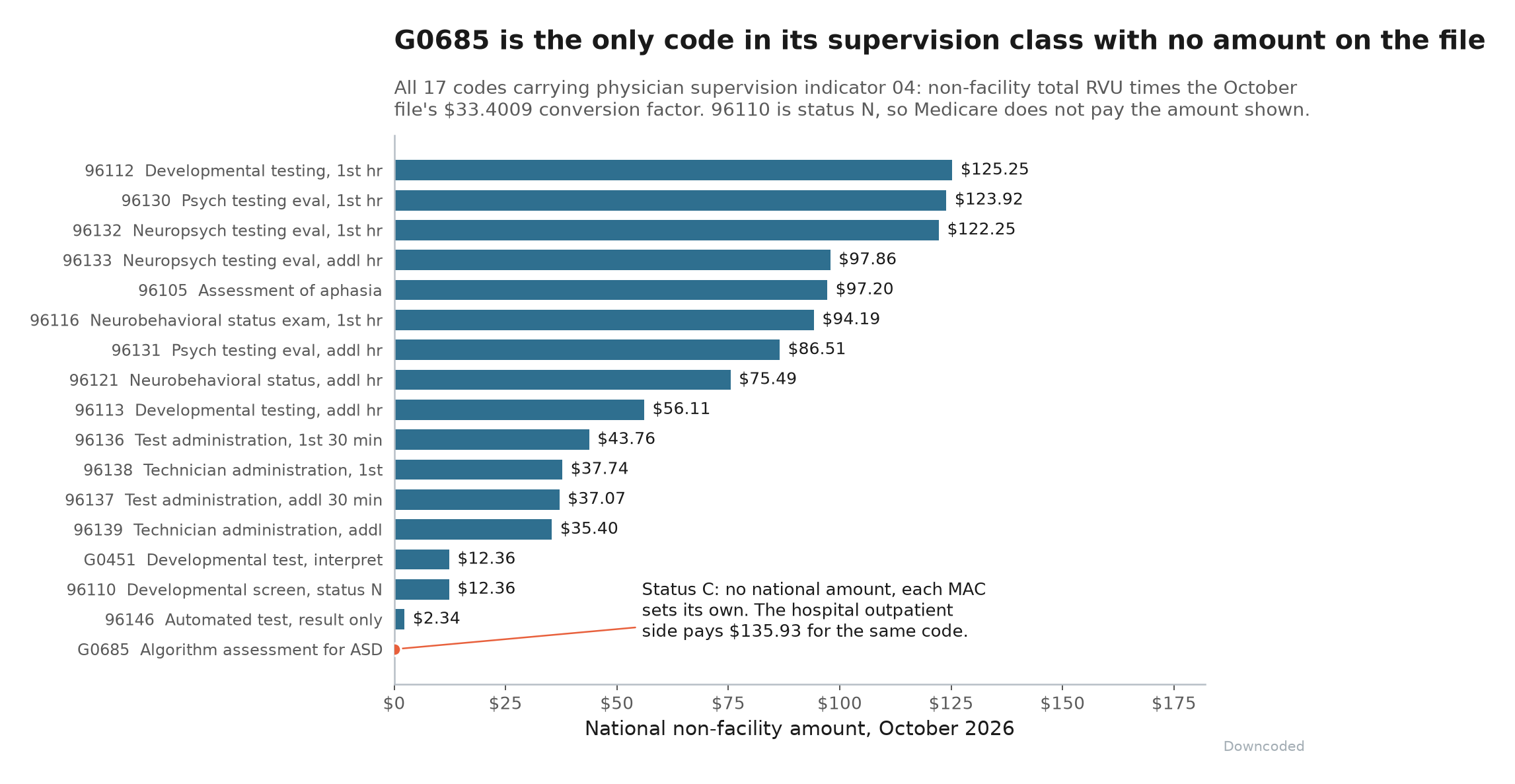
The physician fee schedule has a field most people never read: physician supervision of diagnostic procedures. G0685 carries indicator 04, which means supervision policy "does not apply when procedure is furnished by a qualified, independent psychologist or a clinical psychologist."
Exactly 17 codes out of 19,453 on the October file carry that indicator.
Fifteen are the developmental, psychological and neuropsychological testing family, 96105 through 96146. One is G0451.
The seventeenth is three days old.
So CMS put the algorithm in the room where the testing already happens, with the clinician who already does it.
What CMS did not do is price it. G0685 is status C, contractor priced: every RVU on its row is 0.00, and your MAC establishes the amount case by case on documentation.
Every other code in that supervision class carries an amount on the file, from $125.25 down to $2.34 (chart below).
The split is the practical part.
Run the assessment in a hospital outpatient department and the rate is published, $135.93, with the copayment already computed. Run it in the office and the number is whatever you and your contractor arrive at.
Final Thoughts
Almost no Medicare beneficiary is 16 months old, which is the easy objection to all of this and also the point.
A HCPCS Level II code travels further than Medicare. State Medicaid programs and commercial payers adjudicate against the same code set, and for a pediatric evaluation they are the whole market.
The company said in 2024 that Georgia Medicaid had already put EarliPoint in its medical policy, which it did with no national code to put on the claim.
Before June 2021 this category did not exist in the regulations. It now has an FDA product code, six authorizations, a seven-year age range, two JAMA papers and a national code number with an APC behind it.
The price is the last piece, and it is the piece that will be settled one contractor at a time.
Thanks for reading.