 Downcoded
How Many Vessels Did Medicare Think You Had?
CPT rebuilt lower-extremity revascularization around 46 codes in January. CMS capped every one of the add-ons at a single unit per day in April, and the October file raises all 24 of them without saying why.
CPT handed the vascular interventionalists 46 new codes on January 1. CMS put 44 of them on a ceiling of one unit per day in April and left them there through September.
The October 1 practitioner MUE table moves 24 of the 46. Every one of the 24 is an add-on code, and every one moves up.
The family, and the half of it that got capped
The 2026 restructure deleted 37220 through 37235 and replaced them with 37254 through 37299, sorted into four vascular territories: iliac, femoral/popliteal, tibial/peroneal, and inframalleolar, which got broken out on its own for the first time. Inside each territory, every treatment now splits "straightforward" for a stenosis and "complex" for an occlusion.
Pull the October PFS relative value file and the split is mechanical. 22 of the 46 carry a global indicator of 000. The other 24 carry ZZZ, the marker for an add-on: 22 of those are the "each additional vessel" half of a base pair, and the last two are the intravascular lithotripsy add-ons.
The whole family arrived at once. None of the 46 appear in the January 1, 2026 edition; all 46 are in the April 1 edition, and 44 landed at an MUE of 1 (the two lithotripsy codes came in at 2).
So from April 1 through September 30, the code you report for the second vessel you treated had a ceiling of one.
One appendix, three tibial arteries
The NCCI Policy Manual is direct about where an MUE value comes from. Anatomy is the first criterion it lists, and the example it uses is the appendix: the MUE for an appendectomy is 1 "since there is only 1 appendix."
Apply that criterion and the October values stop looking arbitrary. Every add-on in a territory moves to the same number, and that number is the territory's vessel count (chart above):
- Iliac, three vessels (common, external, internal): 1 to 3
- Femoral/popliteal, two (common femoral/profunda, superficial femoral/popliteal): 1 to 2
- Tibial/peroneal, three (anterior tibial, posterior tibial, peroneal): 1 to 3
- Inframalleolar, two (dorsalis pedis, plantar): 1 to 2
The lithotripsy add-ons follow the same logic, 2 to 4 on the iliac side and 2 to 3 on the femoral/popliteal.
Counting the base code, that leaves room for one vessel more than the territory has, which is the direction you want the error running.
Not one of the 22 base codes moves. All 22 are still at 1, which is right: you only treat a first vessel once.
What a ceiling of one actually cost
All 24 carry an MUE Adjudication Indicator of 3, before and after. That matters twice over.
An MAI of 3 makes this a date-of-service edit, and the manual is unambiguous about how those adjudicate: units for the code are summed across the claim, and "if the summed UOS exceed the MUE value, all UOS for the HCPCS/CPT code for that date of service are denied." Report two units against a ceiling of one and you are paid for neither.
Take 37295, the priciest of the 24 (tibial/peroneal, stent plus atherectomy, complex). It carries 11.27 facility total RVUs, which is $376.43 at the CY2026 non-qualifying conversion factor of $33.4009. A three-vessel tibial case reporting three units of it put $1,129.28 through an edit set at one, and lost all of it. The base code on the same claim, 37294 at $813.98, was never at risk.
The second thing an MAI of 3 does is leave the door open. A contractor with evidence that the units were provided, correctly coded and medically necessary "may bypass the MUE" at processing, reopening, redetermination or appeal.
So the denials from the last two quarters are appealable. They are also not going to appeal themselves.
A quarter with nothing moving down
Zoom out and October is strange on its own terms (chart below). 31 practitioner MUE values are revised, the most in any of the eleven quarterly editions since April 2024, against a median of 5.5 across the prior ten. The outpatient hospital table revises 32 and the DME table 3.
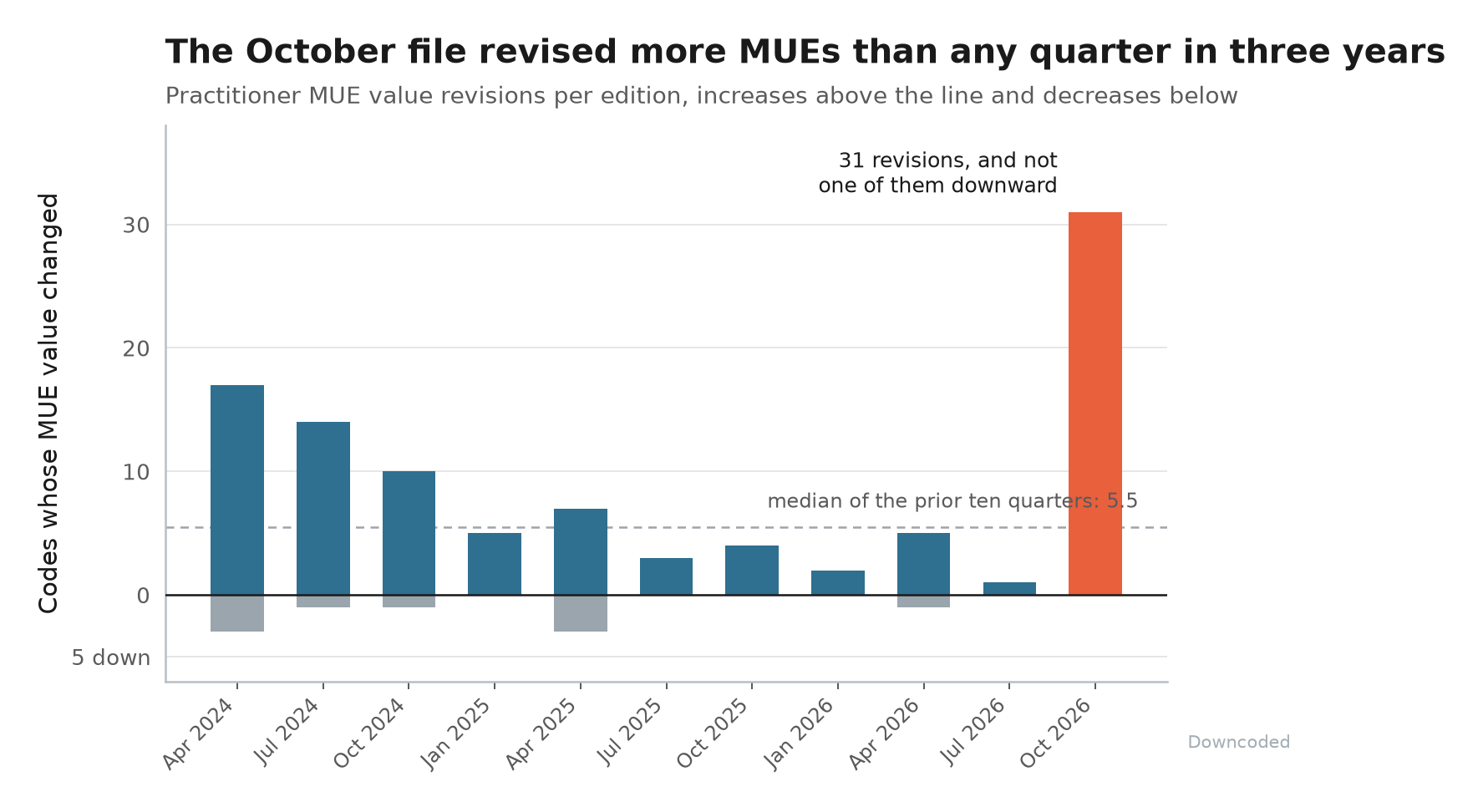
Across all 66 revisions in the three files, zero go down. Seven practitioner revisions sit outside the vascular family, four of them J-codes getting room: J7172 quadruples from 600 to 2400, J2326 goes 120 to 500, J9380 612 to 918.
Final Thoughts
None of this is a coverage decision, and the manual says so in as many words: an MUE "does not necessarily indicate coverage status," and the NCCI program "does not establish medical necessity or payment policy." Nobody at CMS decided that a patient has one tibial artery. A ceiling got set at the conservative end for a family with no claims history, and it took two quarterly cycles to walk back.
The tell is the rationale column. All 24 carry the same stated basis before and after, 23 of them "Nature of Service/Procedure." CMS changed the number without changing a character of the reason given for it.
The practical residue lands on your side. Six months of multi-vessel lower-extremity cases ran into a fully appealable edit, and the October file corrects it going forward without touching anything already denied. Worth pulling your 2026 denials on 37255 through 37299 now, because after October 1 the edit stops generating the evidence that the old one was wrong.
Thanks for reading.