 Downcoded
How to Read an OIG Audit That Has No Title
Sixty-six active HHS-OIG audits of Medicare carry no title at all, only their own project number. The narrative, the series and the already-published siblings tell you what each one is checking, and the biggest block of them is pointed at Part C diagnosis codes.
Pull the HHS-OIG Work Plan down as a spreadsheet instead of reading it in the browser, and the first thing you notice is how many entries have no name.
168 of the 277 active projects carry a title that is just their own file number. Project A-07-21-05134. Project A-02-22-01022. Row after row of them.
OIG explains it in one line on the browse page: "Some projects may have redacted titles until the work is complete and their reports are published."
That is true, and it is also the narrowest possible redaction.
The title is the only field they blank
Every one of the 168 still carries its full narrative, the paragraph describing exactly what the audit examines and which regulation it runs on. And 166 of the 168 sit inside a series whose name OIG publishes in the next column over.
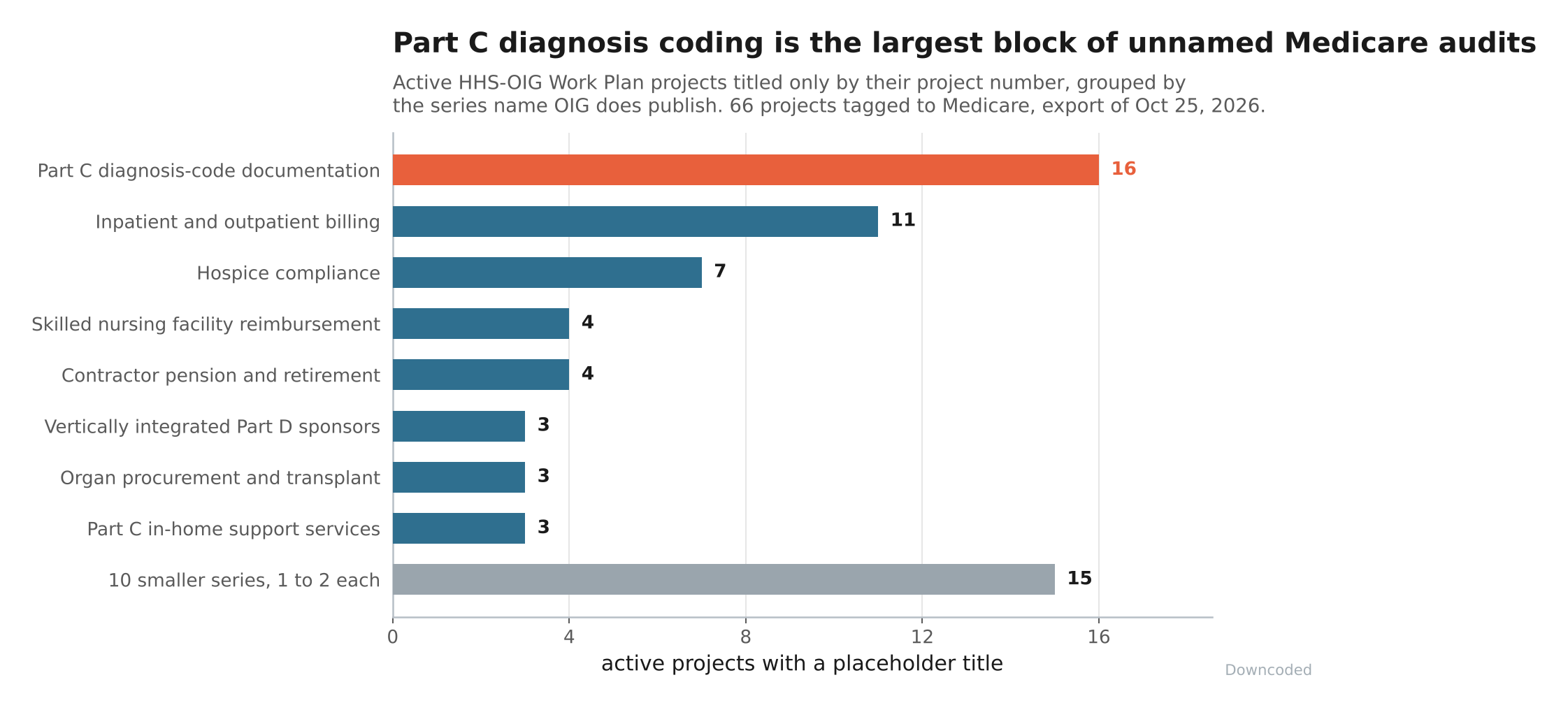
Of the 120 active projects tagged to Medicare Part A, B, C or D, 66 have the placeholder title. Sixty-five of those sixty-six sit inside a named series, so the unnamed Medicare pipeline still sorts by subject, on OIG's own labels (chart below).
What the placeholder is actually covering
The series with published siblings answer this directly.
Take Selected Inpatient and Outpatient Billing Requirements, announced September 2021. It holds 33 projects: 11 active, all 11 with placeholder titles, and 22 completed.
Twenty-one of those twenty-two completed titles are the name of a hospital. Lehigh Valley Hospital. Sarasota Memorial Hospital. The Ohio State University Hospital.
Same pattern in Review of Hospices' Compliance with Medicare Requirements, where 16 of the 17 completed projects open "Medicare Hospice Provider Compliance Audit" and then name the hospice: Ambercare, Tidewell, Franciscan, NW Hospice.
So the field being withheld is a provider's name, and it stays withheld until the report lands.
So read a placeholder row by its series. The narrative tells you the protocol, the completed siblings tell you what the deliverable looks like, and the announced date tells you how long the shop in question has been sitting in it.
The Part C block is the one to look at
Sixteen of the 66 unnamed Medicare projects are auditing whether a Medicare Advantage diagnosis code is supported by the record. They run under five separate series names, which is why the block reads smaller than it is:
Audits of Medicare Part C Unlinked Chart Review Diagnosis Codes(5)Audits of Medicare Part C Health Risk Assessment Diagnosis Codes(5)Medicare Advantage Health Risk Assessments, Continuity of Care(3)Medicare Part C Audits of Documentation Supporting Specific Diagnosis Codes(2)Nationwide Audits of Medicare Part C High-Risk Diagnosis Codes(1)
Across all of Part C, 21 of the 35 active projects have no title. The unlinked chart review narrative is specific about the mechanism: CMS lets an MA organization add diagnosis codes found in a chart review, and on an unlinked review "CMS does not require that the MA organization identify the specific date of service for previously unidentified diagnosis codes."
Four projects in those five series have finished and published, and three of them named the plan: HumanaChoice contract H5216, UnitedHealthcare of Wisconsin contract H5253, United Healthcare Benefits of Texas contract H0609.
The fourth is the nationwide one, and its title is the finding: $462 million potentially overpaid on unsupported acute stroke diagnosis codes.
Thirteen of the sixteen open ones sit in series that have never published anything.
One column to ignore
The export carries an Est FY field that reads like a schedule. Check it against the completed rows before you treat it as one.
613 of the 805 rows read 2027, and that includes 372 of the 396 completed projects. A column assigning the same year to work finished in 2019 and work announced last month will not tell you when anything arrives.
Final Thoughts
The oldest unnamed Medicare project on the list was announced on September 14, 2021. It sits in Audits of Medicare Emergency Department Evaluation and Management Services, a series holding exactly two projects, both still open, neither ever published.
Five years in, the subject of that audit still reads Project A-03-21-00004.
Work plans get read as forecasts. This one works better as an inventory: 66 open Medicare files, 65 of them already sorted into a named bucket, and one field held back until the report names the shop it was about.
Thanks for reading.