 Downcoded
How Two Device Makers Reversed a Proposed Medicare Denial
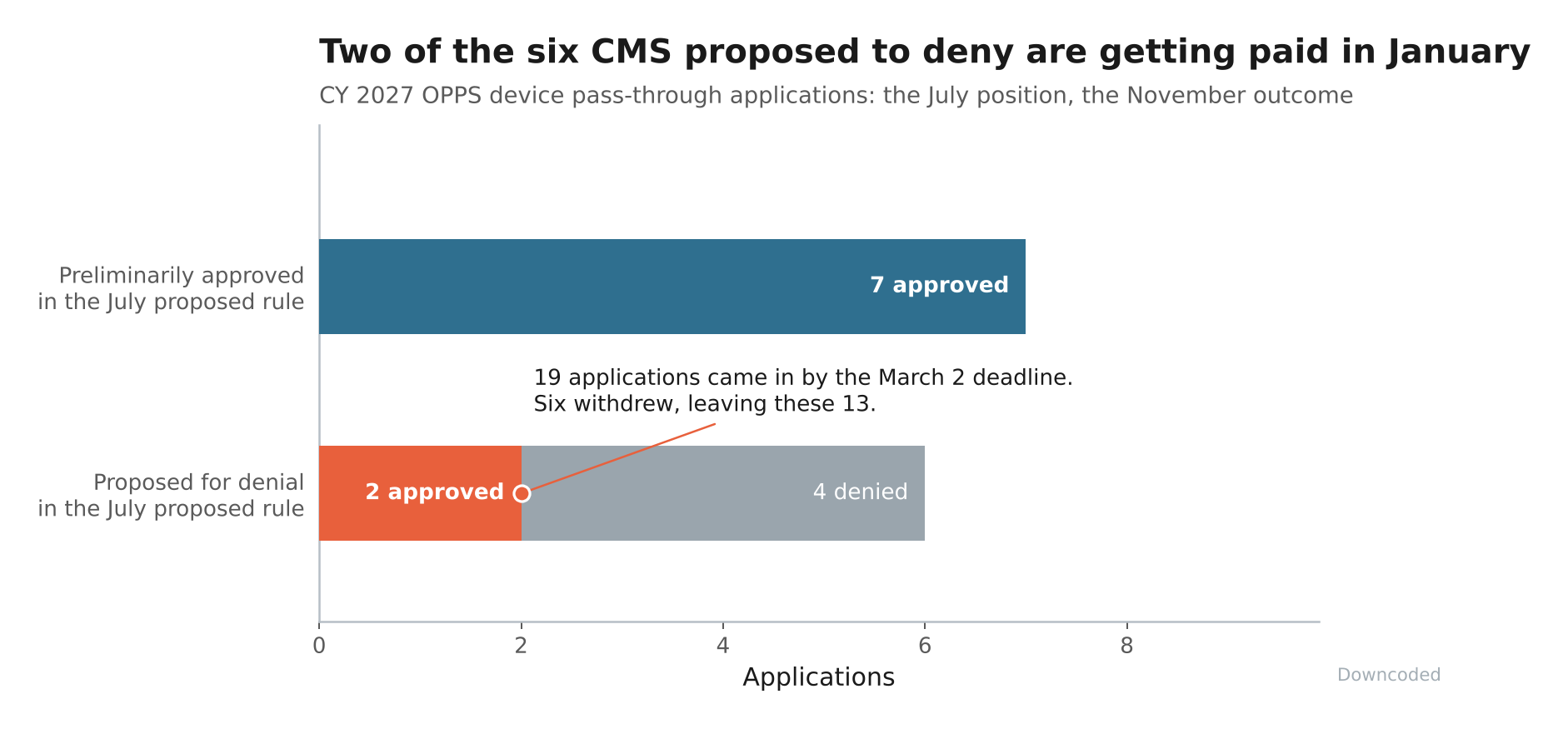
CMS proposed in July to deny pass-through payment to six devices in the CY 2027 outpatient rule. Friday's final rule approved two of them: Neuros Medical's Altius nerve stimulation system and restor3d's TIDAL fusion cage, both effective January 1. All nine approvals this cycle came in through the FDA Breakthrough pathway, and the traditional pathway went nothing for three.
In July, CMS put six devices in its outpatient proposed rule and said, in writing, that it intended to deny every one of them.
On Friday it approved two.
The CY 2027 OPPS final rule ran 479 pages and landed on page 70284 of the Federal Register, and the device pass-through section is the part nobody outside device reimbursement reads. It is worth reading this year.
The Two That Turned
CMS took in 19 complete applications for transitional device pass-through payment by the March 2 deadline, and six applicants withdrew.
That left 13 live for the final rule, and CMS had already split them in July: seven preliminarily approved through the quarterly review process, six marked for denial.
All seven preliminary approvals were finalized. Then CMS approved two of the six it had proposed to deny (chart below).
The first is the Altius Direct Electrical Nerve Stimulation System, from Neuros Medical, Inc. It is an implantable neuromodulation system for amputees, with cuff electrode leads wrapped circumferentially around the sciatic nerve, or around both the tibial and common peroneal nerves, in the amputated leg.
In July CMS said existing codes C1778 and C1822 may appropriately describe the generator and the leads, and that it was "unable to determine" the device category eligibility criterion was met.
Neuros came back on exactly that. Putting the Altius under legacy spinal cord and peripheral nerve stimulator codes, the company argued, "mischaracterizes the Altius System's physics, biology, and clinical reality": a high-amplitude alternating current generator producing a true peripheral nerve conduction block is not the same machine as a spinal cord generator pushing low-amplitude pulsed direct current into the epidural space, and a 360-degree cuff surgically wrapped around a nerve is not a percutaneous lead wire laid alongside tissue.
CMS reversed. The Altius is approved effective January 1, 2027.
The second is the TIDAL Fusion Cage System, marketed as Ossera AFX, from restor3d. A single continuous porous piece of titanium alloy with a circular window for an intramedullary nail, which CMS had proposed to slot under C1713, the anchor and screw category. The fight in the comments was over cost significance, and CMS's response is one sentence long: "we agree that the TIDAL Fusion Cage meets the cost significance criteria specified at Sec. 419.66(d)."
Same effective date. Same pathway.
The Badge All Nine Had
Here is the pattern worth taking away from the cycle. Every one of the nine approvals, the seven finalized and the two reversed, came in under the alternative pathway: an FDA Breakthrough Device designation plus marketing authorization for the indication the designation covers, which stands in for a showing of substantial clinical improvement.
The other seven:
- MY01 Continuous Compartmental Pressure Monitor, MY01 Inc.
- RemeOs Screw LAG Solid, Bioretec, Inc.
- WiSE CRT System, EBR Systems, Inc.
- SetPoint System, SetPoint Medical
- TOUCH CMC 1 Prosthesis, Medartis
- Esprit BTK Everolimus Eluting Resorbable Scaffold System, Abbott Laboratories
- TOPS System, Premia Spine, Inc.
Ten of the 13 applications CMS reviewed came through that alternative pathway, and nine of them cleared.
Three came through the traditional route, where an applicant builds the substantial clinical improvement case itself out of the literature. Those three went zero for three.
What the Status Actually Buys
Pass-through is a temporary payment lane, and the temporariness is statutory. Section 1833(t)(6)(B)(iii) caps a device category at not less than two years and not more than three, and 42 CFR 419.66 is where the mechanics live.
The clock starts on the first date pass-through payment is actually made under the OPPS for any device in the category, and CMS expires categories quarterly specifically to get each one as close to a full three years as it can. When the window closes, the device cost gets packaged into the procedures it is reported with, using the claims data those same three years generated.
So the real prize is the three years of separately identifiable claims data, because that data sets the rate the device lives on once the lane closes.
If you code outpatient cases in orthopedics, vascular, cardiac rhythm management, or hand surgery, the practical note is narrow. Each of the nine applied for a new device category and each got one, so there are new category codes to load ahead of January 1.
CMS calculates the device offset at the HCPCS and CPT code level, which is the line where your procedure code and your device code meet.
Final Thoughts
Two reversals out of six is a small number, and we would not call a two-for-six rate a reason to expect anything. The comment file is still the only lever an applicant has after a proposed denial posts, and twice this cycle it moved CMS off a position it had already written down.
The next window is open now. Applications filed for the quarters beginning June 1, September 1 and December 1 of 2026, and through March 1, 2027, get discussed in the CY 2028 proposed rule, and CMS went out of its way to say the quarterly process did not change when rulemaking review was bolted onto it.
Comments on Friday's rule close January 4, 2027, three days after the nine start getting paid.
Thanks for reading.