 Downcoded
How Your JW Modifier Becomes a Manufacturer's Invoice
Medicare billed drug manufacturers $173 million for discarded Part B drug, and the arithmetic runs entirely off JW units sitting on provider claims. Payment on the newest report is due December 31.
The JW modifier has been mandatory on Part B drug claims since January 2017, and for six of those years it did nothing except document the obvious. You billed the administered units on one line, the discarded units on a JW line, and Medicare paid you for both.
Since January 2023 that second line has been doing something else. It has been generating an invoice to the drug's manufacturer.
"Who actually pays for the drug that goes in the sharps container?"
CMS has now published two annual refund reports under the Discarded Drug Program. The first, covering the four CY2023 new refund quarters and sent to manufacturers in December 2024, came to $139,062,042.89 across 42 billing and payment codes. The second, covering the CY2023 updated quarters plus the CY2024 new quarters and sent in September 2025, came to $173,061,020.81 across 52 codes.
Those two periods are not like for like, so the 24.4% between them is not a growth rate. The code count is the cleaner signal, and it went up by ten.
The Formula Starts On Your Claim Line
Section 90004 of the Infrastructure Investment and Jobs Act added the refund to section 1847A of the Act, and CMS wrote the mechanics into 42 CFR 414.940. The calculation CMS showed manufacturers in its August webinar is short enough to read in one breath:
(JW units on claims data x ASP-based payment limit) - (applicable percentage x estimated total allowed charges)
The applicable percentage is the threshold, statutorily at least 10% of total charges for the drug in a calendar quarter. Everything above it comes back from the manufacturer. CMS has raised it by rulemaking for a handful of circumstances: 35% for hydrogel-reconstituted drugs with variable dosing, 90% for a low-volume dose in 0.1 mL or less, 45% for 0.11 to 0.4 mL, and 26% for designated orphan drugs reaching fewer than 100 beneficiaries a year.
Read the left-hand term again. The quantity CMS multiplies by the payment limit is JW units on claims data. Yours.
There is no separate survey, no manufacturer self-report of wastage, no audit sample. The entire measurement instrument is the modifier your charge capture puts on the line, which is also why JZ exists: since July 2023 it has attested that nothing was discarded, turning the absence of a JW line from an ambiguity into a statement.
Where the Money Actually Sits
The refund is concentrated to a degree that makes the program easy to ignore or impossible to, depending on your chargemaster (chart below).
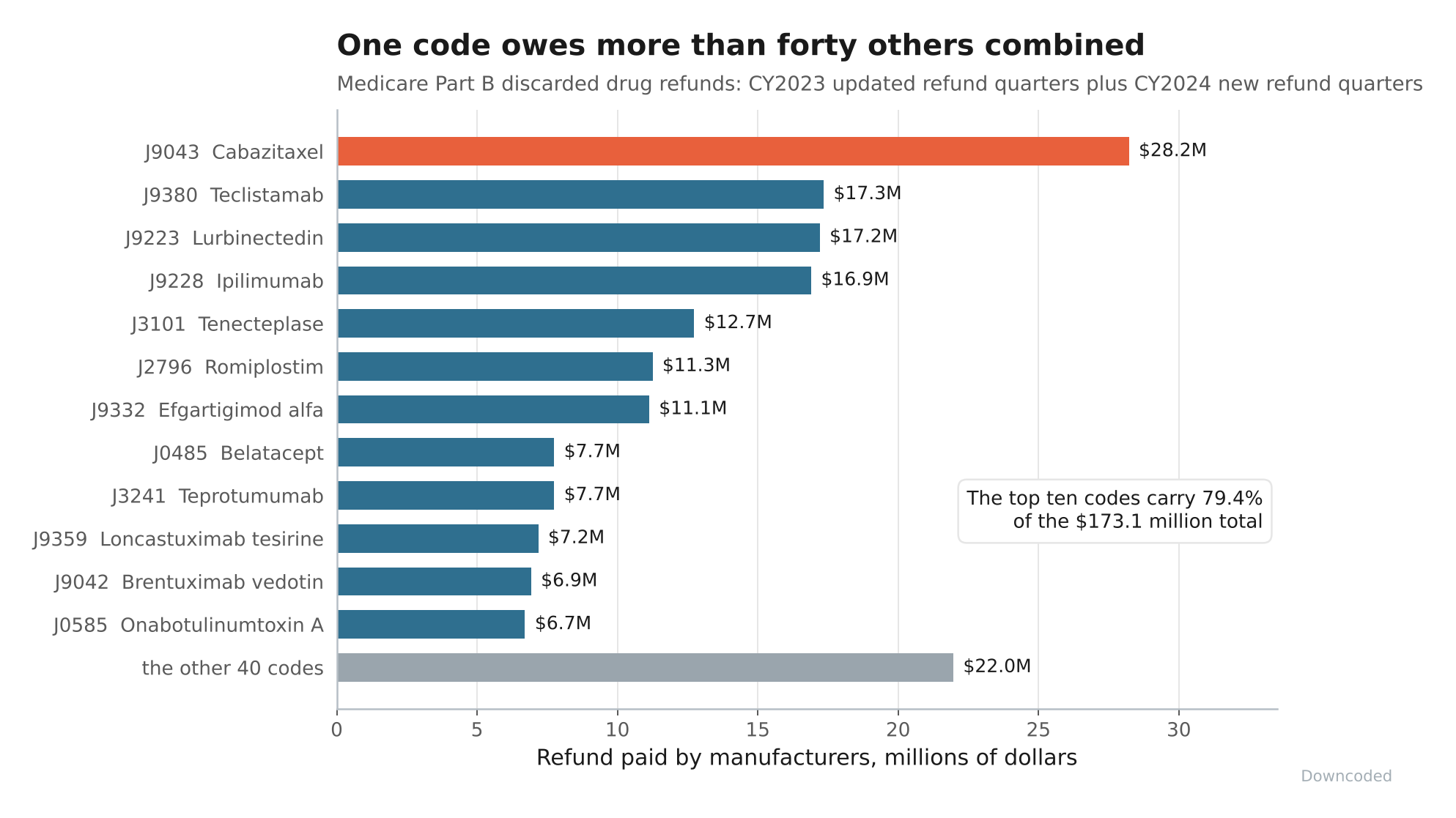
J9043, cabazitaxel, owes $28,220,040.28 by itself. That is more than the forty codes outside the top twelve put together, which come to $21,966,679.37. The top ten carry 79.4% of the whole $173.1 million. Twenty-six of the fifty-two codes owe under $100,000 each, and all twenty-six together are 0.21% of the total.
So the program is really a story about a dozen oncology and specialty-infusion codes.
J9380 teclistamab arrived at $17,347,970.14 without appearing in the first report at all, and J9332 efgartigimod went from $3.9M to $11.1M. Going the other way, J9264 paclitaxel protein-bound particles fell 70.1%, from $13,964,619.06 to $4,170,320.02.
Those swings are what a threshold does to drugs whose vial sizes sit near it.
Why a Drug That Wasted 9.85% Still Owes
Here is the catch worth internalizing. The threshold is quarterly, and the published discard rates are annual.
In CY2023 Medicare's allowed amount for discarded J0585 onabotulinumtoxinA was $44,334,307.19 against $450,298,990.14 total, a discarded share of 9.85%. Under the floor. The manufacturers still paid $1,538,243.80 for those same four quarters, because at least one quarter cleared 10% on its own.
The codes well clear of the line are not subtle about it. Cabazitaxel discarded 30.95% of its CY2023 allowed amount, tenecteplase 33.15%, loncastuximab tesirine 31.92%, teclistamab 23.39%.
Across all of Part B, CMS's own CY2023 file puts the allowed amount for discarded drug at $935,077,488.32 out of $52.66 billion, or 1.78%. Manufacturers sent back $139 million of it, roughly 15 cents on the dollar, and the rest stayed where Medicare put it.
Final Thoughts
The third report went out through the Manufacturer Payment Portal on September 1, 2026, covering the four CY2025 quarters and any updated CY2024 amounts. The dispute window closed October 1. Payment is due December 31, 2026, or thirty days after a dispute resolves, and a manufacturer that skips it owes a civil money penalty of 125% of the assessed obligation on top. The public version of that table usually lands on the CMS page a few months after the money does, so the CY2025 numbers are not readable yet.
None of this is a provider obligation, and nobody is going to send you a letter about it. What it is, is a federal collection program whose only input is the accuracy of a modifier your staff applies hundreds of times a week, on exactly the drug codes where a single vial is worth four figures.
You get paid for the discarded units either way. Somebody downstream is getting billed for them on the strength of your claim line, and that has been true for almost four years.
Thanks for reading.