 Downcoded
Iowa Committed All $209 Million of Its Rural Award
CMS has spent the last 58 days publishing what the $50 billion rural program is actually buying, one state at a time: 38 press releases, 30 states, $2.42 billion named. Iowa is the only state CMS says has committed its entire first-year award. The newest release put $78 million directly on the books of 216 rural Texas providers.
Iowa's first-year share of the federal rural health money is $209,040,064.
Last Friday CMS said Iowa has committed all of it.
That sentence is doing more work than it looks like.
The Rural Health Transformation Program is $50 billion over five years, $10 billion a year from 2026 through 2030, and every state got an award in December. What no state had to publish was a line-item account of where its share went.
So CMS has been publishing it for them, one state at a time, since the middle of August.
What Iowa Put It On
Iowa runs its share through an initiative it calls Healthy Hometowns, and the October 9 release names what the money bought rather than the categories it fits into.
Robotic-assisted orthopedic surgery capability in rural hospitals. The state's first Maternal-Fetal Medicine Telehealth Network. Cancer prevention and screening, EMS and mobile health, rural workforce development, and health information exchange tools connecting more than 100 facilities.
The detail worth stealing for your own board deck is the implementation line: seven major medical equipment installations supporting 44 advanced procedures, already done.
That is a state in the first year of a five-year award reporting installed equipment and a procedure count, which is a different kind of disclosure than a press release about a funding opportunity.
What the Other Twenty-Nine Named
We read every card on the CMS newsroom index this week and pulled the ones carrying the program's name. Five are program-level.
The other 38 are state releases, and they start on August 19 with South Dakota and Pennsylvania on the same day and run through Texas yesterday.
Thirty-eight releases, 30 states, 58 days.
Add up every dollar figure in them and you get $2,416,680,000, which is 24.2% of the money available this fiscal year. The individual pieces run from $1 million in North Dakota to Iowa's $209 million, and seven states have had more than one release (North Carolina has had three).
Set each state's named total against the award it actually holds and the spread is the whole picture (chart below). Iowa sits at 100%, and Alabama, with two releases, sits at 98%.
Texas, holding the largest award in the country at $281,319,361, has had $129 million of it named across two releases.
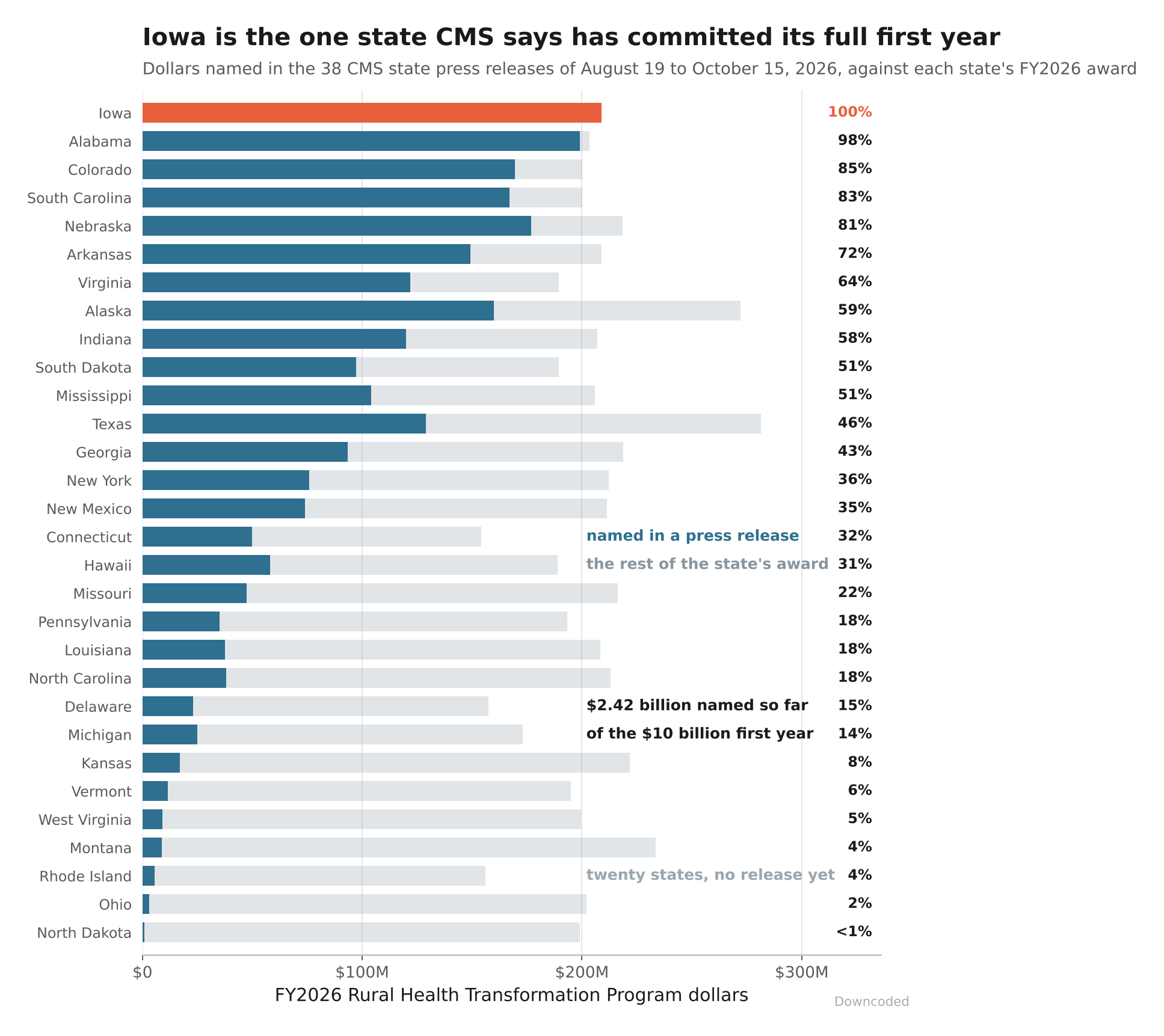
Twenty states have had no state release at all yet.
The Part That Reaches a Provider
Yesterday's Texas release is the one to read if you want to know what this looks like at the receiving end.
$78 million through an initiative called Rural Texas Strong, and CMS says it goes "directly to 216 rural healthcare providers" for chronic disease prevention, workforce recruitment and retention, and medical equipment and facility upgrades. That is a named count of recipients, which is rare in a federal announcement of this size.
Delaware's October 14 release is the smallest piece in the set and the most specific about terms: two educational awards to medical students and an expected 61 housing and relocation awards in graduate medical education, with recipients committing to five years of practice in rural Delaware and at least 50% of that practice in qualified rural areas.
Ohio's $3.15 million is aimed at one integration problem: connecting independent pharmacies, retail pharmacies, FQHCs and outpatient hospital pharmacies across the state's 73 rural counties, so prescription drug monitoring data actually lands in the EHR and the dispensing system.
Three states, three completely different shapes of money. Equipment, a workforce contract, and an interface.
Final Thoughts
The useful thing here is that an itemization exists at all, and that it is free and public while it accumulates. States do not reapply each year, so the FY2026 pattern is the best read anyone has on where the next $40 billion is pointed.
If you sit on the finance side of a rural hospital, a critical access facility, or a group with rural sites, the practical move is to find your state's release, see whether your initiative name is in it, and note that this money arrives as a state subgrant rather than as a rate change. It gets booked differently, it gets reported differently, and nothing about it shows up in a fee schedule.
Iowa is the first state to have the whole year accounted for in public. Twenty-nine states are partway there, and twenty have not started.
Thanks for reading.