 Downcoded
Lafayette, Louisiana Is the Capital of Medicare's Dementia Model
CMS refreshed its Innovation Center participant roster on November 2. The GUIDE dementia model now carries 286 rows across 45 states, and the state with the most of them is Louisiana, ahead of California and Florida. Twenty-eight of Louisiana's thirty-three are Curana Health, filed one legal entity per state from a single Lafayette address, and the July fact-sheet revision added two dementia codes that exist only for the kind of patient Curana sees.
CMS rebuilt its Innovation Center participant roster yesterday. The file that came out carries 286 rows for the GUIDE dementia model, spread across 45 states.
The state sitting at the top of that count is Louisiana, with 33.
California has 28. Florida has 26.
Louisiana outranks both of them, and the reason is one company in Lafayette (chart below).
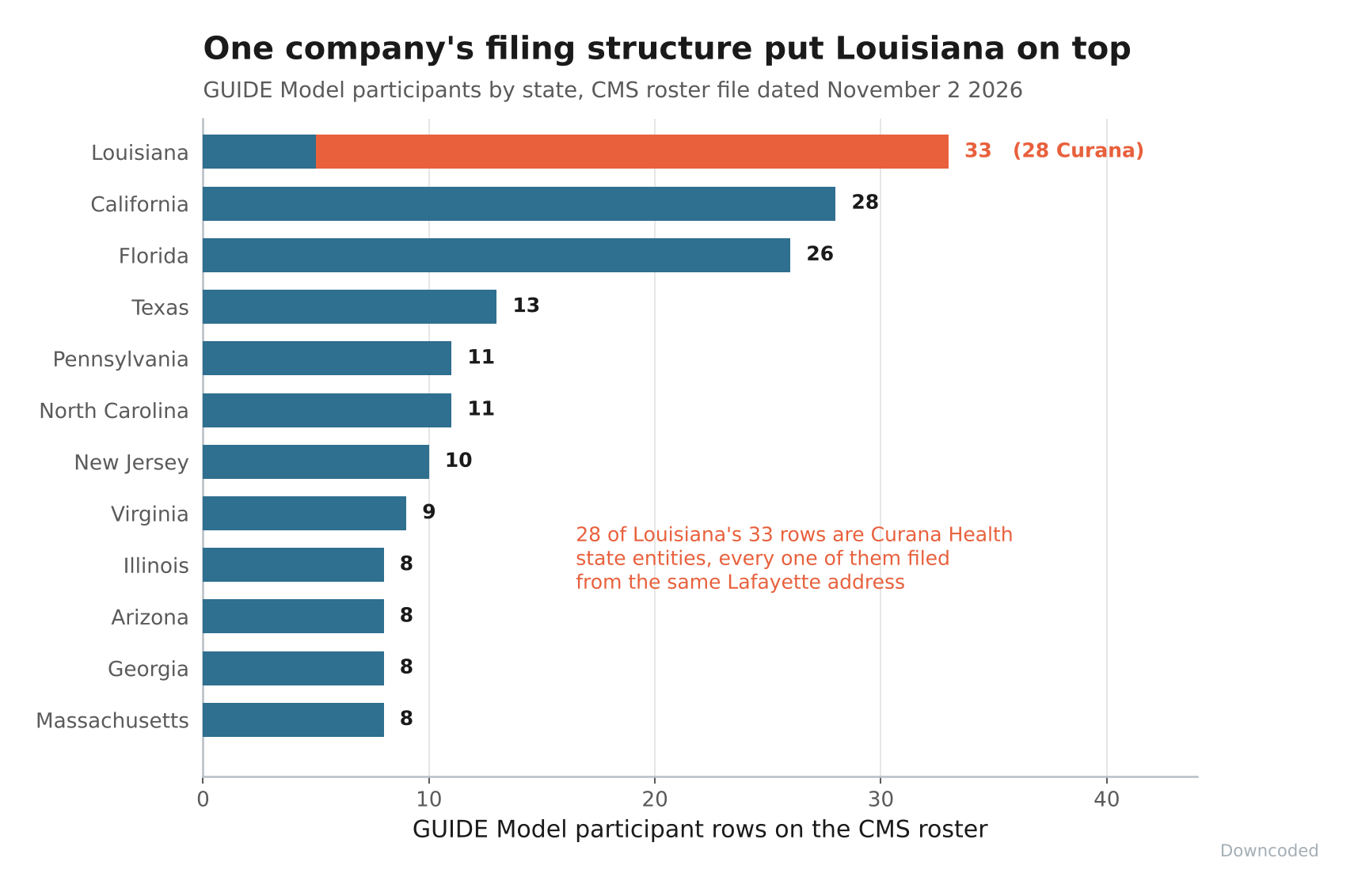
28 of Louisiana's 33 rows are Curana Health. Curana Health of Alabama, LLC. Curana Health of Arizona, LLC. Curana Health of Mississippi, LLC. Twenty-eight separate legal entities, naming twenty-seven states between them, every one of them listed at the same Lafayette street address with the same website and the same note in the file: "Currently providing GUIDE services."
Who Is Actually Behind Those Rows
Curana is a value-based primary care group built for people who live in senior housing. Its own description of the business is skilled nursing facilities, assisted and independent living communities, and memory care settings, which is a narrower place to stand than it sounds.
CMS selected it for GUIDE in July 2024, in a cohort the company described at the time as "almost 400 participants." Curana took the New Program Track, which meant a pre-implementation year and a first billable service date of July 1, 2025.
Its medical group went in approved to operate in 28 states.
That approval is what the roster is showing you. One professional entity per state, because that is how a multi-state medical group gets licensed and enrolled, and the roster prints the entities rather than the parent.
Counted that way, Curana is 9.8 percent of every GUIDE participant row in the country. The next largest family on the roster, the sixteen rows sharing Harmonic Health's website, is not close.
And the fit was there before the model was. Chris Dawe, who runs the medical group, put the number in the 2024 announcement: more than 50 percent of the seniors Curana serves carry a confirmed dementia diagnosis.
A company whose patients are half dementia patients walked into the dementia model with the widest footprint anyone built.
Medicare Just Wrote Two Codes for the Building
Here is the part worth your attention if you bill anything in senior housing.
GUIDE pays a monthly dementia care management payment, one per calendar month per patient, and the code you submit depends on a model tier CMS assigns from your comprehensive assessment. The July 2026 revision of the fact sheet took that code set to 12 G-codes and changed what feeds the tier. The inputs now read: patient-caregiver pair or not, dementia severity, caregiver burden, first six months or established, and the patient's residence type.
Two of the twelve are new, and they are the ones that follow the address:
G0574andG0575, the low complexity dyad tier for patients residing in residential care communities, new patient and established patient.
That is a payment tier defined by where someone sleeps. It sits alongside the six codes for patients with a caregiver (G0519 through G0521, then G0524 through G0526) and the four for patients without one (G0522, G0523, G0527, G0528).
Respite rides separately on G0529 through G0531, by the four-hour unit at home, the day at an adult day center, and the twenty-four-hour unit facility-based. The annual cap for PY 2026 is $2,625 per patient, up from the $2,500 that still shows on Curana's own consumer page and on the CMS model page.
What the Roster Is Really Telling You
Two things you can use.
- Read CMMI rosters as entity lists. State columns on these files record where a legal entity was filed, and a national group with per-state PLLCs will pile up in whatever state its corporate counsel used. Louisiana looks like the densest dementia-care market in America. Strip the Curana entities out and it has five participants.
- The dollar math lives off the base rate. DCMP base rates get a population and income adjustment and a performance-based adjustment starting in each track's second performance year, then a PFS geographic adjustment factor keyed to the service facility ZIP code on the claim. CMS's own charge-amount guidance notes a base rate can land +75 percent above where it started. If you are modeling this line, the tier gets you the code and the geography gets you the money.
CMS's model page still reports 292 participants while the roster we pulled carries 286 GUIDE rows.
Both numbers count entities. The gap between an entity and a company is the whole story of this file.
Final Thoughts
GUIDE runs eight years from July 1, 2024, which makes it one of the longer-dated things in the Innovation Center portfolio and one of the few that pays a clean per-member-per-month for care coordination rather than asking you to beat a benchmark. The companies that got large in it early did so by already being where the patients are.
Curana was already in 1,600 senior living sites with a thousand clinicians when the model opened. Everything else was paperwork, twenty-eight times.
Thanks for reading.