 Downcoded
Louisiana Orders Home Ventilators Seven Times as Often as Utah
E0466 is the fifth largest DMEPOS code in Medicare and the most expensive per patient of the top five, at $9,923 a year. The rental rate barely moves across the country. The ordering rate moves 7.6x, and on October 28 every one of those orders needs a face-to-face encounter on file.
Medicare paid for a home ventilator on behalf of 58,889 people in CY2024, and it spent $584,369,968 doing it.
That works out to $9,923 per patient per year, which makes E0466 the fifth largest DMEPOS code in the program and the most expensive per head of the five.
The four codes above it are continuous glucose monitor supplies, intermittent catheters, alginate dressings and oxygen concentrators. Oxygen runs $827 a patient.
E0466 runs twelve times that.
So a code carrying just under a million dollars for every hundred patients is worth knowing the shape of. We pulled the CY2024 DMEPOS file by referring provider geography and looked at where the orders come from.
Same rental rate, different patients
The money per patient is flat. Across the 51 jurisdictions the allowed dollars per E0466 beneficiary run from $7,269 in the District of Columbia to $10,965 in Wyoming, and the average allowed per monthly rental service is $1,147.39 in Louisiana against $1,209.56 in Utah.
Same fee schedule, same rental math, no real spread.
The ordering rate is a different story.
Measured against each state's own oxygen concentrator population, which is the largest home-respiratory base in the same file and the cleanest denominator it offers, Louisiana refers 15.25 E0466 patients for every 100 oxygen patients. Utah refers 2.00.
That is a 7.6x gap between the top and the bottom of the country, on a code where the price is fixed (chart below).
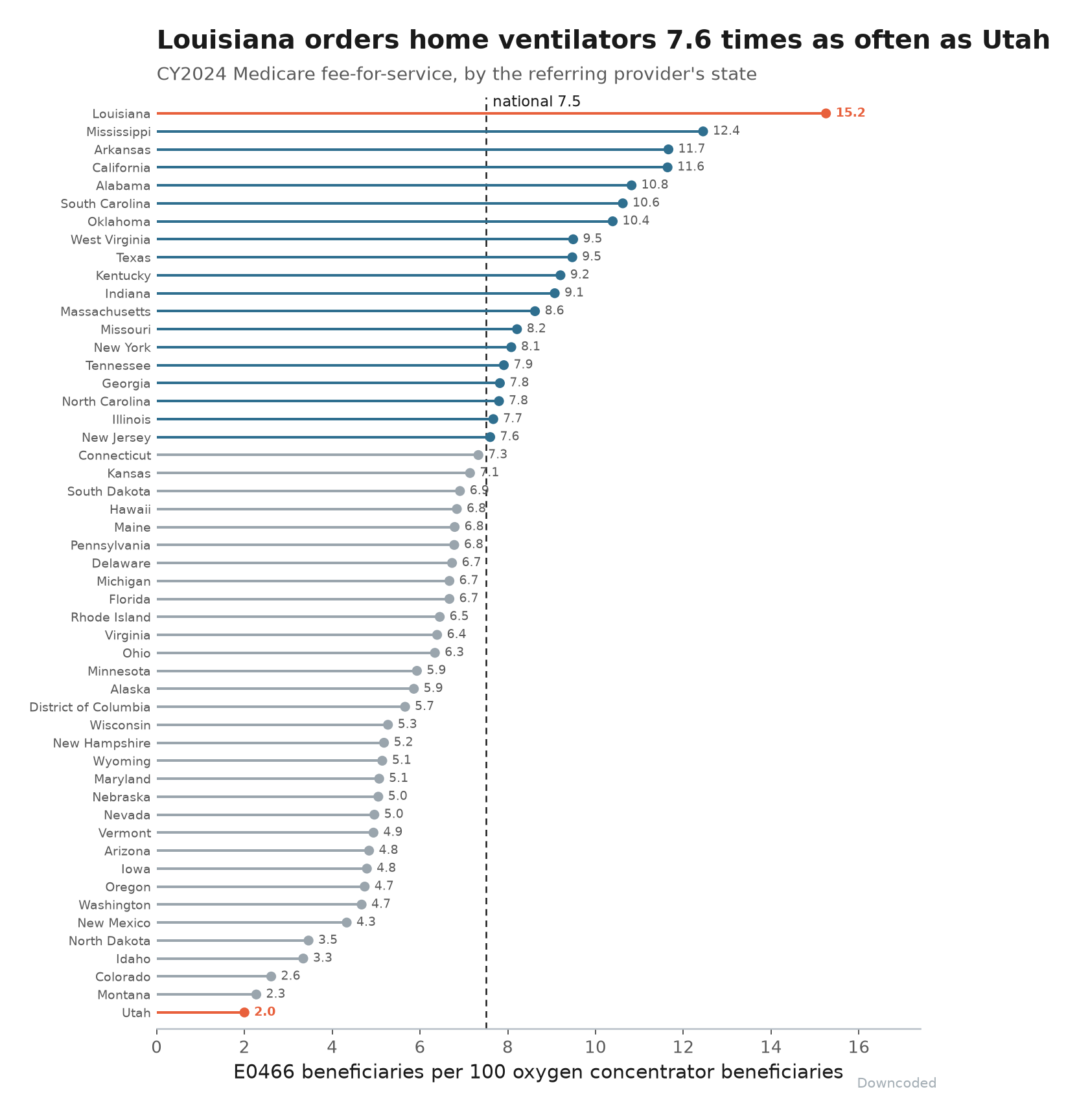
The national rate is 7.51 per 100 and the median jurisdiction sits at 6.73, so the distribution is not a bell curve with two odd tails. It is a block of nineteen jurisdictions at or above the national rate, clustered heavily in the Deep South and the lower Mississippi Valley, and a long fade down through the Mountain West.
California is the one that should stop you. At 11.64 it sits fourth in the country on rate, and because it is California it is also first in dollars at $62.2 million.
Texas is second at $49.0 million and a rate of 9.47. The five largest states by E0466 spend carry a third of the code.
Worth saying plainly: none of this is a claim that anyone is ordering wrong. The file has no diagnosis, no severity, no Medicare Advantage penetration, and any of those could move a fee-for-service ratio on their own.
What it establishes is that CMS can see the same spread we can, on a rental code with 28,040 referring providers behind it and only 2,620 suppliers billing it.
What lands on October 28
CMS put E0466 on the Face-to-Face Encounter and Written Order Prior to Delivery list in a July 30 notice, along with E0467 and E0468, the two multi-function ventilator codes with 1,337 and 31 beneficiaries between them. Twenty-two codes were added, bringing the list to 105.
The agency said why, in its own words: lumbar-sacral orthoses, lower limb orthoses, upper limb orthoses, ventilators, oxygen and hospital beds "were identified by CMS' Comprehensive Error Rate Testing (CERT) program as being within the top 20 DMEPOS service types with improper payments in 2025."
Implementation is October 28, 2026. Seven weeks.
From that date a face-to-face encounter and a written order have to exist before delivery, as a condition of payment, on a code that costs Medicare more per patient than any of the four bigger DMEPOS lines above it. We ran the retention side of this notice on August 30, and the short version is that the record has to survive seven years under 42 CFR 424.516(f), not the length of the rental.
Final Thoughts
The useful read here is what CMS chose to do about the spread. It picked a documentation control rather than a payment control, on a category its own error testing already flagged, and set the clock for the end of October.
If your referring physicians sit anywhere in that top block, the exposure is arithmetic. Nine thousand nine hundred dollars a patient, a paper requirement that starts mid-quarter, and a file at CMS that already knows how many of these you order relative to everyone else.
Thanks for reading.