 Downcoded
Medical Necessity Was Never the Question
OIG pulled 100 denial files at Oregon's largest Medicaid plan and 21 of them failed on process alone. It never sent a single request out for medical review, and the most common defect was that the wrong person made the call.
A provider in Oregon asked a Medicaid plan to approve ultrasound-guided neck injections. The request arrived with medical records and a letter noting that two other physicians had already evaluated the patient and found the injections medically necessary, as a step toward deciding whether surgery made sense.
The plan's subcontractor said no. The person who said no was a registered nurse, and the stated reason was that the service was not covered.
That denial was improper, and nobody had to disagree about the neck to establish it.
HHS-OIG posted the audit today, five days after issuing it. Of 100 randomly sampled prior authorization denials at Health Share of Oregon, the state's largest coordinated care organization, 21 failed at least one federal or state requirement governing how a denial gets made and delivered. Scaled to the 27,032 denials Health Share issued in 2023, that comes to 5,677 requests, inside a 90 percent confidence interval running from 3,930 to 7,785.
"Was the denial even valid, before anyone argues about whether it was right?"
Nobody Reviewed the Medicine
Worth being exact about what OIG did here. It did not send a single sampled request out for medical review.
Medical necessity was never the question.
What it checked was the administration of the denial: who decided, what the notice said, when it went out, and who got told. Five requirements, and the failures pile up on the first one (chart below).
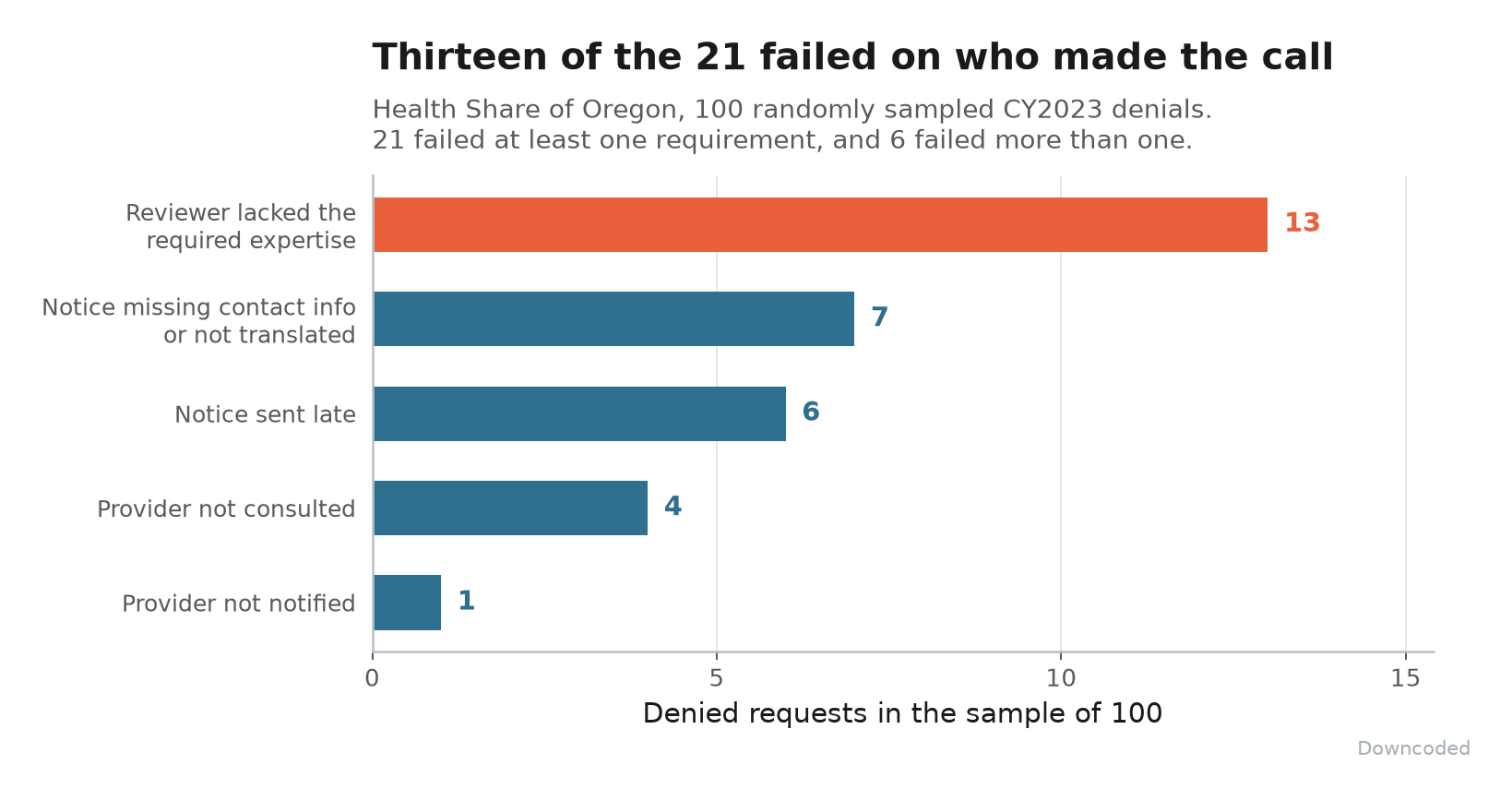
Thirteen of the 21 improper denials failed because the decision came from someone without the expertise the rule requires. 42 CFR 438.210(b)(3) requires that any decision to deny, or to authorize less than what was asked for, be made by an individual with appropriate expertise in the enrollee's medical, behavioral health, or long-term services and supports needs. Oregon says the same thing in its own language at OAR 410-141-3835(10)(f)(B).
Health Share agrees with all of this, for what it's worth. Its stated policy is that RNs may issue administrative denials, the kind that turn on whether the person was enrolled at all, and may not make clinical denial decisions.
The neck injection call was clinical, made by an RN, at a subcontractor.
The other four defects are the ones your office can see from the outside. Seven notices went out missing the plan's contact information or not translated for an enrollee with a recorded non-English language preference. Six went out late. Four denials were issued without anyone contacting the requesting provider first, which the same regulation tells plans to do when appropriate. One provider was never told the denial had happened.
Twenty-one denials, 31 separate defects. Six of them broke more than one rule at once.
The Plan Didn't Make These Decisions
Health Share took in roughly $3.1 billion in capitation covering more than 400,000 enrollees during the audit year. It also, in OIG's phrasing, fully delegated prior authorization decisions to its subcontractors, which is five primary care networks and five dental care organizations.
So the reviewer who denied the injection did not work for the entity whose name was on the notice.
Health Share did run quarterly reviews of a sample of its subcontractors' denial files. OIG's finding on those reviews is short and does most of the work in the report: they were not effective at detecting the problems. The plan had not told its subcontractors which credentials a reviewer needs, some subcontractors had no process for routing requests to a medical director, and turnover ran high through the year.
That is the shape of the exposure in delegated utilization management.
The contract obligation sits with the plan. The reviewer works for the subcontractor.
Final Thoughts
This is the sixth plan-level audit in OIG's Medicaid MCO denial series and the third since March. Louisiana Healthcare Connections came in at 12 of 76 sampled denials in March, Pennsylvania's Community Behavioral Health at 100 of 100 in June, Health Share at 21 of 100 today. The three older ones (Keystone First in 2022, Amerigroup Iowa and New York's Centers Plan for Healthy Living in 2023) drew judgmental samples rather than random ones, so don't line all six up as a rate. Read them instead as the reason OIG kept going.
None of these audits ordered a single denial reversed, and none of them says a defective notice is a winnable appeal. What they establish is that a real share of Medicaid managed care denials would not survive a look at the file on grounds that have nothing to do with clinical judgment, and that the plans themselves were not catching it.
You hold the same file they sampled. The notice either names a reviewer with clinical credentials or it doesn't, landed inside the timeframe or it didn't, and either followed a call to your office or arrived cold.
Thanks for reading.