 Downcoded
Medicare's DME Front Door Reopens Thursday
The nationwide moratorium on new medical supply company enrollments hits its six-month mark on August 27, and CMS has published no extension. The revocation file shows what the screens that come back are actually good at catching.
CMS first reached for its enrollment moratorium authority on July 31, 2013, against new home health agencies in Miami-Dade and Cook Counties and Part B ambulance suppliers around Harris County. It then renewed that moratorium every six months for five and a half years, widened the home health piece to four whole states, and finally let it lapse on January 30, 2019.
Six months is the only clock the authority has. Another one runs out Thursday.
The nationwide moratorium on Medicare enrollment of DMEPOS medical supply companies took effect February 27, 2026 (91 FR 9855). Under 42 CFR 424.570(b) it "remains in effect for 6 months," and CMS can keep it alive only in six-month increments that it has to announce in the Federal Register.
As of Monday morning no extension notice is published, and none is sitting on public inspection.
What Actually Comes Back On
The moratorium covers the seven medical supply company specialties, from the plain one through the versions with orthotics, pedorthic, prosthetics, prosthetic and orthotic, registered pharmacist and respiratory therapist personnel. It reaches initial applications and non-exempt changes in majority ownership under 42 CFR 424.551, and nothing else.
Existing suppliers kept billing the whole time. So the footprint is small by design.
CMS counted more than 6,000 enrolled medical supply companies as of October 2025, 7.5% of the roughly 80,000 DMEPOS suppliers in the program, and put normal new-enrollment volume at about 600 a year, or 300 over a six-month window. That is the number the moratorium has been holding back since February: roughly three hundred applications.
CMS built the case on program integrity. Across 2023 through late October 2025 the medical supply company specialties ran a 17% revocation rate, which the notice calls "nearly triple the rate for other DMEPOS supplier types." All seven landed in the top 20 of more than 80 DMEPOS specialties by share revoked at least once since 2023. Six of the seven made the top 10 for law enforcement referrals.
Here's the catch on what happens if Thursday passes quietly. The notice promises that once a moratorium lifts, the affected supplier types get assigned the "high" screening level under 42 CFR 424.518(c)(3)(iii) for six months. Read 424.518(c)(1)(ii) and prospective DMEPOS suppliers are already designated high categorical risk, permanently. The screening that switches back on is the screening that was running before February.
What the Back Door Is Good At
That screening does produce removals, and the composition of them is the tell. We pulled CMS's Revoked Medicare Providers and Suppliers extract, the file of enrollments currently sitting under a re-enrollment bar, and split its 8,136 records into the medical supply company family (605 of them, covering all seven moratorium specialties) and everyone else (chart below).
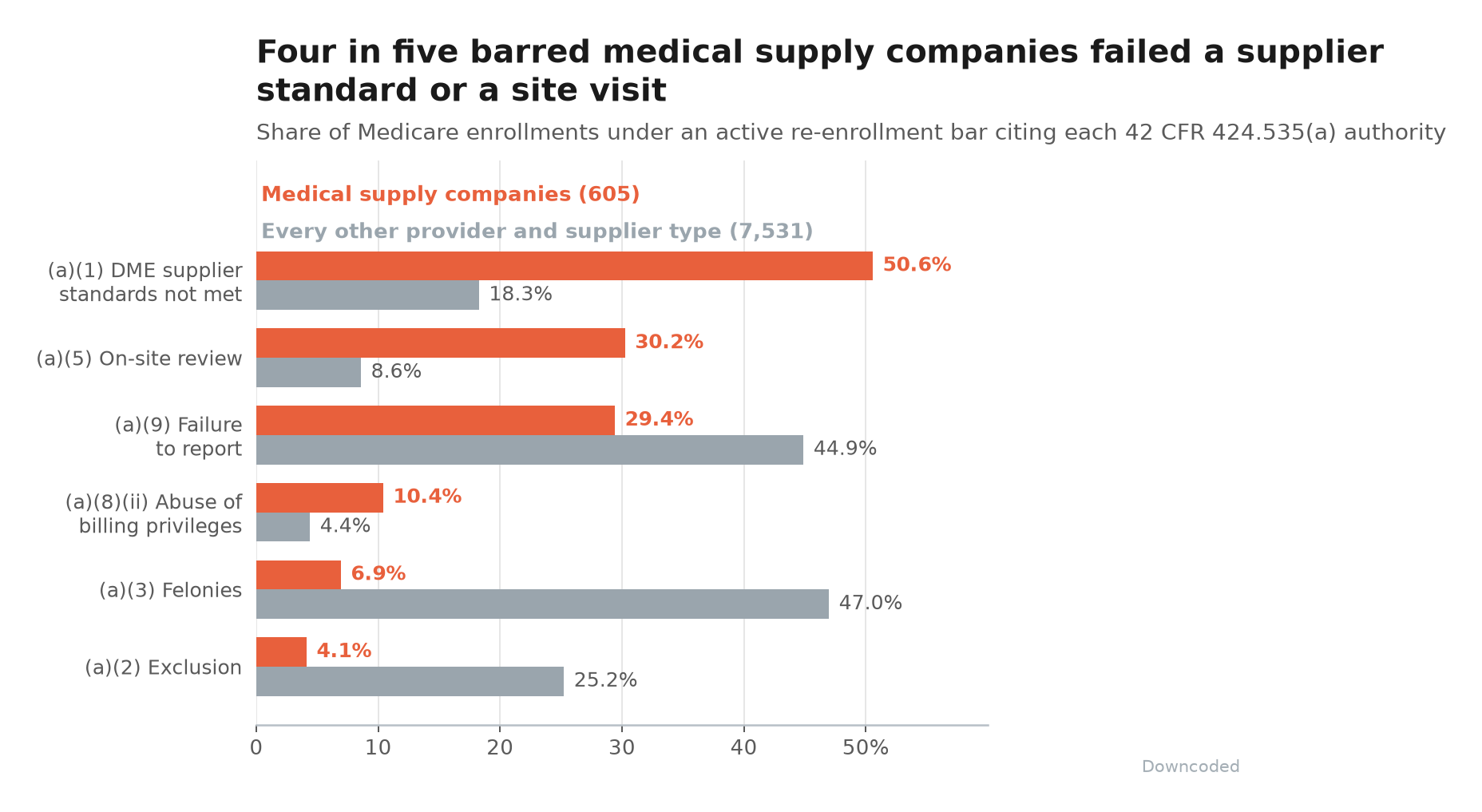
80.7% of the barred medical supply companies cite 42 CFR 424.535(a)(1) noncompliance with DMEPOS supplier standards, (a)(5) a failed on-site review, or both. For every other provider and supplier type in the file, that figure is 26.9%. Run it the other way and the contrast holds: felonies under (a)(3) appear on 47.0% of everyone else's bars and 6.9% of the medical supply companies', and OIG exclusion under (a)(2) on 25.2% against 4.1%.
Medicare removes these suppliers through the enrollment machinery. The storefront failed inspection, the standards weren't met, the paperwork didn't hold.
Which is precisely where HHS-OIG aimed its August 20 white paper (OEI-02-24-00311), whose first call to action is "block fraud at the front door." Site inspections check whether a supplier posts its hours and answers a working business phone, and their timing "can be predictable, allowing bad actors to temporarily stage their facilities to appear compliant." The $50,000 surety bond most DMEPOS suppliers carry typically costs about $1,500. Straw owners defeat the fingerprint checks. Paper applications skip the identity checks that the online system requires. Suppliers that bill only Medicare Advantage never enroll at all, so none of it touches them.
Final Thoughts
None of this is an argument that a moratorium is the right instrument. It is a blunt one, it stops the roughly three hundred applicants who would have enrolled this half-year, the honest ones included, and CMS has been careful to frame it as breathing room "while it considers further safeguards."
The question is what fills the space when the breathing room ends. If Thursday comes and goes with no notice in the Federal Register, the answer is the pre-February status quo: high-risk screening, a $1,500 bond, and an on-site visit a supplier can see coming. Watch the Federal Register this week. If you contract with DMEPOS suppliers, or you are one, the second clock is already running behind this one, because the home health and hospice moratorium implemented May 13 hits its own six-month mark in November.
Thanks for reading.