 Downcoded
Medicare Has Been Gold Carding Since 2020
The hospital outpatient prior authorization program has carried an exemption since the day it opened. Ten requests, a 90 percent affirmation rate on initial submissions, and the MAC stops asking, permanently, with nothing to apply for. 257 outpatient departments held it in FY2024, your MAC is calculating the next cycle's rate this month, and the opt-out closes November 30.
Medicare requires prior authorization on 51 codes in your hospital outpatient department, across eight service categories, as a condition of payment.
It also has a published, automatic way to stop asking you for them.
Ten requests and a 90% provisional affirmation rate during the annual assessment, and the exemption "would remain in effect until CMS elects to withdraw the exemption," in the operational guide's own words. There is no application, no portal, and no renewal to file.
Your MAC is running that assessment right now. The guide gives it a window of October 1 through October 31.
What the Bar Actually Is
The criteria have been identical in every document CMS has published since the program opened in July 2020:
- At least 10 requests submitted during the assessment year. Fewer than ten and you are not evaluated.
- At least 90% provisionally affirmed, measured across all eight service categories combined rather than per category.
- At least 60 days' notice before an exemption, or a withdrawal of one, takes effect.
Here is the part that decides it, and it is one word in the guide's October line: MACs calculate the affirmation rate of initial PARs.
You can resubmit a non-affirmed request "as many times as necessary to achieve an affirmation decision," and that second pass pays the claim. It does not move your rate.
So the hospital that gets to 90% is the one whose first submission is already complete, and a department that leans on resubmission to get paid can run a perfectly healthy approval record and never qualify.
257 hospital outpatient departments were over the bar in fiscal 2024 (chart below). That is the newest figure CMS has published, out of a program that took in 422,435 requests that year.
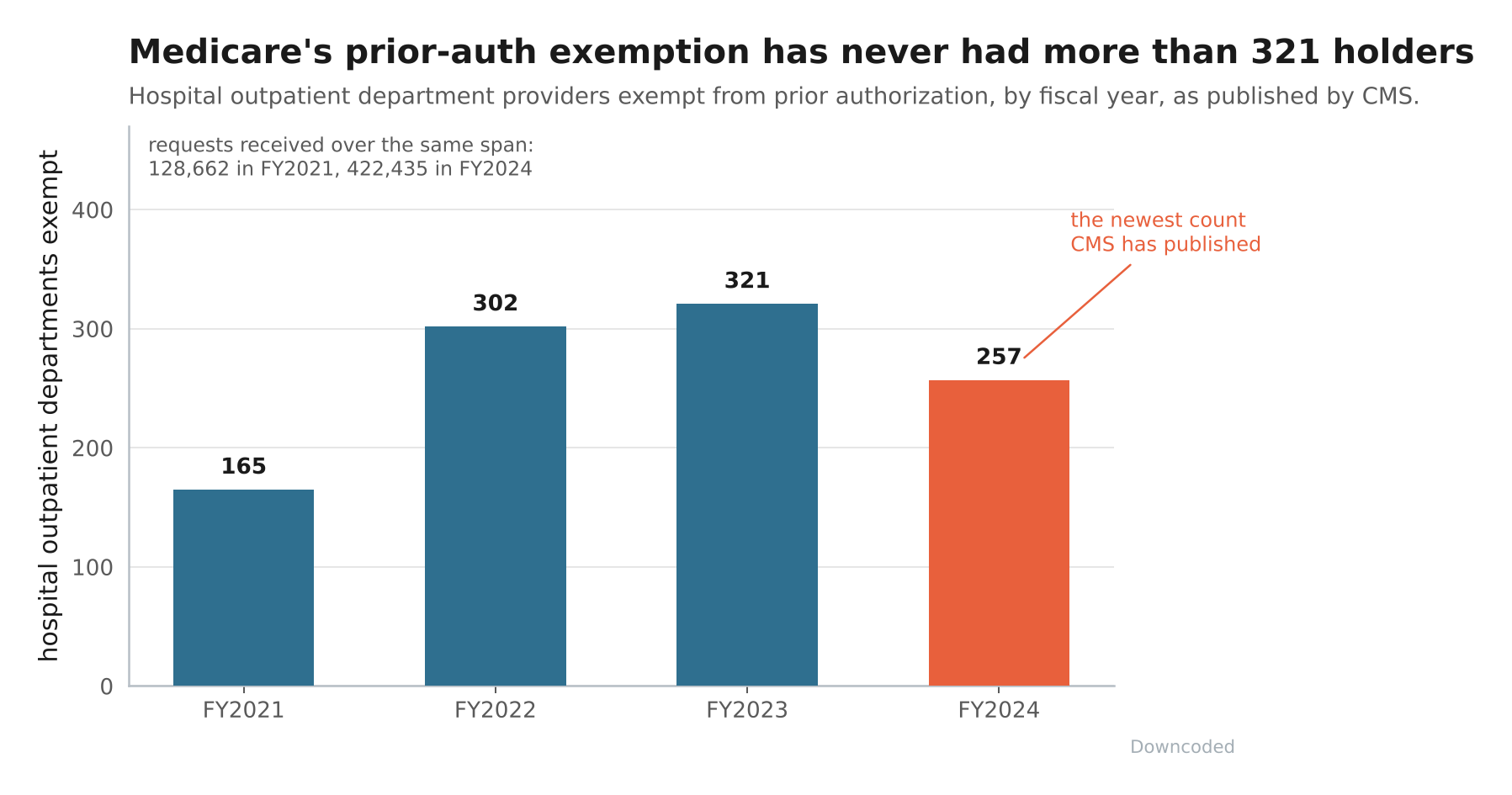
The count has moved in both directions: 165 in FY2021, 302 in FY2022, 321 in FY2023, then 257. Facet joint interventions joined the list in July 2023 and roughly tripled the program's volume, which brought in a large set of departments submitting their first requests and holding a first-pass record to match.
Program-wide, 79.2% of completed requests came back affirmed in FY2024, the same share as FY2021, with a dip to 73.9% in FY2023. The exemption bar sits about ten points above that, per provider, on first submissions only.
The Rest of the Calendar
The guide's timeline, rewritten with 2026 dates in its March 2 revision, runs like this:
- October 1 to October 31. MACs compute affirmation rates for non-exempt providers and notify everyone at 90% or better.
- October 1 to November 30. The opt-out window. A request to decline the exemption goes to your MAC, and late submissions are rejected.
- November 2. Providers already exempt get a Notice of Continued Exemption or a Notice of Withdrawal of Exemption, decided on a ten-claim postpayment sample pulled on August 1.
- December 18. Anyone who lost the exemption can start submitting PARs again ahead of the new cycle.
- January 1, 2027. The cycle begins. Exempt providers should not submit requests, and a PAR that arrives from an exempt provider is rejected outright.
That August 1 sample has a floor of its own. An exempt department needs at least ten claims submitted and paid by June 30 to stay in, and the MAC withdraws the exemption from anyone below it.
An exemption can lapse on volume alone, with every sampled claim clean.
Both sides of the review get 45 days: 45 for you to produce the documentation, 45 for the MAC to finish after it arrives.
Why You Might Say No
The opt-out exists because the exemption trades one kind of certainty for another.
An affirmed PAR is a provisional assurance of payment before the patient is on the table. Give that up and the service goes out on your own read of the LCD, with the review moving to a postpayment ADR that arrives up to a year later against claims you have already banked.
For a department running elective, high-dollar, documentation-heavy work, a seven-calendar-day answer in advance is worth more than the paperwork it costs. CMS cut that clock from ten business days for requests submitted on or after January 1, 2025.
The appeal numbers say something about which way most departments lean. Of the FY2024 claims that got appealed to level one, 18.4% were overturned, and CMS names one most common reason for that: documentation that was not provided during the initial review.
Final Thoughts
The 90% figure is not unique to outpatient departments. Home health agencies in the Review Choice Demonstration stay under claim review "until they reach the 90 percent target affirmation or claim approval rate," after which they can be relieved of everything except spot checks.
Medicare has settled on a number and uses it as the price of being left alone.
What makes the outpatient version worth a calendar entry is that the whole thing is published: the threshold, the measurement window, the notice period, the opt-out deadline, and a holder count that CMS prints once a year. There are 257 hospitals whose first-pass documentation was good enough, and nothing about how they got there is secret.
The clock on the next cycle has about two and a half weeks left on it.
Thanks for reading.