 Downcoded
Medicare Has Five Prices for an Hour of Your Time
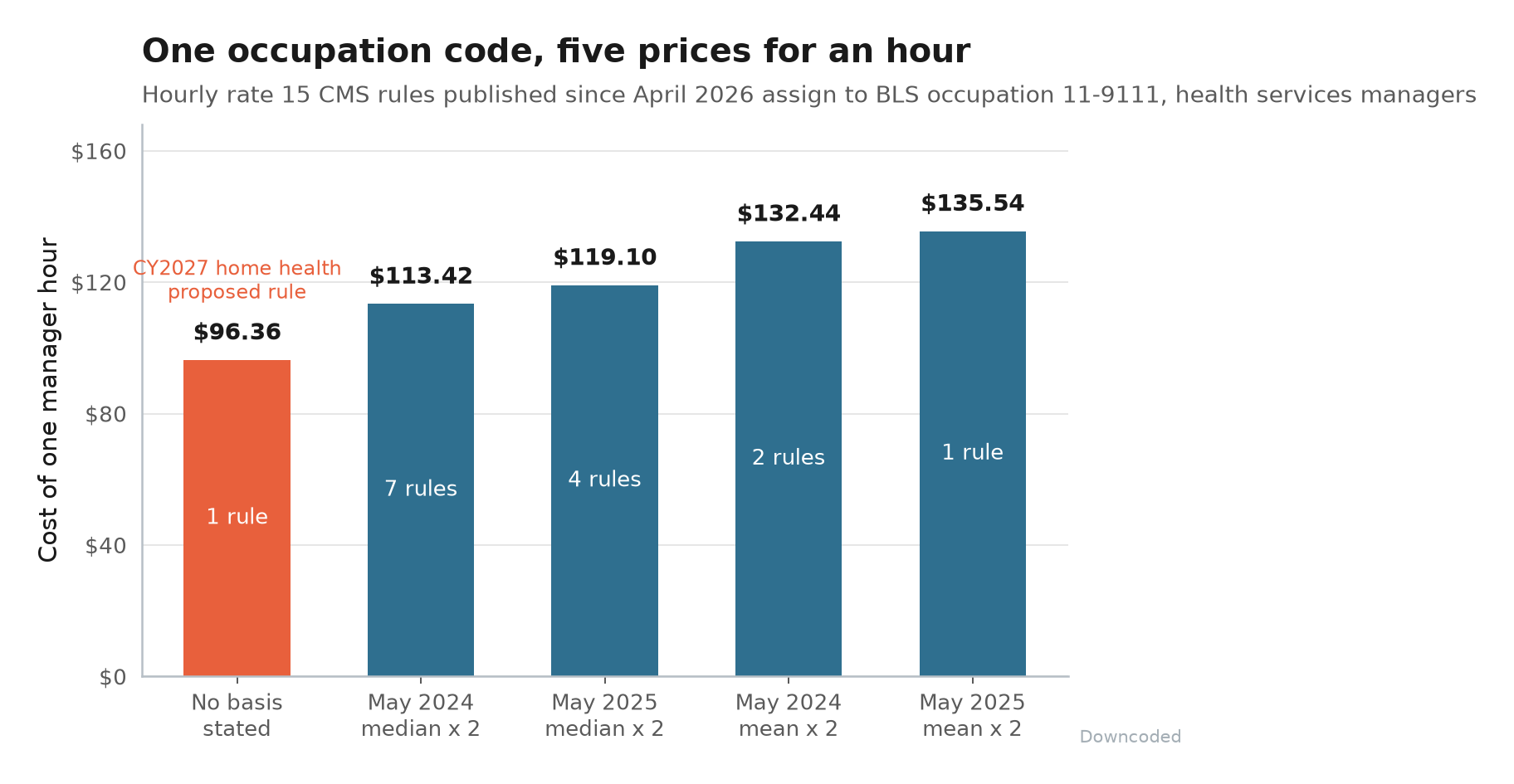
Fifteen CMS rules published since April all price a manager hour off the same BLS occupation code, 11-9111. They land on five different numbers, from $96.36 to $135.54, and four of the five are exactly the four cells of a two-by-two: May 2024 or May 2025, mean or median.
Near the end of every CMS payment rule sits a short paragraph almost nobody reads: the agency's estimate of what it cost you to read the rule.
The method never changes. Pick an occupation, pull a wage off the Bureau of Labor Statistics site, double it for benefits and overhead, guess how many people will bother, multiply.
Fifteen rules published since April all pick the same occupation. 11-9111, medical and health services managers.
Same code, same BLS page, same doubling convention.
They land on five different hourly rates (chart below).
Where Four of the Five Come From
BLS publishes a mean and a median hourly wage for every occupation and refreshes both each spring.
For 11-9111 the May 2024 median was $56.71 and the mean $66.22. For May 2025, $59.55 and $67.77.
Double each and you have four of CMS's five rates exactly:
- $113.42, the May 2024 median, in seven rules including both halves of the FY2027 IPPS cycle, the CY2027 physician fee schedule proposal and the FY2027 hospice final rule.
- $119.10, the May 2025 median, in the ESRD, OPPS, SNF and IRF rules.
- $132.44, the May 2024 mean, in the contract year 2027 MA and Part D final rule and the Medicaid indirect hold harmless proposal.
- $135.54, the May 2025 mean, in the FY2027 inpatient psychiatric facility final rule, the only one in the set that says out loud it used the mean.
So the price of an hour of your attention turns on two coin flips inside the agency: which vintage of the survey the drafting team happened to open, and whether they took the middle of the distribution or the average of it.
The SNF and IRF final rules, issued three days apart, agree. The SNF and IPF final rules, issued the same day, are $16.44 an hour apart.
Then there is the fifth.
The One Nobody Can Source
The CY2027 home health proposed rule cites code 11-9111, links the same BLS page, calls the figure a median, and arrives at $96.36 an hour.
No survey year. No derivation.
Halve it and you get $48.18, which is neither BLS figure in either of the two vintages the rest of the set is drawing on.
It runs 15% under the next-lowest rate in the set and 29% under the highest. Comments on that rule close August 31.
Why Anyone Should Care About a Footnote
The regulatory review estimate is the one place a rule puts a dollar sign on your staff's time, and the arithmetic around it gets sloppy in ways worth seeing.
The FY2027 SNF final rule states the per-reviewer figure as "$476.44 (4 hours x $119.10)", then computes the total as "$36,206 ($453.68 x 76 reviewers)".
$453.68 is four hours at $113.42, last year's rate, sitting inside this year's multiplication. The total follows the new rate, and the multiplicand printed next to it follows the old one.
The reviewer counts are looser still.
The IRF final rule assumes one reader per facility and gets 1,178. The SNF final rule, published three days earlier, counts last year's commenters and gets 76.
Two final rules, two post-acute settings, and a fifteenfold gap in who CMS thinks is paying attention.
"What is an hour of a revenue-cycle manager's time worth to CMS?"
Depends which rule you ask. The answer moves 40.7% across the range.
Final Thoughts
Most of these rules ask for comment on exactly this. "We welcome any comments on the approach in estimating the number of entities which will review this proposed rule" appears verbatim in the OPPS, home health and IPPS proposals, and the ESRD rule says it solicits comment on the approach.
That is an open invitation with dates on it. ESRD closes August 24, home health and OPPS August 31, the physician fee schedule September 14, the Medicaid hold harmless proposal September 21.
None of this moves a payment rate. It does tell you something about the machinery you argue with: when you write a comment saying a new reporting requirement costs more than CMS estimated, you are arguing against a number the agency has published five versions of this year.
Cite whichever one sits closest to your case. All five are already in the Federal Register under CMS's own name.
Thanks for reading.