 Downcoded
Medicare Pays More to Read the Scan Than to Take It
Four Category III codes for automated coronary plaque analysis carried zero RVUs last year, because contractors priced them one claim at a time. On January 1 they became a single Category I code, 75577, worth 30.30 RVUs and $1,012.05, more than three times the CCTA it runs on. Five of the eight contractors that write local coverage already cover it, four of them from the same day, and not one of the five wrote the policy on its own initiative.
A coronary CT angiogram pays $325.66.
The software that reads it afterward pays $1,012.05.
Both numbers come off the same CY2026 fee schedule file. The second one has been there since January, and the four codes it replaced priced at nothing at all.
The Four Codes That Priced at Nothing
Automated quantification and characterization of coronary plaque used to run on four Category III codes, 0623T through 0626T. Pull the CY2025 indicator file and all four come back carrying procedure status C.
CMS defines that status in one sentence: "A/B MACs (B) price the code. A/B MACs (B) will establish RVUs and payment amounts for these services, generally on an individual case basis following review of documentation such as an operative report."
Work RVU 0.00. Total RVU 0.00.
Four codes, four rows, a zero on every one.
Nobody was refusing to pay. CMS simply published no number, which in practice means every claim is an argument and nobody downstream can forecast a dollar of it.
On January 1 the four codes left the file and 75577 arrived in their place with status A: "Active code. These codes are separately paid under the physician fee schedule if covered. There will be RVUs and payment amounts for codes with this status."
And there are. 0.85 work RVUs, 30.30 total, split 29.06 technical and 1.24 professional.
At the CY2026 non-qualifying-APM conversion factor of 33.4009, that is $1,012.05 global, $970.63 on the technical side and $41.42 for the physician read (chart below).
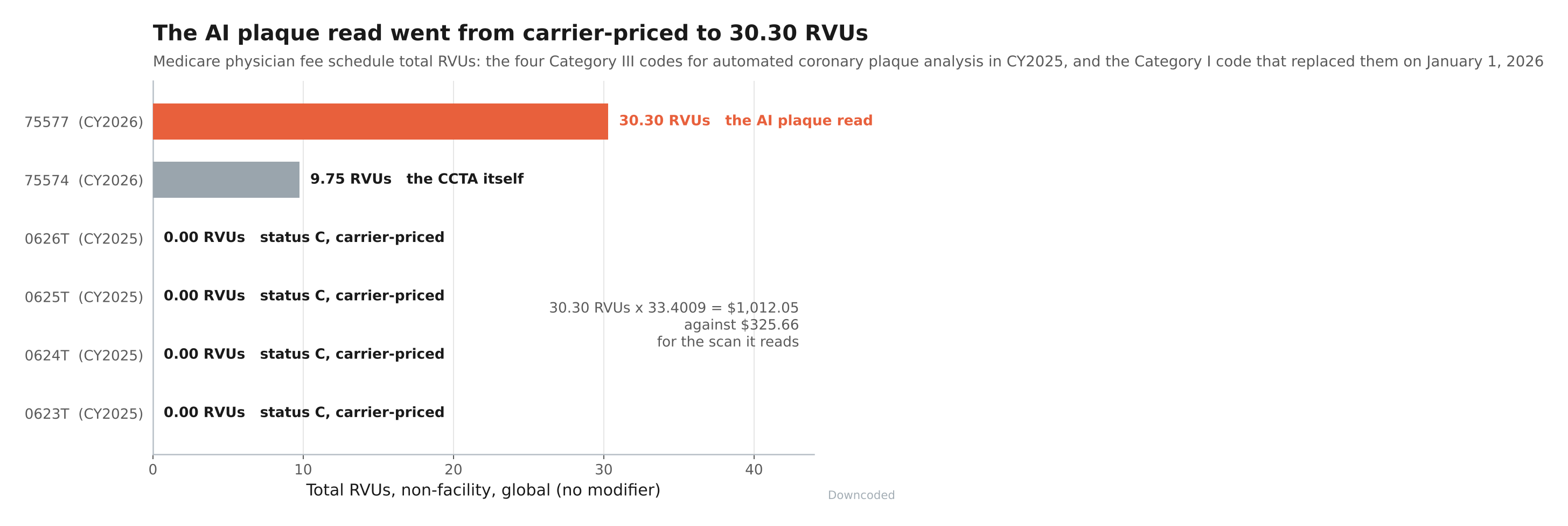
The CCTA underneath it, 75574, carries 9.75 total RVUs. So the analysis prices at 3.1 times the scan it analyzes, and of the $1,337.71 the pair is worth together, the software takes 75.7%.
Five Contractors, Four of Them on the Same Day
A published price is not coverage, and this is where the story gets unusual. Pull the full final-LCD report out of the Medicare Coverage Database and you get 956 policies. Exactly five of them are for AI-QCT/AI-CPA:
- Palmetto GBA, L39851, effective November 24, 2024
- Wellpoint Federal, L39863, the same day
- WPS, L39913, the same day
- CGS Administrators, L39840, the same day
- Noridian, L39881, December 8, 2024
Eight A/B MAC organizations appear anywhere in those 956 rows. Novitas, First Coast and National Government Services carry nothing on this, and no proposed LCD on the topic is open anywhere.
Now, the detail worth stopping on. Every one of the five carries mac_initiated: N, and Palmetto's issue field says why in plain language: "This policy was developed based on a Local Coverage Determination (LCD) request for coverage for Quantitative Coronary Plaque Analysis."
Somebody filed a request. Five contractors wrote the policy, and four of them dated it to the same Sunday.
The comment period moved the criteria too, which is rarer still.
Four of the five carry an identical note in the tracking sheet: "The LCD was updated to expand coverage for stable chest pain and CADS-RAD 1." The draft reached acute chest pain, and the final reaches stable chest pain and the minimal-disease category as well.
What the Claim Has to Carry
The billing article behind the policy is short, and every line of it is a denial waiting to happen:
- The analysis cannot run before the CCTA "has been completed and interpreted," and if it is ordered early, "the study will be non-covered."
- "The name and NPI of the referring/ordering physician that submitted imaging data for AI-QCT/AI-CPA review must be reported on the claim." This is post-procedure analysis of a study somebody else ordered, so the claim has to say who.
- The software "must be FDA cleared or approved." The policy names no vendor and sets no other product condition.
- There is exactly one covered diagnosis code, R93.1, and the non-covered list is empty. A claim without a valid ICD-10-CM code comes back as incomplete under section 1833(e).
Eight clinical circumstances are carved out as non-covered, and the one most likely to catch a clean-looking claim is a normal scan. CAD-RADS 0 or no plaque disease and there is nothing to quantify, so there is nothing to pay for.
Final Thoughts
Palmetto touched this policy nine days ago. The entire October 15 revision reads: "Under Bibliography corrected a broken hyperlink for source #9."
Three revisions in two years, and the other two were a deleted regulatory citation and the word "gender" changed to "sex." That is what a settled coverage policy looks like from the outside.
Which is worth sitting with, because the rest of the AI coverage record does not read like this. Three weeks ago we counted the sixteen proposed LCDs that reached the database on October 1 and found fourteen of them proposing non-coverage. CGS has a final policy on automated brain MRI quantification whose opening line is "This is a non-coverage policy for artificial intelligence assistive software tool."
AI-QCT went the other way, and the route it took is not mysterious.
A request from outside the contractor. A comment period that widened the criteria instead of narrowing them. Five contractors landing on identical text, then a Category I code with a published RVU attached to it.
That last step is the one that changes your week. Status C told you to go argue. Status A tells you what the claim is worth before you file it.
Thanks for reading.