Medicare Set Its Screening Floor With a Test It Cannot Cover
NCD 210.3 now pays for any non-invasive colorectal biomarker test clearing one of two sensitivity and specificity pairs, and CMS showed its arithmetic. The lower bound is Freenome's SimpleScreen, which is not FDA market authorized. Coverage backdates to June 8; the edits go live January 4.
CMS published the arithmetic.
Not the usual gesture at "the totality of the evidence," an actual equation, printed in the final decision memorandum for CAG-00440R: sensitivity of 94.4% for the stool RNA test, 93.9% for next-generation Cologuard, 83.1% for Shield, divided by three, giving 90.46%.
Round down. That is where the 90 in the new colorectal screening coverage rule comes from.
The other number has a stranger provenance.
Transmittal 13921 landed yesterday, August 27, carrying change request 14581. Two documents share the number: one rewrites NCD 210.3 in the coverage manual, the other rewrites eight sections of chapter 18 of the claims processing manual. Together they convert Medicare's colorectal screening benefit from a list of brand names into a performance threshold, and they do it retroactive to June 8.
"If the policy no longer names the test, what exactly does the claim have to clear?"
Where 90 and 79 Came From
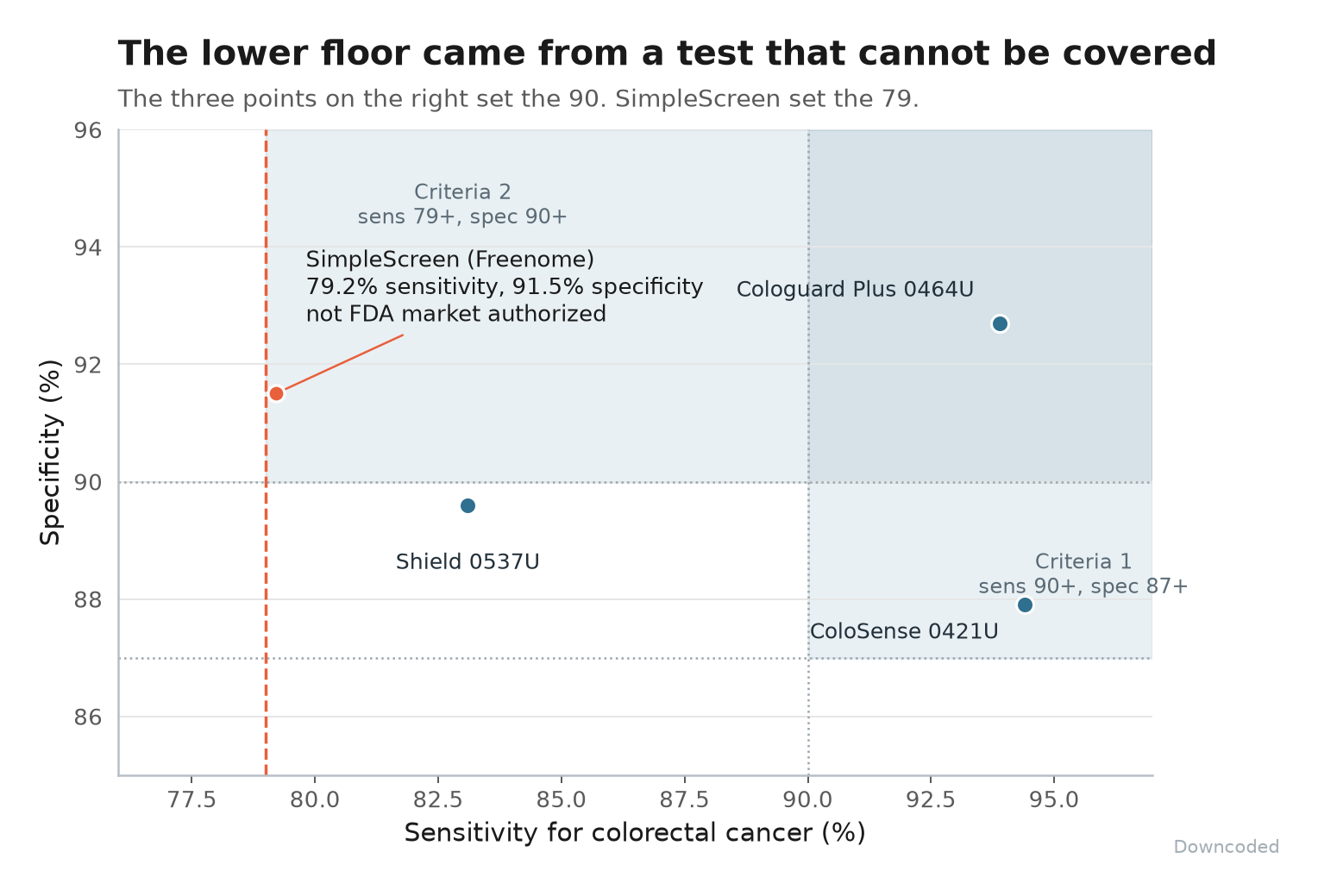
The new NCD covers a non-invasive biomarker test once every three years for asymptomatic average-risk beneficiaries aged 45 to 85, when the test is FDA market authorized, runs in a CLIA lab, keeps up with its FDA-required post-approval study, and meets one of two performance pairs. Criteria 1 is sensitivity 90% or better with specificity 87% or better. Criteria 2 is specificity 90% or better with sensitivity 79% or better.
CMS explains each of the four numbers.
- Criteria 1 sensitivity: the arithmetic mean of the three pivotal-study point estimates, 90.46, floored to 90.
- Criteria 1 specificity: the lowest specificity in the evidence table, ColoSense's 87.9%, floored to 87. The original Cologuard's 86.6% was set aside as superseded.
- Criteria 2 specificity: carried over unchanged from the 2021 blood-based biomarker NCD, where CMS "did not identify a compelling reason to change this cut point."
- Criteria 2 sensitivity: the lowest sensitivity anywhere in the table, 79.2%.
That last one belongs to SimpleScreen, the Freenome circulating-tumor-DNA test from the PREEMPT CRC study. In the same memo's own evidence table, the entry for SimpleScreen carries a parenthetical: not FDA approved, but submitted to FDA.
Answering a commenter later in the document, CMS is blunter. "SimpleScreen is not FDA market authorized or indicated for CRC screening."
So the floor under Medicare's coverage criteria was set by a test that fails the first of those criteria (chart below).
This is not sloppiness. It is the design working as intended, and CMS says so: the framework "provides coverage predictability for tests coming onto the market," and by writing criteria "not test-specific but rather across non-invasive biomarker tests, the NCD will not require reconsideration as new tests come to market." A test that clears one of the boxes is covered the day FDA authorizes it. No national coverage analysis, no 271-day wait like the one Geneoscopy just finished.
The clock on that wait is worth keeping: formal request accepted September 10, 2025; proposed decision March 10, 2026; final decision June 8, 2026. Nobody has to do that again.

The rest of this brief is for subscribers.
The impact tables, the code-level detail, and the rest of the analysis sit past this line.
$50 a month, or $500 a year.
Already a subscriber? Sign in