Medicare's Newest DME Benefit Has One Drug and 69 Patients
Section 6222 of the Consolidated Appropriations Act, 2026 pulled external infusion pumps that need a clinician in the room inside the Part B DME benefit, effective April 1. CMS finalized it Monday, dropped both limits it had proposed, and kept the one requiring a licensed person on site for every infusion. Its own impact analysis says the expansion reaches one drug, 69 beneficiaries in 2025, and saves Medicare $800,000 a year by moving $34,000 of cost sharing onto each patient who takes it.
Congress amended the Social Security Act's definition of durable medical equipment this February. CMS finalized the regulation implementing it on Monday, inside the CY 2027 home health rule.
The expansion reaches one drug.
That figure is CMS's own, printed in the rule's regulatory impact analysis: "we expect that there is only one drug that did not previously meet the requirements for coverage through home infusion but does meet the requirements as modified by section 6222 of the Consolidated Appropriations Act, 2026, and will be used by a sufficient number of Medicare beneficiaries to warrant consideration: patisiran."
A few sentences later the agency gives the population. "Claims data for 2025 show that only 69 beneficiaries received patisiran infusions."
Sixty-Nine People
The mechanism is narrow by construction. The DME definition at 42 CFR 414.202 requires that equipment be "appropriate for use in the home," which CMS reads to mean the beneficiary or a caregiver can run it safely without a clinician present. An infusion pump whose drug label says a professional has to administer it fails that test, so the pump never qualified as DME, so the drug never qualified as a supply necessary for the pump, so the whole therapy stayed in the outpatient department.
Section 6222(a) of the CAA, 2026 says that class of pump must be treated as meeting the home-use requirement when three conditions hold, for items furnished on or after April 1, 2027. The label has to instruct that a health care professional administer or supervise. A qualified home infusion therapy supplier has to do the administering or supervising. And the label has to call for at least 12 infusions a year.
Patisiran, sold as Onpattro for the polyneuropathy of hereditary transthyretin amyloidosis, satisfies all three without effort. Its label says plainly that the drug "should be administered by a healthcare professional," and it is dosed intravenously every three weeks, which CMS converts to 17 infusions a year.
Now look at what happened to the patient base while Congress was drafting (chart below).
Medicare Part B beneficiaries on patisiran peaked at 338 in 2022 and fell to 84 in 2024, a 75.1% decline in two years, with spending down from $98.1 million to $24.0 million. CMS's 2025 claims count of 69 continues the slide.
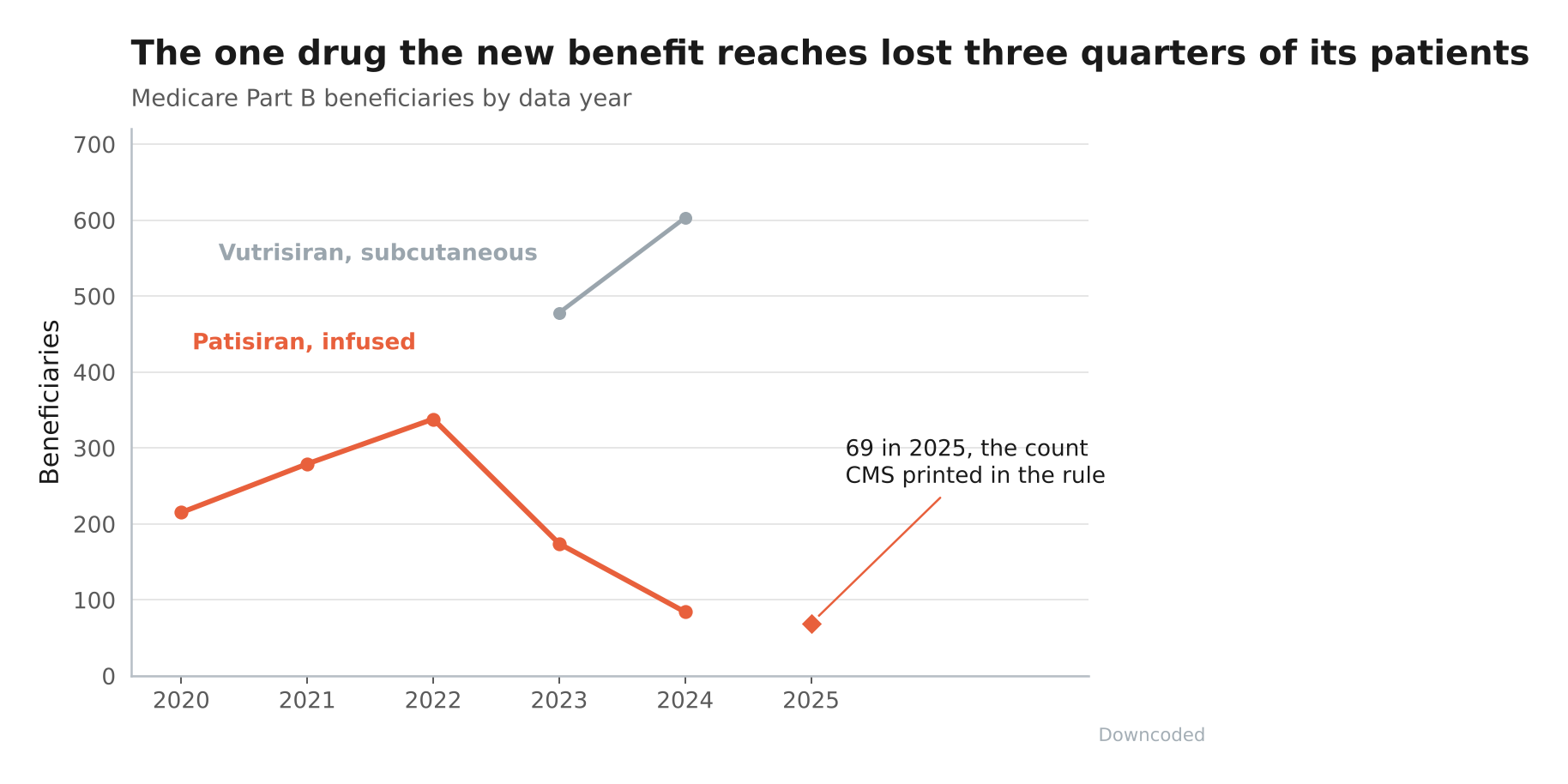
Those patients did not stop being sick. Our read is they moved to vutrisiran, the same manufacturer's follow-on for the same indication, which went from 478 beneficiaries in 2023 to 603 in 2024.
Vutrisiran is a 25 mg subcutaneous injection given once every three months. Four doses a year, no pump.
"What does a benefit category do when the therapy it was written for is the one the market is leaving?"

The rest of this brief is for subscribers.
The impact tables, the code-level detail, and the rest of the analysis sit past this line.
$50 a month, or $500 a year.
Already a subscriber? Sign in