 Downcoded
OIG Has an Inbox for Your Arrangement Question
Somebody emailed OIG about hospitals handing out gift cards to move patients inside their own system. This morning OIG published the answer where anyone can read it. Here is how that channel works, and what the binding one costs.
Somebody wrote to OIG and asked whether a hospital can hand a patient a gift card to get them to transfer to another hospital in the same system.
This morning OIG posted the answer where anyone can read it.
The page it landed on now carries a line at the bottom reading "Last updated Nov. 5, 2026."
The person who asked is not named anywhere, and never will be. That is the deal.
"What does it cost to get OIG to look at your arrangement?"
Two prices. One of them is an email.
The Inbox
OIG runs a standing FAQ process, built out of stakeholder input gathered under its Modernization Initiative, to give what it calls "informal feedback to the health care community." Since March 2023 it has taken questions from anyone on four things:
- general questions about the Federal anti-kickback statute and the Beneficiary Inducements CMP
- how those two authorities apply to a type of arrangement
- compliance considerations
- the Health Care Fraud Self-Disclosure Protocol
You send it to OIGComplianceSuggestions@oig.hhs.gov with enough facts to make the question answerable. OIG reserves the right to rewrite your question "to ensure generality," to decline it entirely, and to never tell you it published you.
Three pages sit at the top of the FAQ index, above the older ones on exclusions and CIAs, and they hold 22 published answers between them: 17 general questions, 3 on specific arrangement types, 2 on compliance considerations. The compliance page has not been touched since March 22, 2023, so the throughput is real but it is not a firehose.
What Landed This Morning
OIG "would have significant concerns" if a hospital offered a gift card, cash, or any other cash equivalent to a federal health care program beneficiary to induce a transfer to a hospital in the same system.
And it drew the system line wide: any affiliated hospital, "including but not limited to, hospitals with common ownership, a wholly owned subsidiary, a joint venture, or any other affiliation."
Both authorities get implicated, the statute and the CMP. No safe harbor or exception would apply.
OIG then named three risks, which is the part worth forwarding to whoever runs your transfer center:
- Steering and unfair competition. A card can move a patient past a closer or better hospital, and a system with the resources to offer one disadvantages the hospitals that cannot.
- Cost to the programs. If the receiving hospital is, for example, a critical access hospital, Medicare may simply pay more for the same care.
- Quality. Hospitals inside one system do not all deliver the same quality, and a card can pull a patient toward the weaker one.
Read it next to general FAQ #5 and the taxonomy sharpens. A big-box gift card is a cash equivalent, because it converts too easily. A card redeemable only for gas, or for a gym, or by its express terms only for fresh produce, is in-kind. That distinction is what decides whether the patient engagement and support safe harbor at 42 CFR 1001.952(hh) is even available to you, since it protects in-kind items only.
OIG also fenced the answer carefully. Remuneration other than a gift card is out of scope, and nothing in the FAQ touches EMTALA or any Condition of Participation.
The Other Price
The formal channel is the advisory opinion, and it is a different animal: written under section 1128D of the Act, governed by 42 CFR Part 1008, legally binding on HHS.
Binding on HHS, and relied upon only by the party that asked.
OIG publishes every opinion in redacted form "for informational purposes only," and says plainly that no third party may legally rely on one. The redacted opinion you are reading about someone else's joint venture is reading material.
Requests go in as a PDF to a different address, and you get an accept, reject, or more-information response within 10 business days.
Then the meter runs. Under 42 CFR 1008.31, the requestor "is responsible for paying a fee equal to the costs incurred by the Department," salaries, benefits, and supervisory support included, and OIG's calculation of that cost "is not reviewable or waiveable."
That process has issued 19 opinions so far in 2026, which already beats 2023, 2024 and 2025 outright, and sits under the eight-year high of 22 set in 2022 (chart below).
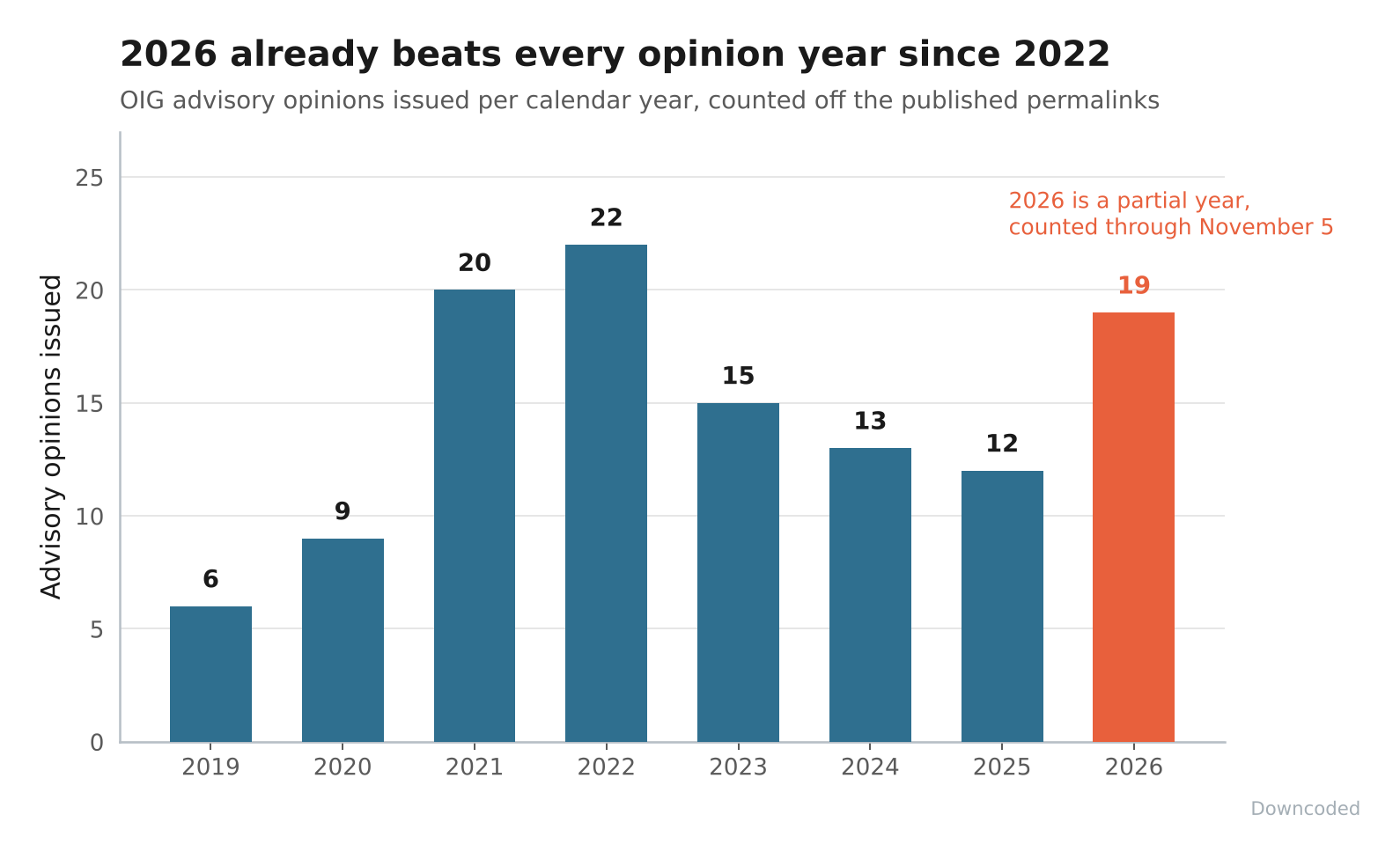
So the binding channel clears somewhere between one and two arrangements a month, for the parties who pay to stand in it.
Final Thoughts
The gift card answer binds nobody. OIG says so at the top of the page, and the industry lawyers will say so again in every memo written about it this week.
It also tells you, for the price of reading it, exactly which three harms OIG will reach for if it ever looks at your transfer incentives, and exactly how wide it draws the word "affiliated." That is most of what a compliance committee actually needs on a Thursday.
The inbox is open to you on the same terms it was open to whoever asked this one. Nothing stops a revenue cycle director from writing in about the thing their own policy manual cannot resolve, and the worst outcome is silence.
Thanks for reading.