 Downcoded
OIG Will Give You the Software It Extrapolates With
The audit OIG issued on August 3 found $8,112 in improper payments across 100 sacroiliac joint injection sessions and turned it into a $15.2 million finding. The program that does that arithmetic has been a free download on the OIG website since the late 1970s, and the Program Integrity Manual tells contractors to use it by name.
OIG reviewed 100 sacroiliac joint injection sessions and found $8,112 in improper payments.
The report it issued on August 3 asks CMS to act on $15.2 million.
Everything between those two numbers is arithmetic, and the agency that did it publishes the program. Free, no login, no license click, two builds sitting on one page.
"If the auditor's instrument is a public download, why is the extrapolation the part nobody checks?"
A Hundred Sessions, Twenty-Two Million Dollars
The frame in OAS-25-09-021 is narrow and specific: Part B claim lines for sacroiliac joint injections paid by the five MACs that had both an LCD and an LCD Reference Article in force, dates of service October 1, 2023 through September 30, 2024. CGS, NGS, Noridian, Palmetto, and WPS.
First Coast and Novitas had neither document, so their claims never entered the universe.
Grouped into sessions paying $50 or more, that came to 186,842 sessions worth $22,044,999.
Simple random sample. 100 items. Seventy-two failed a Medicare requirement, and the sampled dollars at issue were $11,243.
So each sampled session speaks for 1,868 others.
Appendix D names the tool twice and both times generically: "the source of the random numbers was the Office of Audit Services' (OAS's) statistical software." OIG's own compliance page is less coy. RAT-STATS, it says, "created by OIG in the late 1970s, is also the primary statistical tool for OIG's Office of Audit Services."
The Only Number That Gets Demanded
OIG published a point estimate of $15,156,922 and a two-sided 90 percent interval running from $13,181,722 to $17,132,122 (chart below).
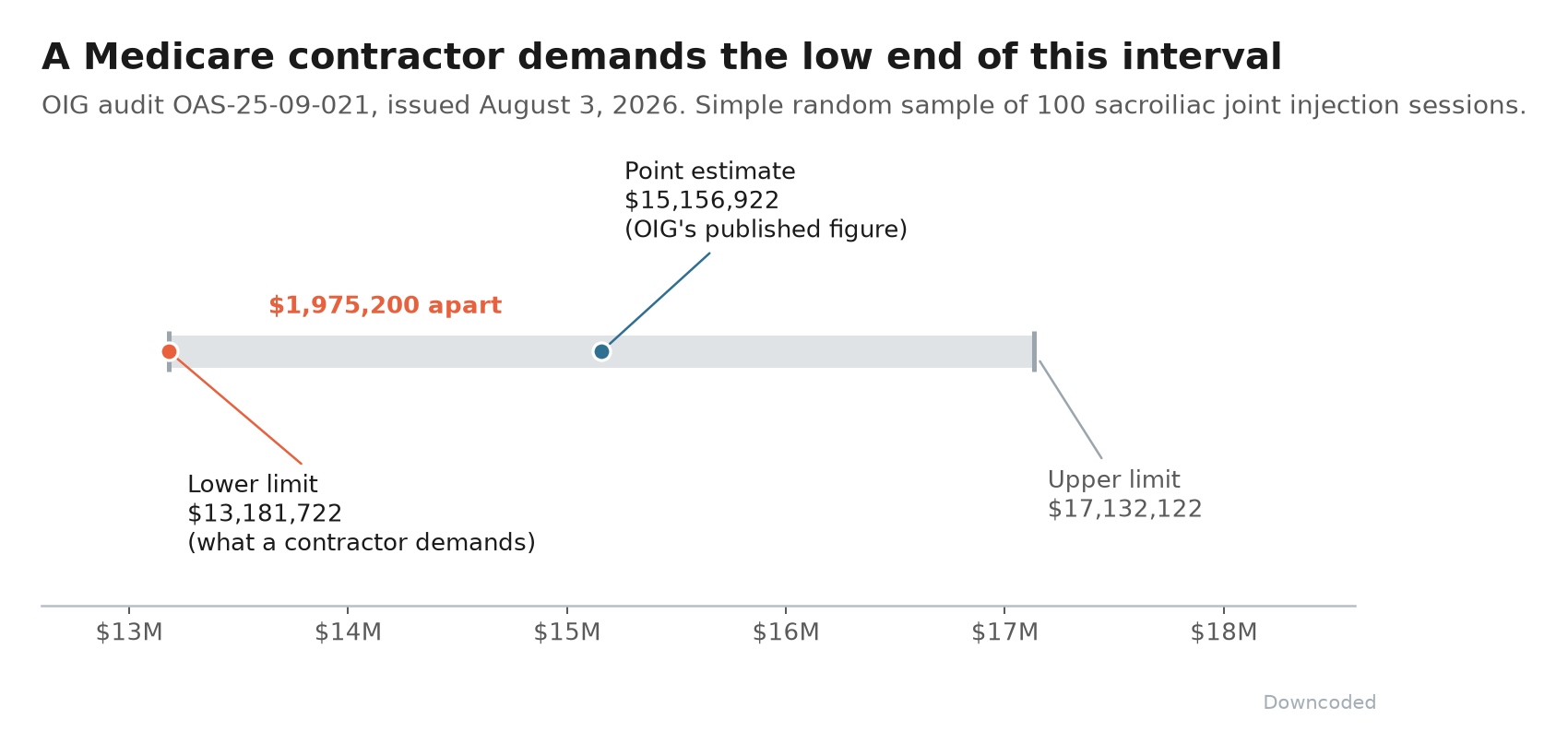
A MAC, UPIC, or RAC extrapolating against one provider does not get to use the middle of that band. Program Integrity Manual 8.4.5, revised in 2023, is explicit:
"In most situations, the lower limit of a one-sided 90 percent confidence interval should be used as the amount of overpayment to be demanded for recovery from the provider/supplier."
CMS calls the procedure conservative and says it "works to the financial advantage of the provider/supplier." On this sample that advantage is $1,975,200, the entire distance between the published estimate and the low end of the band.
The spread of the sample sets that distance. Relative precision here works out to 13.0% of the point estimate, and every point of it is money that never appears in a demand letter.
Which is why the manual points at the software by name. Section 8.4.4.2 orders contractors to document every step of the random selection "to ensure that the necessary information is available for anyone attempting to replicate the sample selection," then lists the acceptable packages: SPSS, SAS, and "RAT-STATS, available through the HHS-OIG website."
Replication is the whole design. Someone is supposed to be able to rerun it, and nothing in the manual says that someone works for the contractor.
What Is Actually in the Download
Both builds came down anonymously this run, straight off the page, no form in between.
The 2019 build is a 2.2 MB zip holding 38 files, a .NET Framework 4.5.2 desktop application. RatStats.exe is 217,088 bytes and stamped June 29, 2019.
Six Excel templates ship alongside it for frame distribution, stratification, stratified variable boundaries, and multi-step random number generation. OIG left the debug symbols in the release.
The 2010 build is still posted too, 14.4 MB, and it carries its own Visual Basic 6 runtime: msvbvm60.dll, file date November 2000. Whatever else that says, it says nobody was quietly retired mid-audit.
The two-page change overview is worth reading before anyone tells you the versions disagree:
"The 2019 version of RAT-STATS has been programmed with the goal of replicating exactly the input and output file organization of the 2010 version of RAT-STATS."
Twelve modules did not make the crossing: two random-number frame routines, six attribute appraisals, four variable appraisals. OIG explains the last four in a footnote with unusual candor. "We removed these modules because we did not have any record of their use within the OIG in the past 5 years."
What arrived is the more useful half. The 2019 build added the option to compute a confidence interval by the empirical likelihood approach for unrestricted and stratified variable appraisals, citing Chen, Chen and Rao (2003), "Empirical Likelihood Confidence Intervals for the Mean of a Population Containing Many Zero Values."
Read that title against a claims frame. Most claims in any universe are clean, so most of the overpayment values in the sample are zeros, and normal-theory intervals handle a pile of zeros badly.
OIG shipped the method built for that exact shape and wrote down which paper it came from.
Final Thoughts
An extrapolated demand reads like a black box because it arrives as one number with no arithmetic attached. Neither agency involved actually treats it that way. CMS wrote down which limit of which interval to demand and ordered the selection documented so it can be rerun. OIG wrote the program, gave it away, published what changed between versions, and cited the statistics literature behind the new interval method.
Your frame is reconstructable from your own remits. The sample size, the seed, and the selection steps are supposed to be in the record you already have a right to.
The rest is a 2.2 MB download that has been free since the Carter administration.
Thanks for reading.