 Downcoded
Retroactive Payment Didn't Bring the Telehealth Visits Back
CMS added two quarters to the Medicare Telehealth Trends file on September 17, and they are the first public look at the six-week lapse. Telehealth's share of eligible users fell to 10.76 percent in Q4 2025, the lowest quarterly reading since the quarter the pandemic expansion began, and Q1 2026 came back under every first quarter of the last three years. Congress paid those claims in full.
On September 17 CMS added two quarters to the Medicare Telehealth Trends file. The release before it stopped at September 30, 2025.
The flexibilities lapsed the next day.
"Congress paid those claims retroactively. Did the visits come back?"
Not yet, and the gap is bigger than the trend line had any business producing.
Ten Quarters, Then a Hole
The file measures one ratio: of the Medicare fee-for-service beneficiaries who received a telehealth-eligible service in a quarter, what share received it by telehealth. That makes it a modality share.
A slow quarter for office visits moves the denominator and the numerator together, so it barely shows up here.
That share sat between 12.61% and 13.76% for ten straight quarters, Q2 2023 through Q3 2025. Seasonal, flat, dull.
Q4 2025 printed 10.76% (chart below).
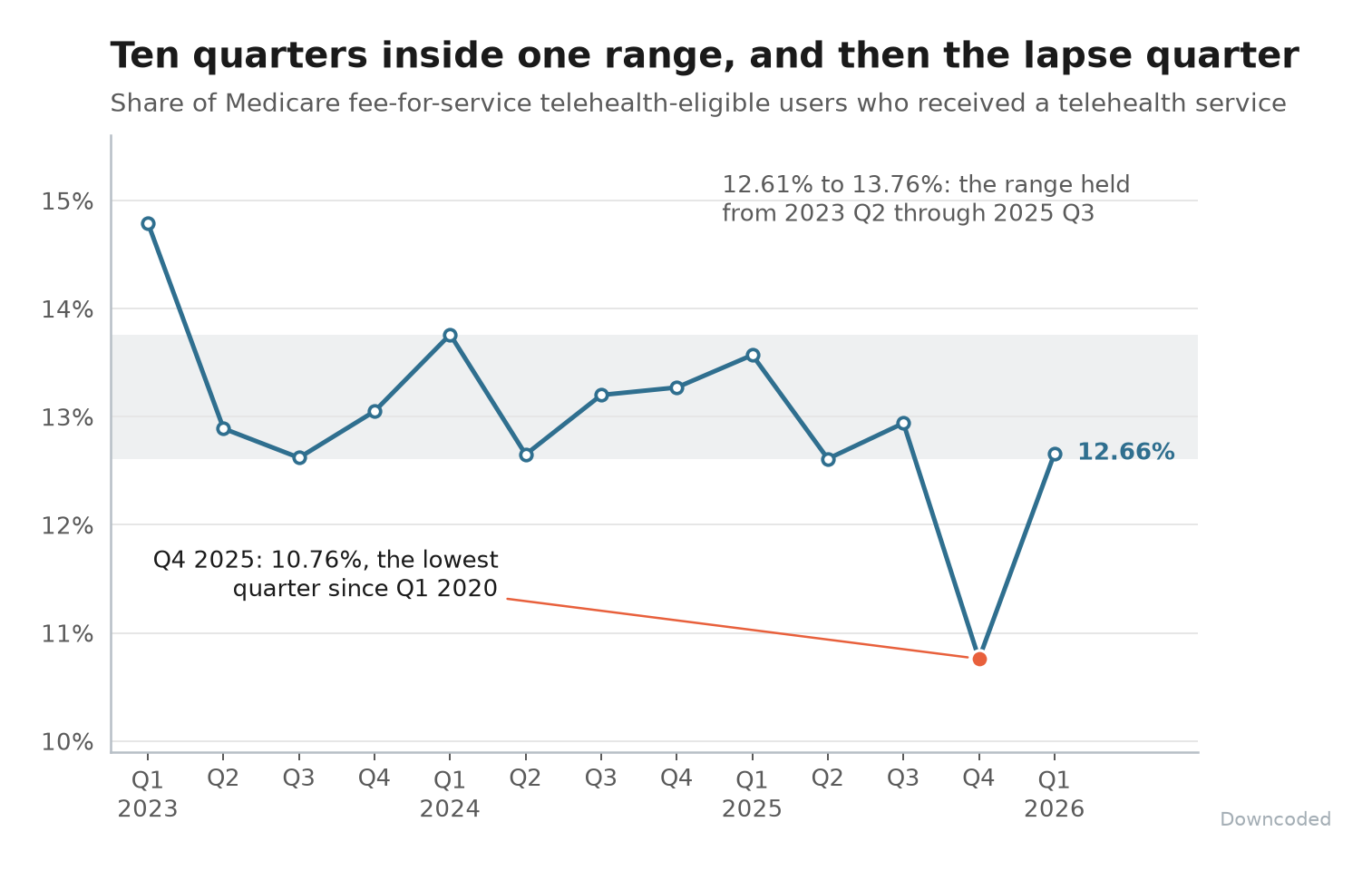
That is the lowest quarterly reading anywhere in the file since Q1 2020, the quarter the pandemic expansion started in. In people, 2,371,077 telehealth users against 2,839,260 three months earlier, a drop of 468,183.
Year over year, the four quarters running into the lapse came in at +0.1%, -1.1%, +0.3%, and -1.0%. Q4 2025 came in at -18.2%.
The Money Arrived on Schedule
Now the sequence, because the timing is the whole argument.
The statutory suspensions expired October 1, 2025, and CMS told the MACs to hold the affected claims rather than deny them.
On October 21 it released the physician fee schedule, ground ambulance, and FQHC claims, plus telehealth claims it could "confirm are definitively for behavioral and mental health services." Everything else stayed on hold.
On November 6 CMS instructed the MACs to start returning the rest. Professional telehealth claims submitted on or before November 10 came back with CARC 16 and RARC M77.
P.L. 119-37 was signed November 12 and restored the suspensions retroactively, October 1, 2025 through January 30, 2026. Practitioners resubmitted.
Section 6209 of the Consolidated Appropriations Act, 2026 then carried the flexibilities out to December 31, 2027.
So every telehealth service actually furnished in Q4 2025 was payable, and this file counts claims received through August 18, 2026. CMS prints its own lag table on page 4: 98% of carrier claims are in by six months, 99% by nine.
Which makes that hole furnished volume. The visits did not happen.
Who Didn't Stop
Split the same quarter by entitlement and the shape changes. Q3 to Q4 2025, the aged cohort dropped 18.1% and the ESRD cohort 17.5%.
The under-65 disabled cohort dropped 7.8%.
The one service line Congress never took away was behavioral and mental health, and it is also the one CMS specifically named when it lifted part of the claims hold on October 21. The cohort that barely moved is the cohort whose telehealth concentrates there.
The file carries no service-type field, so we wouldn't call that proof, and it is the only candidate on the table.
Geography did less than you would expect. Rural beneficiaries fell 14.2% against urban's 17.0%, because the pre-2020 rules that snapped back required a rural originating site.
A rural beneficiary sitting at home was as uncovered as anyone in Chicago.
Final Thoughts
Q1 2026 recovered to 12.66%, still under the last three first quarters: 14.79% in 2023, 13.76% in 2024, 13.57% in 2025. Against Q1 2025 that is 188,662 fewer telehealth users.
Claims for that quarter have had under five months of run-out against the August 18 cutoff, so treat 12.66% as a floor that will tick up a little.
Six weeks of statutory uncertainty, cured in full on November 12 with retroactive payment authority, and two quarters later the modality share is still outside a band it held for two and a half years.
The next date on the calendar is December 31, 2027. The claims hold from the last one unwound exactly as designed, and every dollar came through.
What cost money was the decision made in week one to stop putting telehealth slots on the schedule, and there is no transmittal that reverses that.
Thanks for reading.