 Downcoded
Ten Years of 2016 Lab Prices End on January 1
The Medicare clinical lab fee schedule has been priced off private payor rates collected in the first half of 2016, and hasn't moved a dollar since 2020. The reporting window that resets it closed Friday. Starting January 1, rates can fall 15% a year for three years, and the book of business underneath them looks nothing like it did in 2016.
In the first six months of 2016, labs recorded what commercial insurers actually paid them for a metabolic panel, a TSH, a vitamin D.
They reported it to CMS the following spring. Those rates set the Medicare clinical lab fee schedule that took effect in 2018.
They are still setting it today.
On Friday the reporting window closed on the first refresh of that data set since 2017. Applicable laboratories had from May 1 to July 31, 2026 to report private payor rates and volumes collected between January 1 and June 30, 2025, and CMS will use what came in to determine CLFS payment amounts for CY 2027 through CY 2029. We logged the deadline as a single line in Friday's radar. It deserves more than a line.
Because the price basis stood still for a decade, and the book of business underneath it did not (chart below).
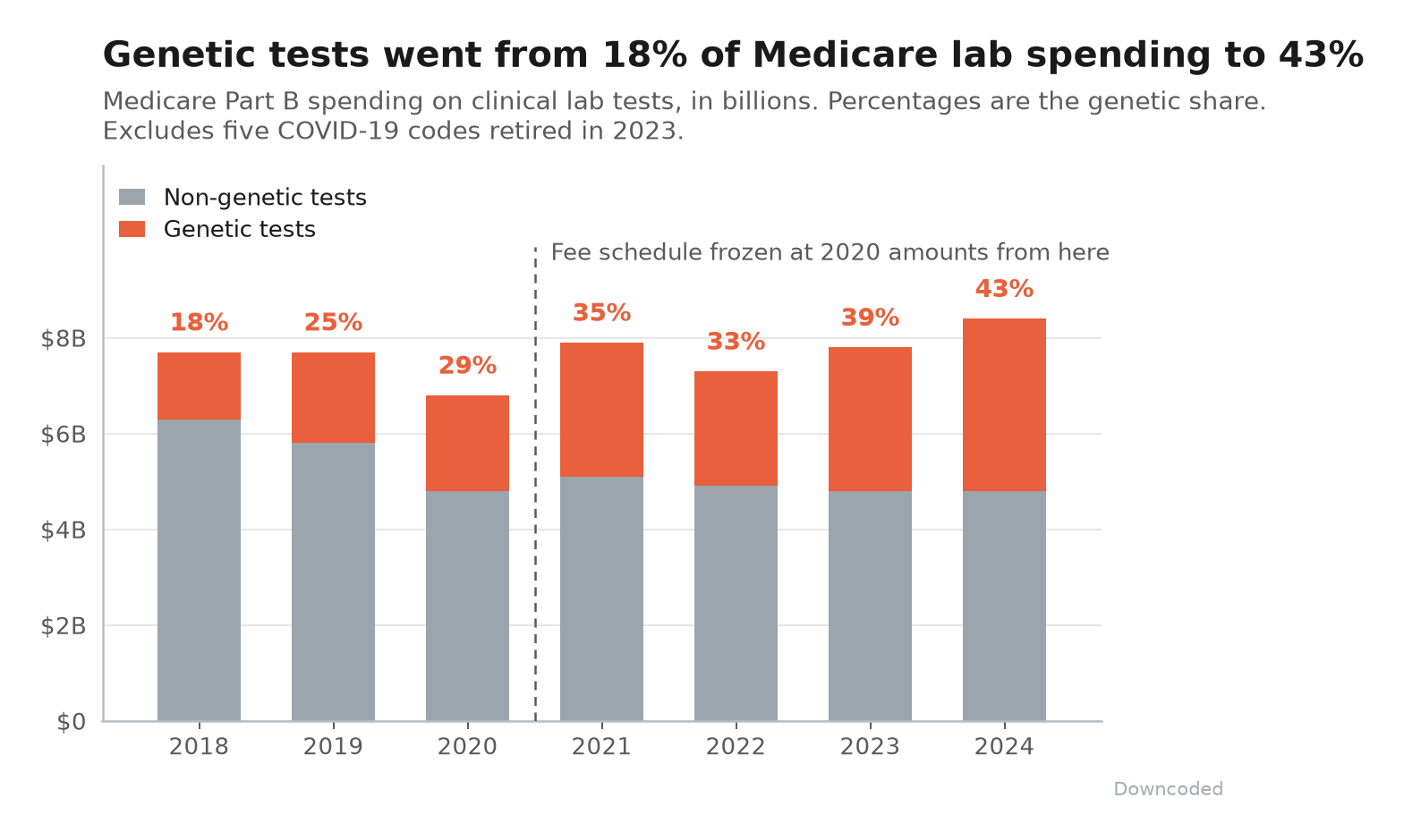
What the 2016 Rates Never Saw
OIG's most recent lab data snapshot puts Medicare Part B spending on clinical lab tests at $8.4 billion in 2024, up 5% on the year. The agency is blunt about why that number moves: it has nothing to do with rates, "which have remained the same since 2020."
What moved was mix. Genetic tests were 18% of Part B lab spending in 2018 and 43% in 2024, worth $3.6 billion, on 5% of the test volume.
Non-genetic spending, the panels and counts that make up the routine book, fell from $6.3 billion to $4.8 billion across the same stretch.
The single largest line item in Medicare lab spending in 2024 was 87798, infectious agent detection by nucleic acid where no more specific code exists. It paid $442.5 million, up 51% in one year, at a median of $447.05 per test.
Second place was the comprehensive metabolic panel: $406.7 million spread across 38.6 million tests at a median of $10.35 each.
Same fee schedule. One test pays 43x the other, and the volume ratio runs the other direction by a factor of twenty-six.
Meanwhile the number of Part B enrollees getting any lab test at all fell 15% since 2018, to 23.4 million, as the population kept shifting into Part C.
Fewer patients, more expensive tests, frozen rates. That is the book CMS just re-measured.
How Far It Can Fall
Section 1834A(b)(3) caps how fast the repricing can bite. Payment amounts dropped no more than 10% a year through the 2018 to 2020 phase-in, then Congress stopped the clock entirely: 0.0% reduction for CY 2021 through CY 2026.
A run of appropriations bills did that, the most recent being section 6226 of the Consolidated Appropriations Act, 2026, enacted February 3.
The current cap is 15% per year for CY 2027 through CY 2029. Three consecutive years at the cap leaves a test at 61.4% of its CY 2026 rate, a 38.6% cumulative cut.
Then the three-year reporting cycle resumes on its original schedule, 2029 and 2032.
Here's the catch: the cap binds in one direction only. It limits reductions against the prior year's amount.
A test whose weighted median private payor rate lands above the current Medicare amount goes up, and it goes up in a single step.
So the January 1 file is a re-sort. Which side of it a given code lands on depends on what commercial payors were paying for that code in the first half of 2025.
High-volume routine chemistry has been commoditized for years and the private rates on it are thin. The tests where commercial payors pay well are, disproportionately, the molecular and genetic ones that now carry 43% of the spending.
The Work Between Now and January
Rank your CLFS revenue at the code level. The exposure is concentrated: for most labs and hospital outreach operations, a dozen codes carry the majority of fee schedule dollars, and the repricing only matters where the volume already is.
Then check the reporting itself. The threshold is narrow: an NPI or 14x hospital outreach lab needs more than 50% of its Medicare revenues from CLFS and PFS plus at least $12,500 in CLFS revenues during the collection period, and the obligation to file sits at the TIN level.
Missing it carries civil monetary penalties of up to $10,000 per day per failure or omission. If your TIN had an applicable laboratory and nobody filed by Friday, that is a compliance item for this week.
And model both directions. A budget built on a flat CLFS is a budget built on a policy that expired.
Final Thoughts
The lab fee schedule is the quietest line in Medicare payment, and it has been quiet for a specific reason: for six years it was legally incapable of changing. That made it easy to leave out of the model and easy to leave off the compliance calendar.
What the OIG data makes clear is how much drift accumulated behind the freeze. A payment system indexed to what commercial insurers paid for blood work in 2016 has spent years funding a genetic testing book that barely existed when the prices were set.
The correction was always going to be large whenever it finally arrived.
It arrives on January 1.
Thanks for reading.