 Downcoded
The 1.2 Million Who Kept Medicare Advantage and Dropped Its Drug Plan
CMS's monthly enrollment file shows standalone PDP enrollment up 1,466,468 in a single month and MA-PD down 1,170,558, only the second monthly MA-PD decline in thirteen years. Medicare Advantage itself grew across the same step, which means the medical card and the drug card just stopped being the same payer for well over a million patients.
Standalone drug plans have been losing Part D since the month the series starts.
January 2013 put 63.8% of Part D enrollees in a standalone PDP. July 2025 put 41.9%, and the line went down in almost every month in between.
Then January 2026 came in at 44.3% and stayed there through June (chart below).
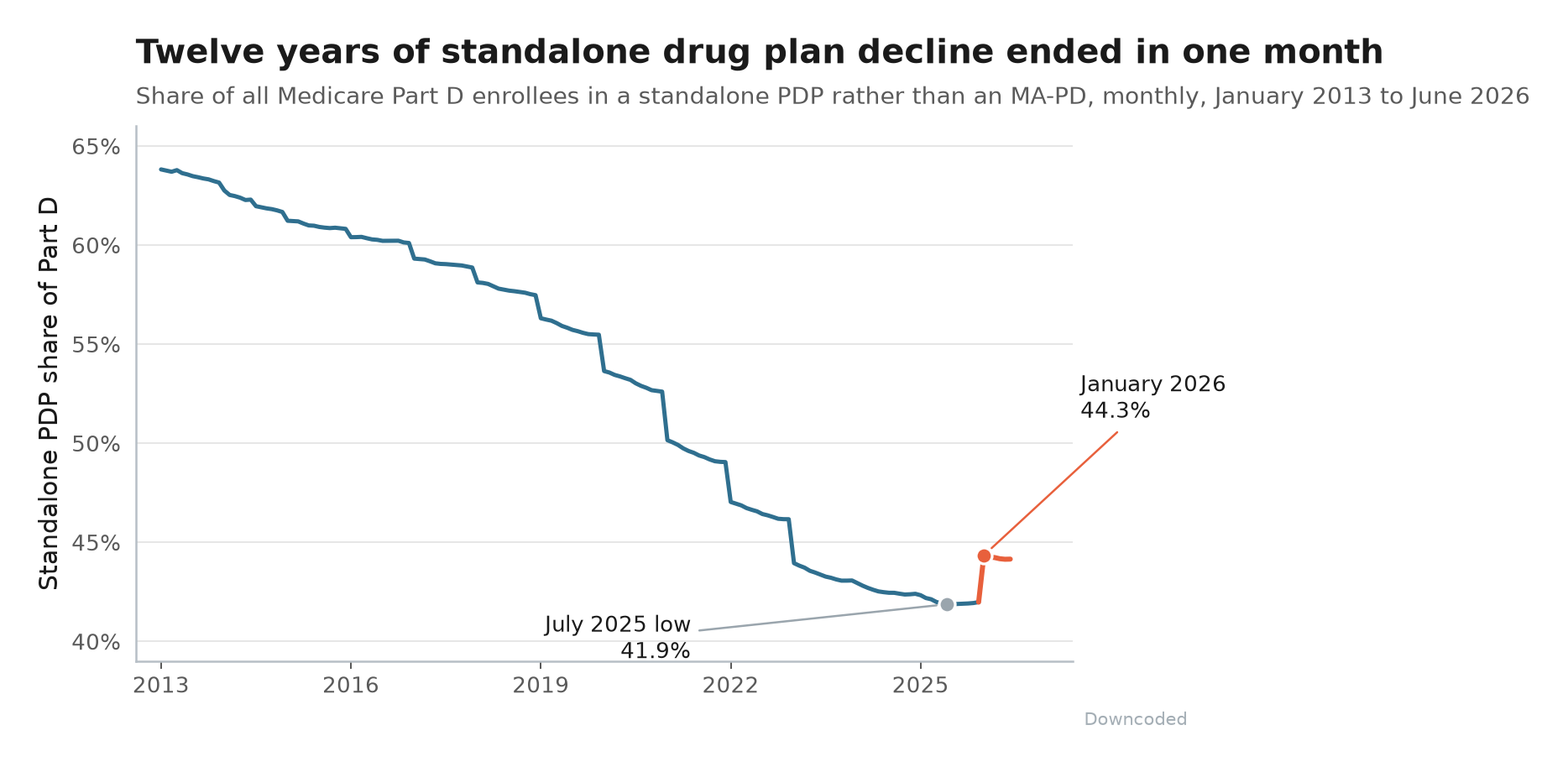
That is 1,466,468 more people in a standalone PDP than the month before.
Our 7am brief this morning used the current 44% share as a background fact while reading the PBM disclosure RFI. The composition underneath it is the more interesting half.
The Month MA-PD Went Backwards
MA-PD enrollment fell by 1,170,558 between December 2025 and January 2026.
CMS's Medicare Monthly Enrollment file carries 162 monthly rows, January 2013 through June 2026. Across all 161 transitions between them, MA-PD enrollment has gone down exactly twice: December 2025, by 5,560, and then January, by that 1.17 million.
So the natural read is that a million-odd beneficiaries walked out of Medicare Advantage.
They didn't. Medicare Advantage and other health plans went up by 91,274 across the same step, and Original Medicare went up by 23,421 (chart below).
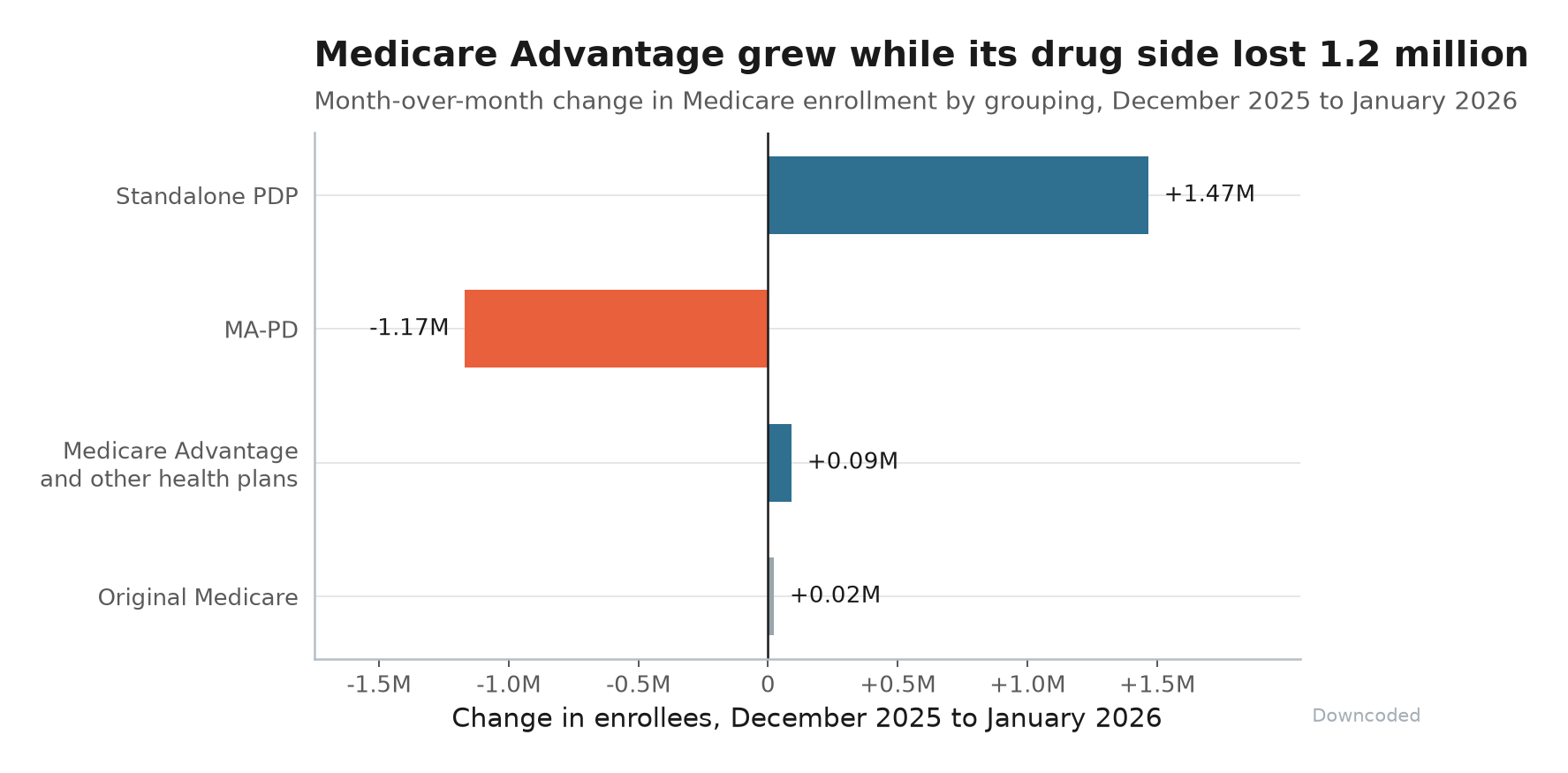
Take the MA and other health plan total, subtract MA-PD, and the residual is enrollees sitting in an MA or similar plan that carries no drug benefit.
December: 2,866,396. January: 4,128,228. June, six months on: 4,134,999.
So 1,261,832 people kept the medical plan and moved the pharmacy benefit somewhere else, and none of it unwound.
How That Is Even Allowed
The baseline rule says it isn't.
42 CFR 423.30(b) is blunt about it: "MA enrollees are not eligible to enroll in a PDP," with two carve-outs, an MA private fee-for-service plan that offers no drug coverage and an MSA plan. Neither of those describes 1.26 million retirees.
The door is 42 CFR 423.458(c)(1), the employer group waiver, under which CMS "may waive or modify any requirement under this part that hinders the design of, the offering of, or the enrollment in an employer-sponsored group prescription drug plan."
Which is exactly where KFF's plan-level cut of the same program lands. Employer group MA-PD down 1.2 million year over year to 2.7 million, the first annual decline in employer group MA-PD since 2010.
Employer group PDP up 1.2 million to 6.3 million, the largest increase since 2013. 70% of all PDP growth came from group plans.
Employers pulled the pharmacy benefit out of the retiree MA contract and bid it on its own.
The Card Stops Telling You Everything
For an MA-PD patient, one company owned both sides. The prior auth, the formulary, the appeal clock, the Part B versus Part D argument: all of it ran through a single payer, and a denial on one side could be rerouted to the other side of the same house.
For these 1.26 million, that assumption is now wrong, and the front of the card still looks identical.
- The 271 you get back from the MA plan covers the medical benefit. The drug plan is a separate contract with a separate sponsor, and nothing on the medical eligibility response is obliged to name it.
- Adult vaccines are Part D drugs by definition (42 CFR 423.100 ties the term to ACIP-recommended, FDA-licensed adult vaccines). The shingles dose you give in the office bills to a PDP that may have no corporate relationship at all to the plan adjudicating the visit it happened during.
- A Part B drug denied as "this belongs under Part D" used to be an internal transfer. Now it is a referral to a different company, with its own coverage determination timeline and its own appeal record.
None of that is new mechanically. Practices have run split medical and drug coverage for Original Medicare patients since 2006.
What changed in January is the population. A block of patients whose cards say Medicare Advantage now behaves, on the pharmacy side, like Original Medicare plus a PDP.
Final Thoughts
One month of data is one month of data, and a single January can be an artifact of a few large employers moving at once. Six months of hold is harder to dismiss, and the direction of travel in the group market is unambiguous in both the CMS file and the plan-level counts.
Watch the residual rather than the share. The 4.1 million MA enrollees with no drug benefit inside their plan are the population where your eligibility check and your Part B versus Part D routing quietly stopped agreeing with each other.
It was 2.9 million in December. Whether it is still 4.1 million next January is a question the 2027 bids answer, and those are already written.
Thanks for reading.