 Downcoded
The 15 Codes That Stay in the Book and Stop Working
The FY2027 diagnosis file adds 190 billable codes, the second-smallest annual haul in six years, and every summary you read this month will lead with that number. The one that reaches your denial queue is 30, and half of those codes never leave the tabular list at all.
The FY2027 diagnosis code set adds 190 billable codes.
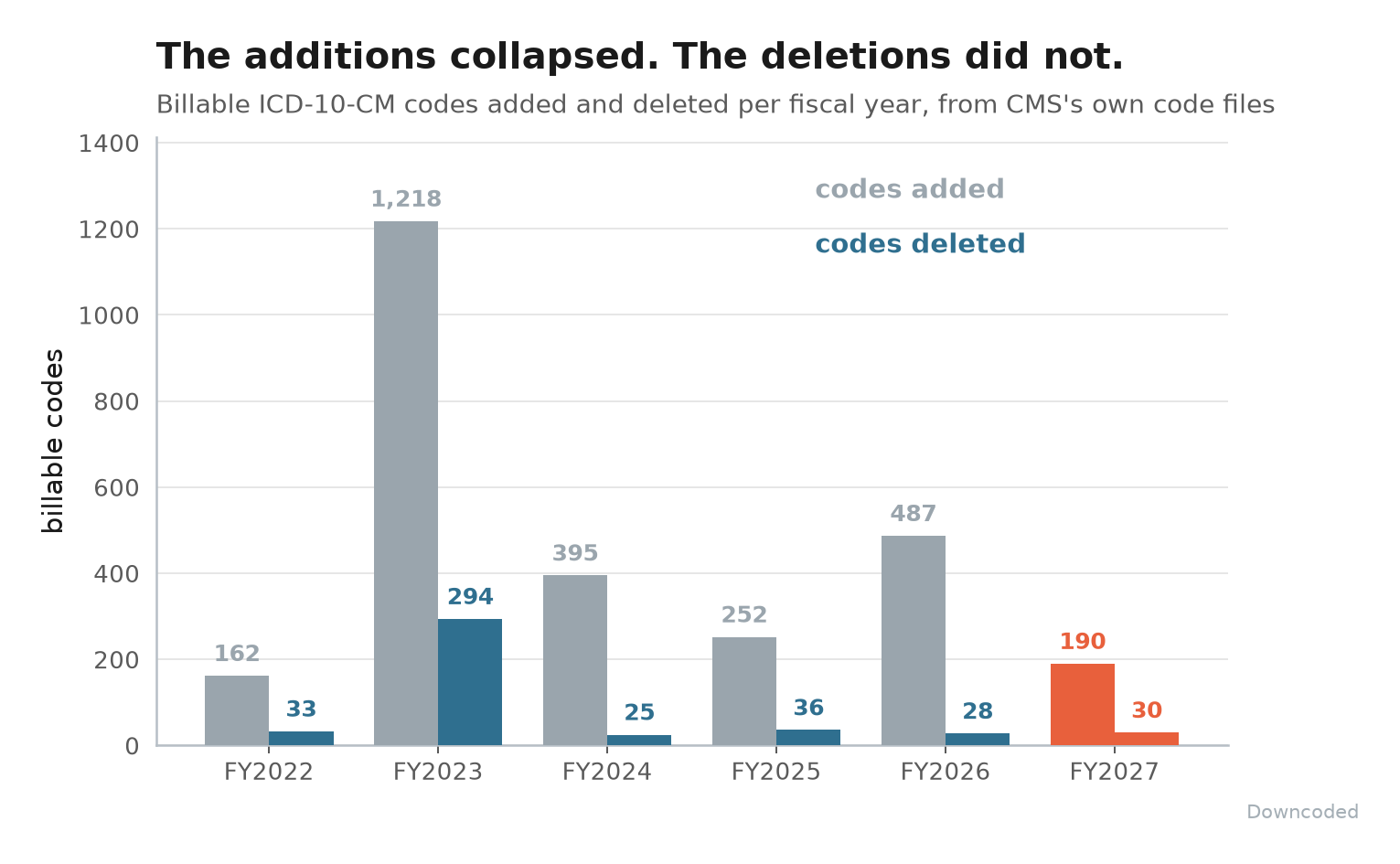
That is the second-smallest annual addition in six years, and 61% below last year's 487. It is the number every code-update summary published between now and October will lead with.
It is also the number that costs you the least.
The one that reaches your denial queue is 30. That is how many codes come off the billable list on October 1, and while the additions fell by nearly two thirds, the deletion count went up (chart below).
CMS deleted 28 last year, 36 the year before, 25 the year before that. Outside the FY2023 realignment, deletions have never left the twenties and thirties, no matter what the additions did.
Two Piles of Fifteen
Split the 30 deletions and they land in two even piles.
The first pile is codes that simply vanish. S23.420A, D and S, sternoclavicular sprain, and the twelve T52.8X_ organic-solvent codes.
Look one up on October 1 and it is gone. Your scrubber throws an invalid-code edit, somebody fixes it that morning, and the story ends.
The second pile is the one that gets expensive. Fifteen codes stay exactly where they are in the tabular list and stop being billable, because CMS gave each of them children:
- M72.2 plantar fascial fibromatosis becomes M72.20, M72.21 and M72.22. Laterality.
- I42.0 dilated cardiomyopathy becomes I42.00 unspecified, I42.01 familial-genetic and I42.09 other.
- I42.8 picks up arrhythmogenic cardiomyopathy, I49.8 picks up Brugada syndrome and ventricular bigeminy, and D69.1 splits out Glanzmann thrombasthenia.
- Z68.1, BMI 19.9 or less, becomes Z68.18 (18.4 or less) and Z68.19 (18.5 to 19.9).
- Z87.890, personal history of sex reassignment, becomes five codes.
- The eight M86.8X_ other-osteomyelitis codes each pick up right, left and unspecified.
Seven singles plus the eight osteomyelitis sites. Fifteen.
Why a Header Fails Worse Than a Deletion
CMS's own order addendum shows the mechanism in two lines. D69.1 is deleted with a billable flag of 1, then re-added with a billable flag of 0. Same code, same description, now a parent.
So the code is still in the book. It is still spelled correctly, still passes a format check, still resolves in a lookup, still sits in the problem list where a physician put it in 2019.
What it no longer does is pay.
M72.2 is the one to pull first. Plantar fascial fibromatosis is where plantar fasciitis gets billed, and it runs constantly through podiatry, orthopedics and outpatient PT.
On September 30 it is a valid billable code. On October 1 it is a header, and the claim carrying it comes back unprocessable.
The places that will still be holding it are the places no code-set update touches: the EHR favorites list, the printed superbill, the order set nobody has opened since the last EMR migration, and the payer policy whose covered-diagnosis table names the parent.
The Additions Are Mostly Two Expansions
Worth two minutes on the other side, because the 190 are concentrated rather than scattered. Four categories carry 104 of them: T52 organic solvents (36), O31 complications of multiple gestation (28), M86 osteomyelitis (24) and O00 ectopic pregnancy (16). The remainder spreads across a dozen chapters in ones and twos.
Notice T52 and M86 on both lists. Twelve T52 codes deleted and 36 added, eight M86 codes deleted and 24 added.
Those are the same expansion seen from both ends, which is how one event gets counted twice.
Final Thoughts
The file has been sitting on cms.gov since the first week of June, and the April 1, 2026 update changed nothing, so the 74,719 billable codes live today go to 74,879 in a single step on October 1. Thirty-two days.
A light addition year reads like a quiet one, and for the coding staff learning new codes it genuinely is.
The volume of rework never came from the additions. It comes from the handful of familiar codes that get promoted to parents, keep their descriptions, keep their place in the index, and stop working on a Thursday.
Thanks for reading.