 Downcoded
The 22 Sessions Medicare Will Pay For Again
Congress erased the once-per-lifetime limit on the Medicare Diabetes Prevention Program in an appropriations act, let organizations with no classroom enroll as suppliers, and protected their claims when the patient sits in another state. CMS pushed the point-of-care referral guides out to clinicians on Thursday.
Section 6214 of the Consolidated Appropriations Act, 2026 runs 243 words and carries three numbered clauses. The third one reads, in full, that "no limit is applied on the number of times an individual may enroll in the MDPP."
That is the entire provision. No preamble, no comment period, no impact table.
"What does a Medicare benefit look like when Congress rewrites it in statute and tells CMS it can switch the change on by program instruction?"
It looks like a fact sheet. CMS put two new ones in front of clinicians on Thursday, point-of-care guides for recommending the Medicare Diabetes Prevention Program, and the benefit underneath them is a different product from the one that existed in 2025.
Three Clauses and a Fact Sheet
The section is titled "Inclusion of Virtual Diabetes Prevention Program Suppliers in MDPP Expanded Model," it sits on pages 482 and 483 of the enrolled bill, and everything in it runs from January 1, 2026 through December 31, 2029:
- An entity may participate "by offering only MDPP services via distance learning or online delivery modalities" as long as it meets the conditions for enrollment as an MDPP supplier.
- When that entity furnishes an online session to a beneficiary "who was not located in the same State as the entity at the time," it "shall not be prohibited from submitting a claim for payment for such services solely by reason of the location of such beneficiary."
- No limit on the number of times an individual may enroll.
Then subsection (c): "Notwithstanding any other provision of law, the Secretary may implement this section by program instruction or otherwise."
So CMS did, and the regulation never had to move. Pull 42 CFR 410.79 at title 42's current issue date and the eligibility criteria at (c)(1)(i)(B) still require a beneficiary who, before the first core session, "had not previously received the set of MDPP services in his or her lifetime."
Page 6 of the February MLN booklet carries that same old criterion in its eligibility list and, a few lines down, the sentence "There's no limit to the number of times a patient can enroll in MDPP services."
Both are in print, and the statute is the one that operates. Worth knowing which of them your eligibility screen was built from.
What One Patient Is Worth
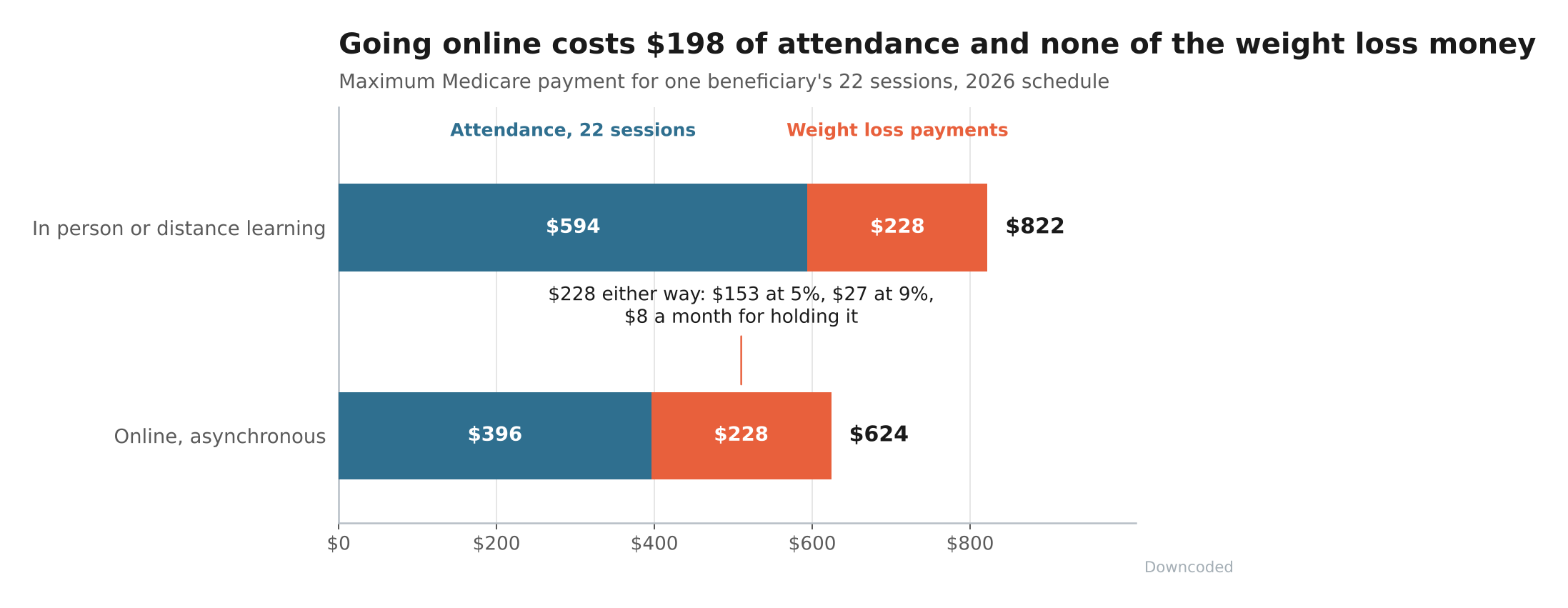
A services period runs up to a year: 16 weekly core sessions in months 1 through 6, then 6 monthly core maintenance sessions. Attendance pays $27 a session in person or by live distance learning (G9886, G9887) and $18 online (G9871).
Weight loss pays on top. $153 the first time the patient is 5 percent under baseline (G9880), $27 at 9 percent (G9881), and $8 for each maintenance session where the 5 percent holds (G9888).
Run both to the ceiling and CMS's own subtotals land at $822 for a synchronous patient and $624 for an online one (chart below).
The attendance half is the only half that moves. The performance half is $228 whichever door the patient came through.
The mechanics that decide whether any of it lands:
- Demo code 82 on every claim, the organization's own NPI as billing provider, the coach as rendering provider off the PECOS roster.
- Place of service 99 for community-setting, distance learning and online sessions.
- Modifier 76 for a same-day make-up session, now valid on G9871 as well as G9886 and G9887.
- G9888 rejects without an earlier-dated G9880, and rejects outright inside the first six months.
- Once the MACs have paid 22 sessions in the service period, later claims reject, "including out-of-sequence claims."
Online delivery carries one condition worth reading before anyone builds to it. The regulation requires live coach interaction in any week the beneficiary engages with content, says "chat bots and AI forums do not count," and states that suppliers "may not use AI or Machine Learning (ML) to replace Live Coach interaction."
The 299 Already In
CMS's supplier file, dated June 1, lists 1,037 locations, 669 administrative and 368 community settings. Behind them sit 299 distinct organizations, and 287 of the 299 operate in exactly one state.
Sixteen of the 52 jurisdictions on that file carry three supplier organizations or fewer. Five carry one. Vermont carries none (chart below).
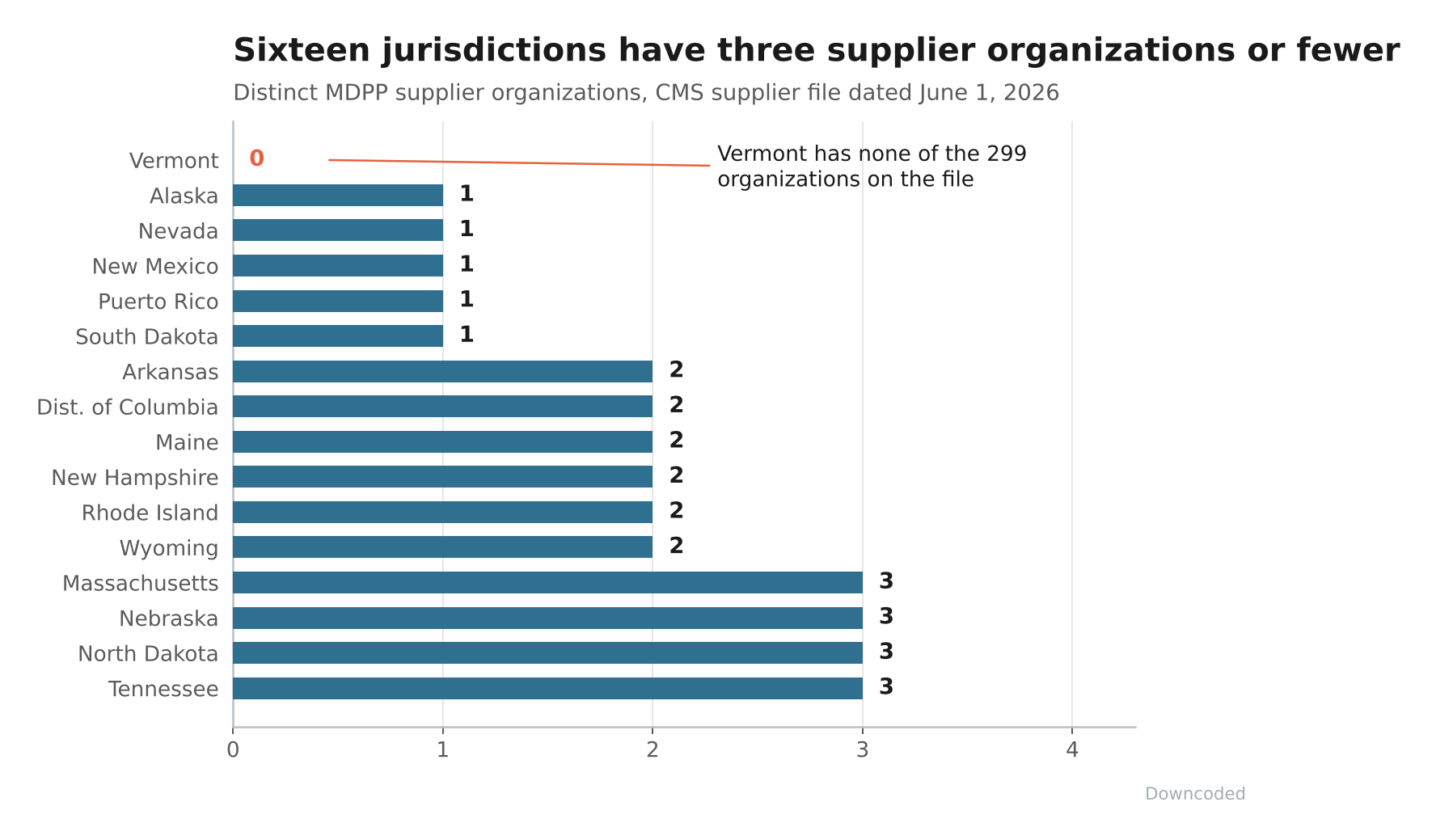
That map is what clause two was written for. A virtual-only supplier enrolled in Rhode Island can submit the claim for an online session attended from Vermont, and where the patient was sitting is not a reason to deny it.
The entry cost is the part that surprises people. "There's no provider enrollment application fee for organizations enrolling in Medicare as MDPP suppliers," and the MAC works the application within 90 days. CDC recognition comes first, preliminary or full or full-plus, coaches need NPIs and go on a screened roster, and the organization enrolls separately even when it already bills Medicare as something else.
Final Thoughts
The demand side is being worked in parallel. CMS told suppliers in September it was standing up a paid media campaign to drive beneficiary enrollment, Thursday's guides hand clinicians a script and a QR code, and Medicare Advantage plans have to offer MDPP as a preventive service either by contracting with enrolled suppliers or by enrolling themselves.
The clinical case was never the weak link. CMS's own provider guide puts the risk reduction at 58 percent, its booklet puts diabetes incidence down 71 percent in people 60 or older, half of adults 65 and older have prediabetes, and one in seven of them knows it.
What changed this year is the supply side.
A benefit that paid once in a lifetime, assumed a room, and stopped at the state line now pays again, enrolls organizations that have no room, and follows the patient across a border. None of that arrived in a fee schedule, which is most of the reason the people who could bill it have not read it yet.
Thanks for reading.