 Downcoded
The 29 Percent Raise at the Bottom of the Outpatient Rule
CMS finalized the CY2027 outpatient rule on Friday at 1.7 percent for hospitals. The last line of the impact table gives the 42 community mental health centers paid under the OPPS 29.0 percent, and nine of those points are the 340B drug cut being redistributed to providers who bill no drugs at all. Every one of the 42 goes up in CMS's own facility file, from $32.5 million to $41.7 million.
Table 112 of the CY2027 outpatient rule is the part everybody screenshots: hospital classes down the side, urban and rural, teaching and not, each with its percentage for next year.
The number that matters most is on the line underneath all of them.
29.0 percent. That is what CMS estimates the rule does to the 42 community mental health centers paid under the OPPS, against 1.7 percent for every other hospital in the system.
We went through this rule yesterday for the device pass-through section. The CMHC line is the other half of it, and the 29.0 turns up in a single sentence of the rule's own summary.
Where the 29 Comes From
CMS publishes four percentages for that row and never multiplies them out. So we did, indexed to CY2026 (chart below).
- APC recalibration takes the 42 clinics from 100 to 117.2. This is Column 2, and CMS states it plainly.
- The FY2027 wage index takes 0.5 points back off.
- The OPD fee schedule increase factor, a 3.2 percent market basket less the 0.9 point productivity adjustment, adds 2.7.
- The 340B drug payment change, redistributed, adds 9.0.
- Outlier and pass-through movement adds the last 0.6.
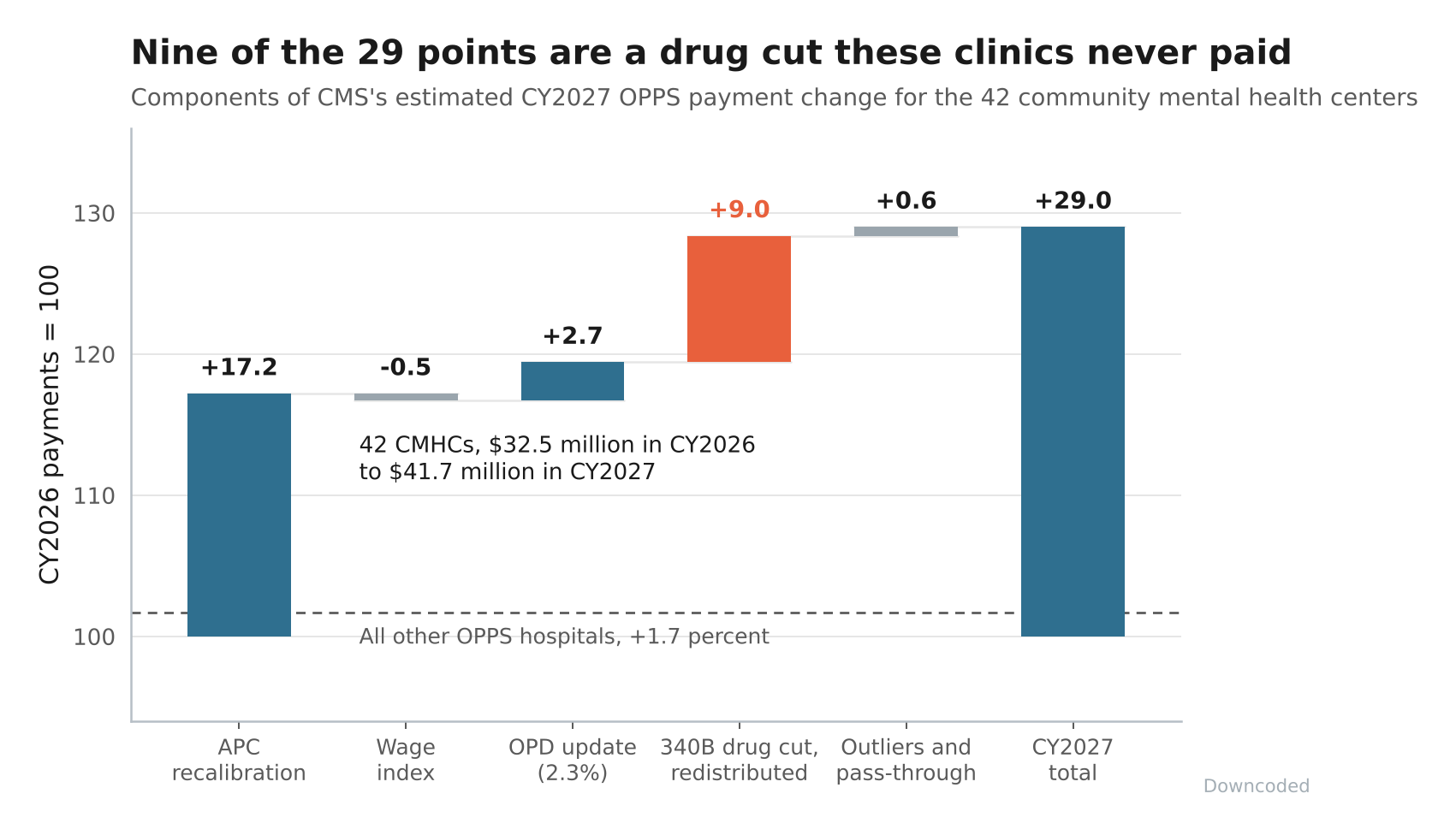
The chain lands on 128.37 against the 128.3 CMS printed for Column 5, which is as close as rounded inputs get. Pull out the fourth step and the whole thing stops at 119.4.
The Cut They Never Paid
CMS is moving payment for 340B-acquired drugs from ASP plus 6 percent to ASP minus 28.0 percent, which takes $4.65 billion out of OPPS drug lines in CY2027.
Budget neutrality puts it straight back. The conversion factor rises so that payment rates for non-drug items and services go up by 7.5 percent across everyone paid under the OPPS.
A CMHC bills four per diem APCs for partial hospitalization and intensive outpatient care, and that is the entire book.
No separately payable drugs, no 340B purchasing, nothing on the debit side of that trade.
CMS says it in the impact discussion, about providers in exactly this position: they "would receive an increase to their non-drug service payments through the budget neutral adjustment to the OPPS conversion factor due to this policy but no change to their drug payments."
And the clawback does not reach them either. The remedy offset that recovers the 2018 through 2022 windfall goes from 0.5 percent to 2.0 percent in CY2027, running until it has recouped $7.769 billion around CY2031, and it reaches only the hospitals CMS named in an addendum after reviewing provider enrollment and OPPS billing records.
A Rate That Is Somebody Else's Rate
None of this was a decision about community mental health centers.
Their per diems are a derivative: CMS multiplies the CY2027 hospital-based PHP and IOP rates by 0.4 and calls the result the CMHC rate, on the finding that CMHC geometric mean costs ran at 40 percent of hospital costs in CY2024 and CY2025. When the hospital side's cost data moves, the CMHC rate moves with it, by construction.
Commenters called the 40 percent adjuster arbitrary and capricious. Several asked for site neutrality outright, arguing the statute entitles CMHCs to the hospital methodology.
CMS pointed at volume instead:
"we have observed sustained increases in the number of Medicare PHP and IOP days billed by CMHCs."
Those 42 clinics went from roughly 101,000 PHP and IOP days in CY2024 to 186,000 in CY2025, and their share of all PHP and IOP days billed under the OPPS from 38.2 percent to 42.4 percent. The IOP piece alone went from about 9,000 days to 41,000.
So the agency's answer to "the rate is too low" is that people kept showing up at it.
Final Thoughts
Pull CMS's own facility impact file and the 42 rows flagged CMHC go from $32,533,215 to $41,718,704. All 42 rise.
Twenty-six of them land at or above 25 percent, nine within a tenth of a point of 30, and the dollar-weighted average of 28.2 percent sits above the median, so the money concentrates in the bigger clinics.
Nine million dollars. In a rule that moves $114.4 billion, these 42 providers are 0.05 percent of it, which is roughly why nobody wrote the line up.
The reading worth keeping is the mechanism. A rate pegged as a fraction of somebody else's rate inherits every move that rate makes, and budget neutrality in a payment system pays the most to whoever holds the least of whatever just got cut.
Check the arithmetic on your own lines in that rule before January 1, because the same two forces ran through all 479 pages of it.
Thanks for reading.