The 298,527 Claims Medicare Paid Twice
CMS published a new computer matching program with the Veterans Health Administration this morning, and it is the first CMS/VA match that moves claim lines rather than enrollment records. The file VHA gets back carries billing NPI, procedure codes, dates of service and payment amounts on every claim both agencies paid. It can start running November 20.
On October 22, 1979, the General Accounting Office published a report on veterans holding both Medicare and VA benefits, and found Medicare had paid for services a VA authorization already covered. The total was more than $72,000 across 153 veterans.
That report turns 47 years old tomorrow.
This morning the Federal Register carries the control it asked for. At 91 FR 66560, CMS published a Privacy Act notice establishing a new computer matching program with the Veterans Health Administration, and the stated purpose is to "identify medical claims for which both agencies made payment for the same health care services," then to "recover duplicate payments."
"What does CMS have on Wednesday that it did not have on Monday?"
Your claim lines.
The Number Already Exists
HHS OIG measured this in report A-09-22-03004.
OIG took five years of VA community care claims, January 2017 through December 2021, pulled SSNs and dates of birth, matched them against the National Claims History file on overlapping dates of service, and found duplicate payments of up to $128 million across 298,527 claims. The population it searched was $19.2 billion of Medicare Part A and Part B payments on 36.3 million claims, so the hit rate ran well under one percent.
Small share, real money.
The useful part is how that money distributes, because it splits the exposure by what kind of shop you run (chart below).
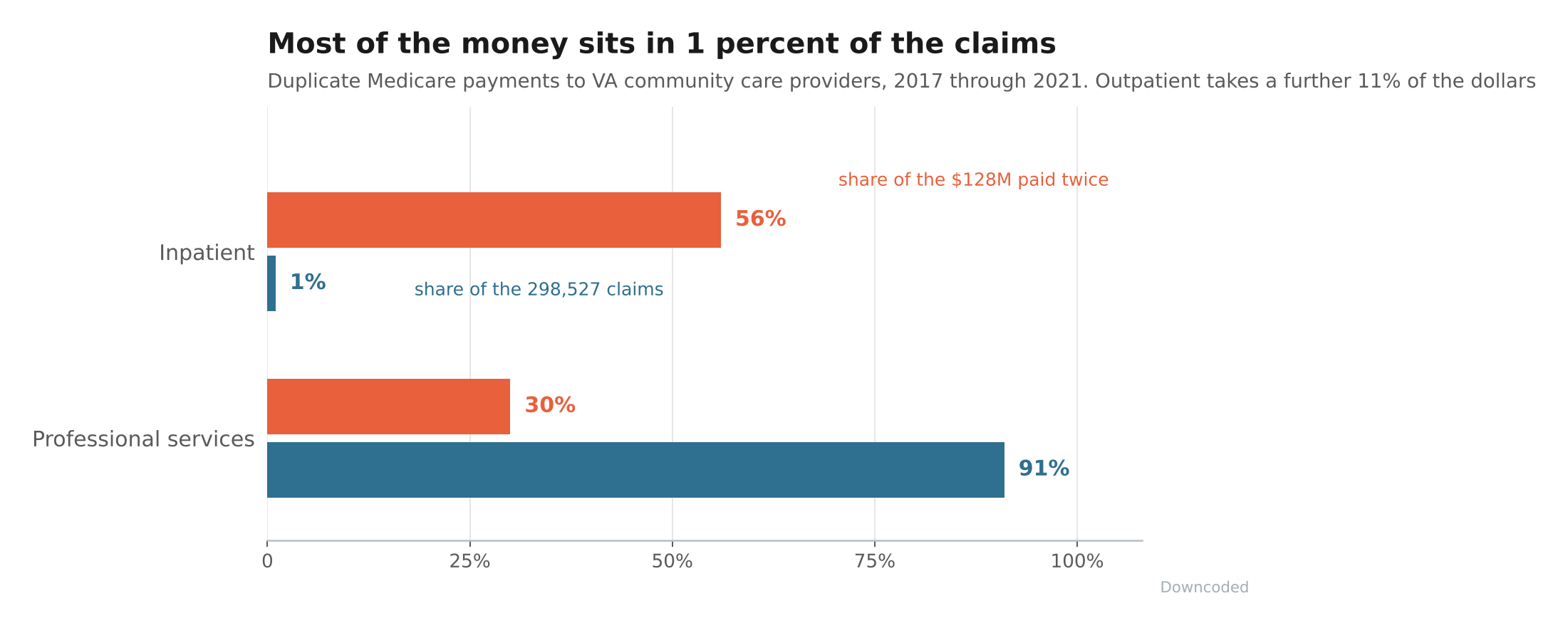
Inpatient services are 56% of the duplicate dollars and 1% of the duplicate claims. Professional services are 30% of the dollars and 91% of the claims, and outpatient takes a further 11% of the dollars.
So a hospital's version of this is a handful of five-figure recoveries, each one worth fighting on its own. A physician group's version is thousands of E/M visits at a couple hundred dollars apiece, where the per-claim arithmetic never justifies an appeal and the aggregate does.
What Actually Crosses the Wire
The notice describes a two-stage exchange. The second stage is the one worth reading.
Stage one is the ordinary enrollment handshake. VHA sends a finder file of every veteran enrolled in VHA health care: VA unique person identifier, SSN, date of birth, name, sex, enrollment dates, date of death.
CMS returns the same identifiers plus the MBI and the Medicare enrollment and termination dates.
Nothing there is new.
Stage two is new. Once both agencies agree on who the dual enrollees are, VHA hands CMS "a file containing medical claims that VHA paid in full or in part" for those people, CMS matches it against its own claims and payment systems, and CMS returns "a response file containing claims that CMS paid in full or in part for the same service."
Read the field list on that second file, because it is yours:
- claim number and claim line
- service date, service type, place of service, revenue codes
- billing provider name and National Provider Identifier
- rendering provider and attending provider
- procedure codes and modifiers
- diagnosis codes and qualifiers
- payment date, amount, units and payment authority
CMS and VHA have run matching programs against each other since at least 2007, so the structure looks routine. The structure is routine. The contents are not.
Pull the earlier notices and every one of them moves enrollment records. The 2010 and 2013 matches with the Health Administration Center sent a list of SSNs against the CMS Enrollment Database to settle CHAMPVA entitlement. The 2013 and 2016 matches sent VHA enrollment data to the Federally-facilitated Exchange to decide whether a veteran held minimum essential coverage and therefore could not take a premium tax credit.
Those ran out of CCIIO's eligibility shop. This one lists its contact as the Division of Medicare Secondary Payer Operations, Office of Financial Management.
That is the money shop, and the only reason that office wants a claim line is to get the money back.

The rest of this brief is for subscribers.
The impact tables, the code-level detail, and the rest of the analysis sit past this line.
$50 a month, or $500 a year.
Already a subscriber? Sign in