 Downcoded
The 65 Cents CTA Chest Needed to Escape Medicare's Imaging Cap
A 2005 statute pays your office the hospital rate on imaging whenever the hospital rate is lower, and the January relative value file quietly drops eleven CT and MRI codes off that list. CT angiography of the chest clears the ceiling by 65 cents, on 112,149 office services a year. The eighteen codes still under it keep $3.07 million more than they did in 2026.
Medicare runs a price ceiling over office imaging that never shows up on a remittance as its own line. The claim just pays less than the fee schedule says it should, and the fee schedule is right.
Section 5102(b) of the Deficit Reduction Act of 2005 built it. For imaging furnished on or after January 1, 2007, if the technical component under the physician fee schedule comes in above the hospital outpatient amount, Medicare substitutes the outpatient amount, geographically adjusted. Mammography is carved out. Everything else in the family (x-ray, ultrasound including echo, nuclear medicine, MRI, CT, fluoroscopy) is in.
CMS published the CY2027 version of that ceiling on November 10, inside rvu27a.zip. It covers 68 HCPCS codes.
In the October file it covered 78.
The Ceiling Is Written in RVUs
Here is the part that makes the cap move in ways nobody tracks. CMS re-expresses the hospital rate in RVUs and runs it through the fee schedule's own machinery.
Three columns of PPRRVU2027_Jan carry a parallel practice expense and malpractice value labeled "used for OPPS payment amount." Run those through the same GPCIs and the same conversion factor as any other code and you get the published ceiling.
We checked it against every line of OPPSCAP_Jan.csv. The reconstruction lands on the published price to the penny on 9,374 of 12,971 rows, and the rest are the global rows of carrier-priced codes, which CMS prints as 0.00.
Two things follow from that.
The ceiling is a fee schedule calculation, so the CY2027 conversion factor cut applies to it too: $33.4009 down to $32.6286, 2.31 percent, on both sides of the comparison. And the substitute RVUs moved up hard enough to swamp it. The technical ceiling that eleven CT codes shared in October was $179.36. In January it is $196.75, up 9.7 percent while the conversion factor fell.
The other tell is the repetition.
Across all 68 codes the national technical ceiling takes only 18 distinct values: $196.75 on eleven codes, $1,524.73 on eleven, $116.48 on nine, $266.58 on seven.
The fee schedule prices procedures. The thing sitting on top of it prices groups.
Eleven Codes Clear It
Eleven codes that were capped in October are simply absent from the January file (chart below). Their CY2027 fee schedule amount now sits under the ceiling, so there is nothing to cut.
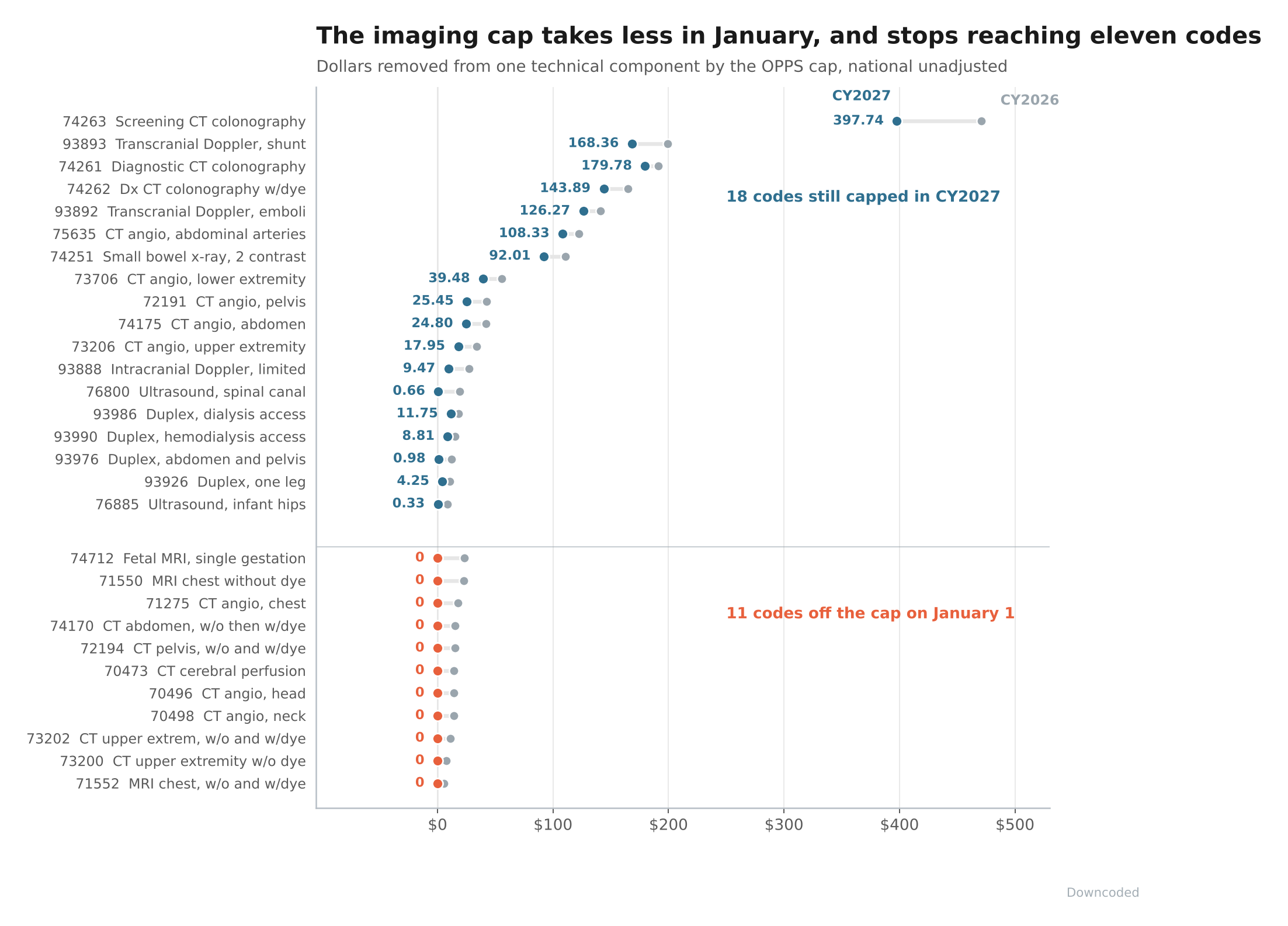
None of them clear it by much.
71275, CT angiography of the chest, prices at $196.10 against that $196.75 ceiling. Sixty-five cents.
MRI chest without dye clears by $1.31. Fetal MRI by $1.96.
CT abdomen, CT pelvis and CT cerebral perfusion all by $3.91, head and neck CTA by $4.57.
Price the relief on real volume and 71275 carries most of it. CY2024 national office utilization was 112,149 services, and the CY2026 cap was taking $17.71 off each one, so $1.99 million a year stops coming out on January 1.
Across the nine escapees with national office rows, 341,379 services and $4.85 million.
What Is Still Under There
Eighteen codes stay capped, and they are where the real money is.
Hold CY2024 office volume constant across the sixteen with national office rows and the cap takes $9.38 million at CY2027 rates, against $12.45 million at CY2026 rates. Practices keep $3.07 million of it without filing anything.
Nearly half of what remains is one code. 93892, transcranial Doppler emboli detection, ran 35,324 office services in CY2024, and the cap removes $126.27 from each: $4.46 million.
The deepest single cut is 74263, screening CT colonography, which Medicare has covered since January 1, 2025 with coinsurance and deductible waived.
The fee schedule prices its technical component at $664.32. The ceiling pays $266.58.
That is $397.74 gone, 59.9 percent, and it ranges from $228.61 to $385.70 depending on which of the 109 localities the scanner sits in.
One more thing worth knowing at the claim level: the dollar the cap removes is the same whether the code goes out global or TC-only, to within a penny of rounding. The cap swaps practice expense and malpractice and leaves the work RVU alone, so the professional component rides through untouched.
Final Thoughts
Nobody is going to send a bulletin about this. The cap has no effective date of its own, no transmittal, no comment period: it is a comparison that runs every January when the two rate books get re-stacked, and the only published artifact is a CSV inside a ZIP file.
Which is the whole reason eleven codes can walk out from under a statutory ceiling by a median of $3.91, and the practices billing them will see a slightly better January and never know why.
Worth a look at your own imaging mix before somebody attributes it to the conversion factor.
Thanks for reading.