 Downcoded
The Benchmark You Are Allowed to Bring to IDR
FAIR Health said in August that its allowed-amount data can be put in front of a certified IDR entity. The federal rule bars the three benchmarks a billing office reaches for first, and the nonprofit's free public site already shows the 20th through 90th percentile of what plans actually pay.
A nonprofit at 800 Third Avenue in Manhattan holds 52 billion healthcare claim records, and it will show you the local price distribution for a procedure code on a public website that asks you for nothing.
That is FAIR Health, and on August 3 it published something that matters more to a revenue-cycle department than another cost-lookup feature. Its NSA and allowed-amount data products, it said, may be submitted by either side for consideration by certified independent dispute resolution entities in the federal No Surprises Act process, and those entities may consult the same data to check what the parties filed.
Worth understanding why that sentence is not trivial.
The three benchmarks you cannot use
Read 45 CFR 149.510(c)(4) and the shape of an IDR case gets clear fast. The certified IDR entity must start from the qualifying payment amount for the same or similar service. It must then weigh five enumerated circumstances: training and outcomes, market share, patient acuity, teaching status and case mix, and good-faith network efforts along with your contracted rates with that plan over the previous four plan years.
Then subparagraph (D), which is the part people miss. The entity must also consider any other credible information a party submits that relates to the offer.
Here is the catch. That door has a wall next to it (chart above).
Under (c)(4)(v), the entity must not consider usual and customary charges, the amount you would have billed absent the balance-billing protections, or any public payor rate, with Medicare, Medicaid, CHIP and TRICARE named explicitly.
So the three numbers sitting closest to hand in any billing system are the three that cannot be weighed.
Your charge master is out. A percentage of Medicare is out. UCR is out.
What providers have been submitting instead
The Departments answered that question themselves in the supplemental background released with the second-half 2025 public use files. Plans, they wrote, often benchmarked their offers to the QPA. Providers, facilities and air ambulance services often benchmarked to past out-of-network payments from the disputing plan and to past in-network rates, either with that plan or with a different plan in the same state.
Which is to say: your own file. Whatever your organization happened to negotiate, in whatever year, with whoever was across the table.
That works until the case turns on whether the number is representative, and (c)(4)(iii)(E) tells the entity to discount information already accounted for by the QPA. A national distribution of contracted rates for the same code in the same geography is a different kind of evidence, and it is not on the prohibited list.
The docket this lands on
Certified IDR entities rendered 1,145,039 payment determinations in the last six months of 2025 alone, against 1,082,247 in the first half, on 1,372,563 disputes initiated (chart below). Emergency department services were 52% of determinations, radiology another 15%.
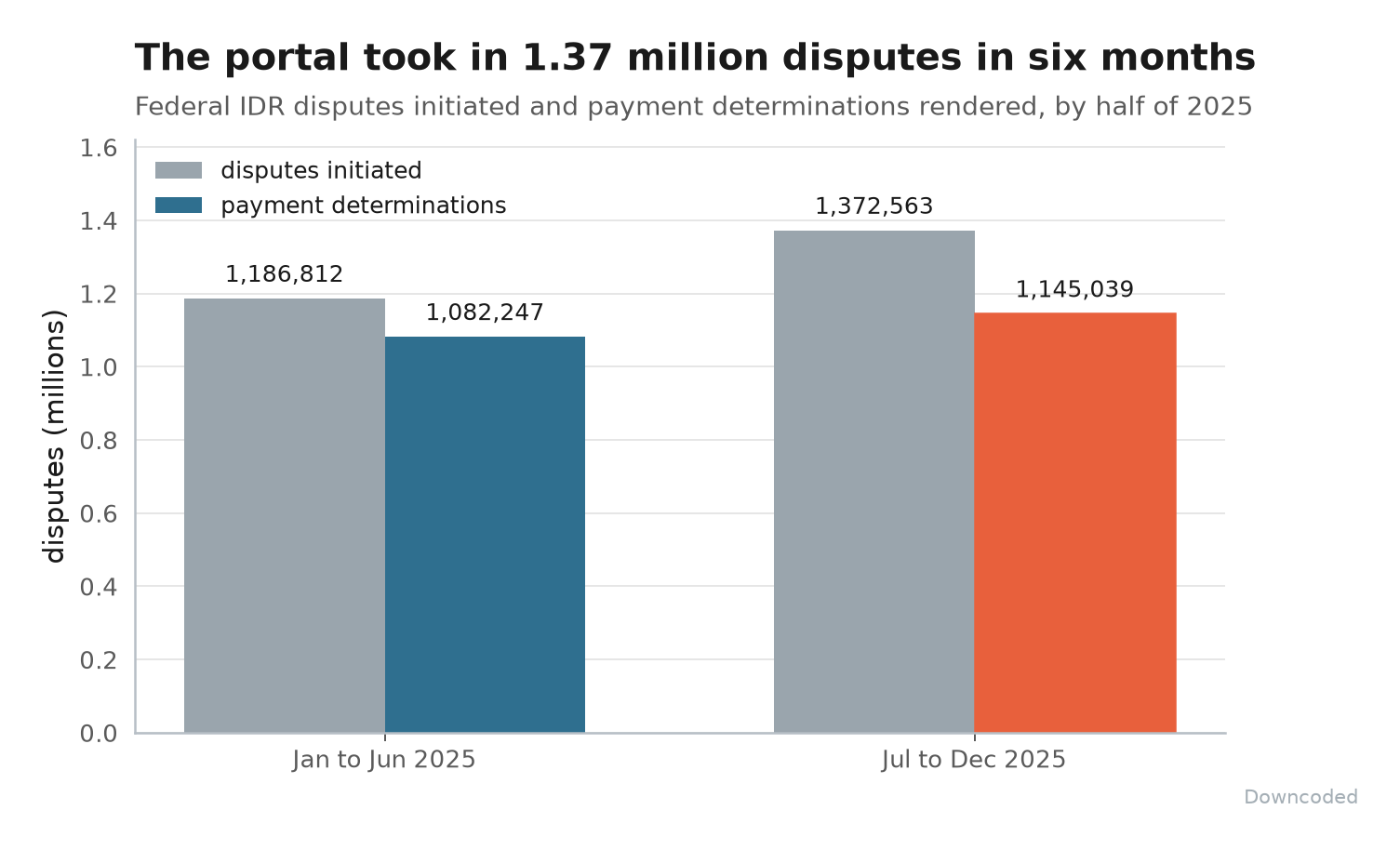
Providers, facilities and air ambulance services prevailed in roughly 85% of those determinations, down from 88% in the first half, and 84% of the ones that were actually contested rather than decided by default. The prevailing offer came in above the QPA 87% of the time.
Every one of those is a written decision that has to explain why the information relied on was not already reflected in the QPA. That explanation is where an outside benchmark earns its keep.
The part that reads as credible
FAIR Health also offers a set of benchmarks built on provider-billed amounts, FH Charge Benchmarks. In the same announcement, it says plainly that the NSA does not permit those in IDR, and that parties need to be licensing the NSA Reference File or the Allowed Benchmarks instead.
An organization telling you which of its own products you may not buy for this purpose is a useful signal about the rest of what it says.
The structure behind that: FAIR Health is a 501(c)(3) public charity, describes itself as conflict-free, is a CMS-certified national Qualified Entity that receives traditional Medicare Parts A, B and D claims from 2013 forward, and runs HITRUST CSF and SOC 2 certified systems for the claim data health plans send it. States have designated it an official data source for workers' compensation, personal injury protection, and surprise-billing programs.
What costs nothing
The consumer site is free, in English and Spanish, no login. Since a May release it carries sliders that run the 20th through 90th percentile for a procedure in your local area, and it shows charge amounts and allowed amounts separately, where the allowed amount is the full contracted fee including the member's share.
Cost data refreshes twice a year across 10,000-plus services.
That is not a licensed benchmark file and it will not go in an IDR submission. It is enough to sanity-check whether an offer on your desk sits near the middle of local contracted rates or well below it, before anyone pays a fee to find out.
The free quarterly telehealth tracker is the other one worth a bookmark, published by census region with claim-line share, urban and rural split, and top diagnostic categories by age band.
Final Thoughts
The IDR rules were written to keep the fight off billed charges and off Medicare, which left the process leaning hard on the QPA that plans calculate themselves. Independent contracted-rate data is the counterweight the statute implies and never names.
We looked at the IDR clock a month ago and found the timeliness numbers finally moving. The evidence question is the slower one, and it is where the dollars actually live.
Thanks for reading.