The Case-Mix System Medicare Told Reviewers to Keep Using
CMS rewrote the home health chapter of the Program Integrity Manual on September 30, six and a half years after the CARES Act let nurse practitioners and PAs certify. The same transmittal quietly swapped HHRG for PDGM in the coding instruction, a line that had been pointing at a retired payment system since January 1, 2020. The summary of changes does not mention it, the one business requirement goes to a single contractor type, and provider education is listed as none. Effective November 2.
Until November 2, the manual that tells Medicare's review contractors how to audit a home health claim instructs them to check whether the Home Health Resource Group codes billed were accurate and appropriate.
HHRG stopped being how Medicare pays for home health on January 1, 2020.
The instruction outlived its payment system by 2,497 days, and it is still the live text on cms.gov this morning. Transmittal 13972, issued September 30 under Change Request 14627, finally replaces it.
What the transmittal says it is doing is something else entirely.
"How long can a review instruction point at a payment system that no longer exists?"
The Fix Nobody Put in the Summary
The summary of changes runs one sentence: the purpose is "to update the Home Health sections of chapter 6 of the PIM (Pub. 100-08) to reflect section 3708 of the Coronavirus Aid, Relief, and Economic Security (CARES) Act." That is the allowed-practitioner change, and it is real.
The word PDGM appears nowhere in it.
Open the attached manual instruction and section 6.2.4 Coding reads nothing like the chapter sitting on cms.gov right now. Four things moved, two of them inside that one subsection:
- "Home Health Resource Group (HHRG) codes" becomes "Patient-Driven Groupings Model (PDGM) codes."
- "the web regrouping program provided by CMS" becomes "the Home Health Prospective Payment System Grouper provided by CMS."
- Over in 6.2.3, "the Form 485/Plan of Care" loses the Form 485.
- Across 6.2.1 through 6.2.6, the word "episode" drops from seven appearances to three.
None of that is in the summary of changes.
None of it is in the business requirements table either, which carries exactly one row: contractors shall accept documentation from an NP, a CNS, or a PA. The single X in the responsibility grid sits in the A/B MAC HHH column and nowhere else.
Provider education: None. Impacted contractors: None.
So a chapter that governs how your home health claim gets reviewed had its case-mix vocabulary corrected inside a change request about practitioner credentials, with no requirement attached and nobody told.
The October 1 MLN Connects, the first edition published after the transmittal issued, does not mention it. We grepped the whole thing for 14627, 13972, "Program Integrity," "allowed practitioner" and PDGM.
Zero hits on all five.
Eleven Years Is a Long Time to Leave a Chapter Alone
The revision stamps explain how this happened.
Six of the eight revised subsections were last issued on July 21, 2015, under Rev. 603. Two more sat at Rev. 704 from March 2017, and one at Rev. 870 from March 2019.
Section 6.2.4, the coding instruction, is a Rev. 603 section. It was written for the 60-day episode and the HHRG grouper.
Nothing touched it while CMS moved the entire benefit to 30-day periods, rebuilt the case mix, and ran five years of behavior-change adjustments on top.
That chapter is live. It is the medical review guidance for a service line where CMS projected $1,070,619,633 in improper payments on a 6.9% error rate in the 2025 supplemental improper payment data, and almost all of what the chapter talks about is documentation (chart below).
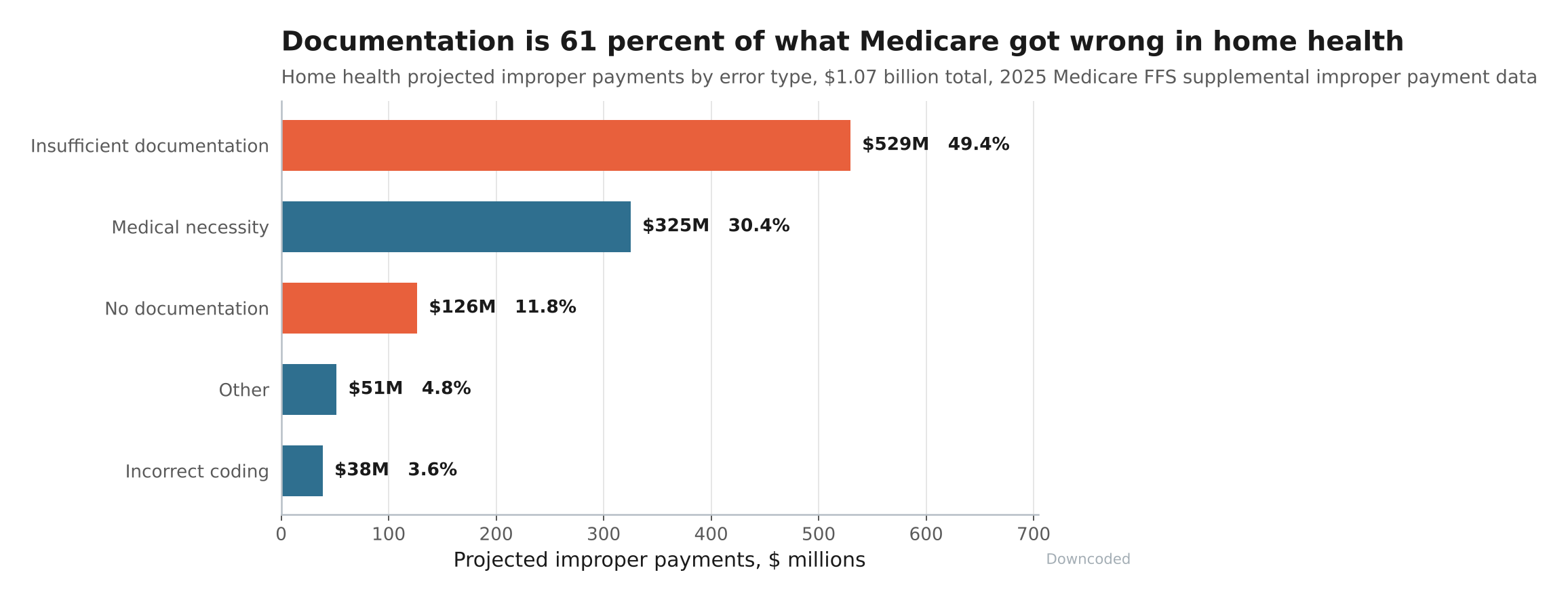
Insufficient documentation is 49.4% of that pool and no documentation another 11.8%, so 61.2 cents of every improper home health dollar turns on exactly what sections 6.2.1, 6.2.3 and 6.2.5 tell a reviewer to go look for. Incorrect coding is the smallest slice at $38,478,623, and 6.2.4 is the subsection that was pointing at the wrong grouper.

The rest of this brief is for subscribers.
The impact tables, the code-level detail, and the rest of the analysis sit past this line.
$50 a month, or $500 a year.
Already a subscriber? Sign in