 Downcoded
The Chest Brace That Talked CMS Into a New Code
CMS decided 49 HCPCS Level II applications out of the June public meeting and published every argument on both sides, including the one that moved a chest brace off a non-covered supply code and onto a new L code effective October 1. The record spells out the test. One applicant met it in writing, and another one did not.
"What actually moves CMS off a code you don't want?"
CMS answered that on August 14, in a 155-page PDF, and mentioned it to the industry six days later in a one-paragraph MLN Connects item.
The document is the 2026 HCPCS Application Summary for Biannual 1, 2026 Non-Drug and Non-Biological Items and Services. It carries every Level II code application decided out of the June 1 public meeting: what the applicant asked for, what CMS proposed, what the public said back, and what CMS finalized.
Entry by entry, in CMS's own sentences.
Every new coding action in it takes effect October 1, 2026.
What Is Actually In It
Fifty-two agenda entries. Forty-nine of them are coding determinations, and the other three are the standing "not otherwise classified" topic, one request to reprice an existing code, and one carryover benefit-category item from last year's cycle.
Of the 49, 22 ended in a new code and 17 got pointed at a code that already existed (chart below). Six drew the sentence "CMS has not identified a program operating need," which means no code at all.
Seven of the 17 landed on A9270, "Non-covered item or service."
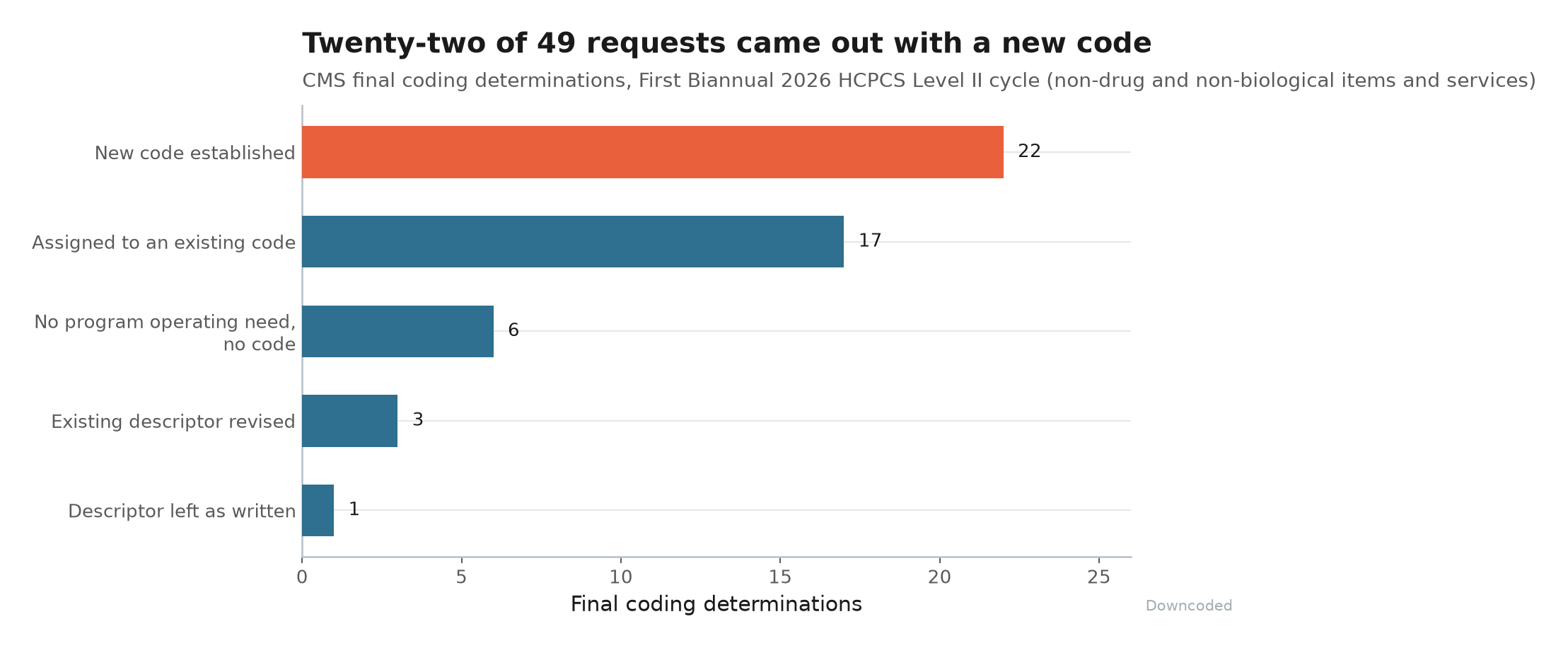
The 22 new-code determinations collapse to 15 distinct codes, because families share one: eleven applications for NeuRx Diaphragm Pacing System components produced a single code, L8697, for eight of them and nothing for the other three, and L8696 gets discontinued in the same paragraph. L1971's descriptor is rewritten to say "trimmed, bent, molded, assembled, or otherwise customized to fit a specific patient by an individual with expertise," with new code L1972 taking the off-the-shelf version.
If you keep an HCPCS crosswalk, that is your October 1 diff, published seven weeks early.
The Brace That Won
Vive Health, LLC asked for a new code for the CoreTech sternocostal orthosis, a semi-rigid chest wall brace for costochondritis. It is a class I device, exempt from FDA premarket notification.
CMS's preliminary answer was A4467, "Belt, strap, sleeve, garment, or covering, any type."
The preliminary payment determination read: "Items or services described by HCPCS Level II code A4467 are not covered under Medicare Part B. No Medicare payment. Pricing Indicator = 00."
That is the whole ballgame for a supplier. Zero.
So they showed up and argued, and the record prints the argument. A4467, the commenters said, "does not adequately describe the CoreTech device's semi-rigid structural components, specific anatomical targeting, and orthotic function." They walked CMS through a three-point force mechanism: force over the sternum, counterforce applied posteriorly, stabilization through the strap system. They named the anterior panel material, polypropylene, and why it was chosen.
CMS revised. Final determination: establish new code L1330, "Thoracic orthosis, sternal and/or sternocostal compression, may include anterior and/or posterior pads, panels, with or without frame, prefabricated, off the shelf."
Benefit category, Back Brace (Orthotic). Payment, local fee schedule amounts set by the DME MACs, pricing indicator 46.
A product headed for a non-covered supply code came out of the cycle as an orthosis with a benefit category behind it.
The Same Code, The Other Way
Later in the same document, Moveo SRL appealed a prior determination that had put its ExoBand gait device in that identical A4467 bucket, asking to be moved to L2999.
CMS said no, and then said exactly why: "The materials and studies provided do not show that the device performs structural orthotic functions such as joint stabilization, controlled alignment, application of a three-point pressure system, or delivery of corrective forces at a specific joint."
Read those two entries back to back and the test stops being a mystery. The question CMS is answering is what the thing is made of and what forces it applies, at which joint.
CoreTech's comment answered that question in those terms. The appeal answered a different one.
CMS revised its own preliminary call 5 times out of 49 this cycle. Two of the five followed public comment, and the other three changed with no comments on file at all.
The Part Nobody Mines
The summaries also carry numbers CMS has not put anywhere else.
Buried in a request to reprice the gradient compression glove code is CMS's own count: as of December 31, 2025, over 130,000 Medicare beneficiaries had received a lymphedema compression treatment item, 6,372 of them a glove under A6581, at a 94.3 percent assignment rate, which CMS notes puts the code in the benefit's top ten. That is real utilization on a two-year-old benefit, published in a coding PDF.
Elsewhere, the average 2026 fee schedule amount for L8030 sits in plain text at $430.74, described as the average across the 50 states, DC, Puerto Rico, and the Virgin Islands.
Both cycles are archived back to 2022 on the same page. Anyone may file, the deadlines are the first business day of January and July, and the January filings land effective October.
Final Thoughts
Coding fights usually reach you as a vendor's letter asserting that a product has a code, or a denial saying it does not. The June cycle already settled dozens of those in writing, with the losing arguments printed next to the winning ones, weeks before the codes go live.
A brace company read the room correctly and got L1330 out of it. The reasoning that worked is sitting in a public PDF, and so is the reasoning that did not.
Thanks for reading.