 Downcoded
The Contracts That Ask the Most Say No the Least
UnitedHealthcare's first filing under the CMS prior authorization transparency rule covers 8.6 million requests across 63 Medicare Advantage contracts. The blended denial rate is 12.9%. The contract-level rate runs from 1.9% to 23%, and the spread has a mechanism behind it.
If you quoted a UnitedHealthcare Medicare Advantage denial rate in a meeting this week, you quoted a blend of sixty-three different numbers.
That became checkable this spring. Under 42 CFR 422.122(c), every MA organization had to post its prior authorization metrics at the contract level by March 31, covering the previous calendar year.
UnitedHealthcare's CY2025 filing is a twelve-page PDF covering 63 H-contracts and 8,593,632 prior authorization requests.
The blended answer is 87.10% approved on initial review and 12.90% not approved.
Now the part the blend hides.
Two contracts, almost the same size
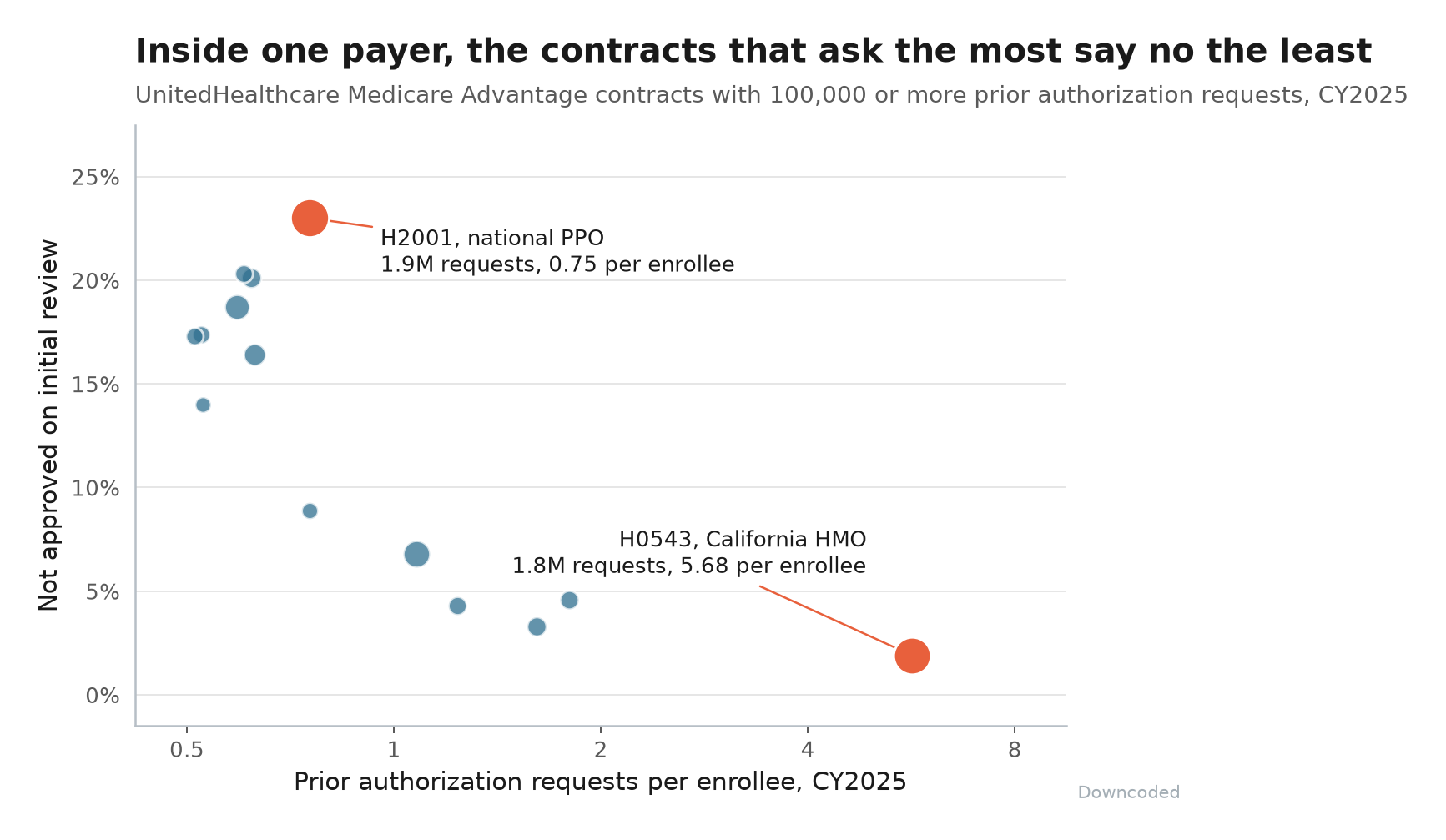
H2001 is the national PPO, 2,559,446 enrollees across 52 state-level jurisdictions in July 2025. It ran 1,928,959 prior authorization requests last year and did not approve 23.0% of them.
H0543 is a California-only HMO with 313,819 enrollees. It ran 1,780,998 requests, within 8% of H2001's volume, and did not approve 1.9%.
Same payer, same year, same reporting template, and a twelve-fold gap in the rate.
Across the fourteen contracts that carried at least 100,000 requests, which is 88% of the total, the shape is orderly (chart below).
Every contract running one or more requests per enrollee landed at 6.8% not approved or lower. Every contract running fewer than one landed at 8.9% or higher.
What that rate is actually measuring
H0543 put 5.68 requests through prior authorization for every member it covered. H2001 put through 0.75.
A contract that routes nearly everything through review approves nearly everything it reviews. A contract that routes only the contested cases through review turns down one in five.
The denial rate is mostly telling you how wide the gate is, and only secondarily how hard it is to get through.
Some of that width is delegation, to be fair. UnitedHealthcare's filing says the counts include requests submitted to capitated-delegated providers and to behavioral, physical and dental health delegates where applicable, and a California HMO is exactly where that applies. Enrollment here is a July 2025 snapshot against full-year request counts, so read requests per enrollee as an intensity indicator rather than a per-member rate.
The same distinction explains the gap between the filing and the marketing. UnitedHealthcare's landing page reports 95.4% of prior authorizations approved; the footnote says that number excludes delegated requests and post-acute transitions and counts approvals after appeal. The filed contract tables include the delegated and post-acute volume, and they come to 87.84% approved initially or on appeal. Each figure is accurate about the population it covers, and only one of them is the population your claims live in.
The appeal nobody filed
Of the 1,108,384 requests not approved on initial review, 63,314 were approved after appeal. That is 5.7% of denials overturned.
The filing publishes overturns as a count and as a share of appeals filed, so the appeal volume backs out to roughly 109,600 appeals against 1.1 million denials. About one denial in ten was appealed, and roughly 58% of the appeals that were filed ended in an approval.
Those two figures are derived off percentages published to one decimal place, so treat them as close rather than exact.
Expedited review is its own animal: 651,232 requests at 6.08% not approved, against 13.46% on the 7,942,400 standard requests. Median time to determination ran half a day expedited and 1.9 days standard.
Final Thoughts
The move here is small and mechanical. The H-contract number sits on every MA eligibility response and every remit you already receive.
Pull the contracts that make up your top payer mix, look each one up in the filing, and staff prior authorization against the ones that actually deny instead of against a national average that belongs to no plan in particular.
CMS wrote the contract-level requirement into the rule rather than settling for a company-wide figure, and 2026 is the first year anyone outside the payer can check the work. By next March there will be two years of it, and any contract whose rate moves will have to account for the move in its own published numbers.
Thanks for reading.