 Downcoded
The Grouper You Keep Rebuilding Already Exists
CMS quietly maintains a taxonomy that sorts all 17,174 Part B HCPCS codes into clinical service lines, re-argued every year by a panel of clinicians and researchers. The 2026 release posted August 21, it added exactly one new category, and 265 of the codes in it used to be DME.
Every analytics team in this industry has built the same spreadsheet. A tab that maps HCPCS codes to something a CFO recognizes: imaging, labs, E&M, wound care, supplies.
Somebody built it in 2019, somebody else patched it when the Q-codes multiplied, and now it lives in a workbook nobody wants to own.
CMS maintains that mapping. It covers 17,174 Part B HCPCS codes, a technical expert panel of clinicians and researchers re-argues the assignments once a year, and the newest release posted August 21.
It is called the Restructured BETOS Classification System, which is a large part of why you have never used it.
What Is Actually In There
The original Berenson-Eggers Type of Service classification dates to the 1980s. The restructured version is the modern rebuild, extended to Part B non-physician services, and it is free on data.cms.gov as a single CSV.
Three levels, coarse to fine: 8 categories, 54 subcategories, 236 families.
The categories are the ones you would draw yourself if someone handed you a whiteboard: Procedure, Test, DME, Treatment, Imaging, E&M, Anesthesia, Other. Procedure carries 6,880 codes, Test 2,916, DME 2,522.
Under those sit the subcategories that do the real work, and every procedure code also carries a major/minor indicator, so global-period questions and service-mix questions can use the same join.
Every code gets exactly one current assignment. Which is the part that makes it usable, and also the part that creates the problem worth knowing about.
"When a service line moves year over year, was it the volume that moved or the grouping?"
The One New Aisle This Year
Release year 2026 added a single new subcategory. It is called Skin and Soft Tissue Substitutes, and 348 codes now sit in it.
265 of them were classified as DME in the prior release, in a family called Skin Allograft, under Medical/Surgical Supplies (chart below). Another 66 are new HCPCS codes with no prior assignment at all, and 16 came over from the Skin Grafting family on the Procedure side.
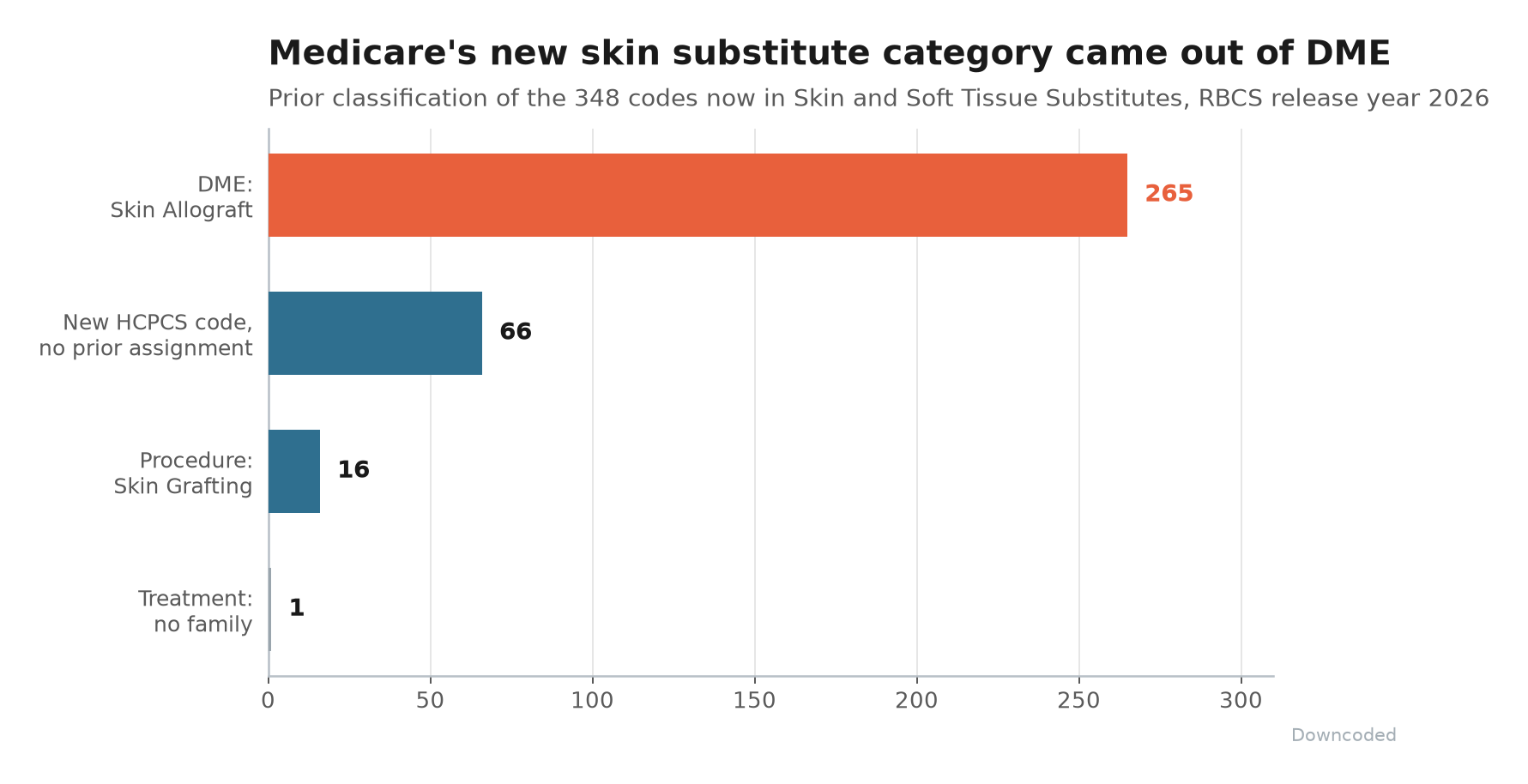
The old Skin Allograft family retains 5 codes. Of the movers, 235 are Q-codes.
So the taxonomy pulled skin substitutes out of supplies and gave them their own service line under Treatment, in the same year the payment side moved underneath them.
That timing is worth sitting with. CMS put Part B non-facility spending on these products at $252 million in 2019 and over $10 billion in 2024, a nearly 40-fold run, and the CY 2026 Physician Fee Schedule final rule (90 FR 49266) started paying for them as incident-to supplies on January 1 at a single rate of roughly $127.28.
A line item that grew fortyfold, got repriced, and now has its own drawer in the national service taxonomy.
The same release also cleaned up the pandemic scaffolding: 114 codes left the Vaccine - Toxoids family for a new Vaccine Product family, and 46 COVID-19 vaccine administration codes folded into a general Vaccine Administration family.
It Keeps The Old Answer Too
Here is the design choice that earns this file a place in your pipeline.
The CSV carries 20,081 rows for 17,174 codes. The extra 2,907 rows are superseded assignments, kept on file with a flag marking which one is current and a column recording the release year each assignment first appeared.
Code A2001 is the clean example. One row puts it in DME, Skin Allograft, first assigned in 2023.
The next row puts it in Treatment, Skin Substitute Products, first assigned in 2026. Both ship in the same file.
2,643 codes have been reassigned at least once since 2020. Two hundred thirty-three have carried three assignments, and two have carried four.
That means a five-year skin-substitute trend is a choice you get to make on purpose. Join to the current assignment and your 2022 spend restates into Treatment; join to the assignment that was published at the time and it stays in DME.
Most home-grown groupers make that choice silently, and usually in whichever direction the last person to edit the workbook happened to pick.
Final Thoughts
Nobody is going to bill a claim differently because of this file. It never touches a remittance.
What it does is settle arguments. When a service-line report moves and the question in the room is whether that is real, a national taxonomy with a published change history is a better answer than the workbook, and it costs nothing to adopt beyond the join.
1,209 assignments are new in this release. Somewhere in there is the reason one of your categories looks different this year than it did last year.
Thanks for reading.