 Downcoded
The IDR Gateway Wants Your Open Disputes Claimed by November
CMS opened account creation for the IDR Gateway on September 15 and shipped the file-validation rules the same month: one CSV, 50,000 records, confirm or deny ownership of every open dispute your organization started before the new system existed. Confirmed disputes become processable in the Gateway by mid-November, and the legacy web forms stop working outside it after January 15.
CMS published a CSV template for the new system with a validation rule stapled to it: one file, no duplicate disputes, 50,000 records maximum, 5MB ceiling.
That is the limit on how many open Federal IDR disputes one organization can claim in a single upload. Somebody sized that number against real dispute books.
The template belongs to the IDR Gateway, the platform the Federal IDR process moves onto in late 2026. Account creation opened September 15, and the technical guidance carries the same date.
What Signing In Buys You
Today the process is a run of single-use web forms. You submit one, you get an email back, and the state of the dispute lives in whatever spreadsheet your team built around it.
The Gateway gives the disputes an owner instead. Sign in through a credential service provider, join an organization, and the platform supports five things:
- starting and responding to disputes
- dispute dashboards and reports scoped to your organization
- tracking a dispute, including which certified IDR entity holds it
- watching assigned disputes by process phase
- in-system notifications on dispute activity, alongside the emails you already get
Access comes in two types, verified and administrator, and an organization runs on 2 to 10 administrators depending on its size. Administrator invitations expire in 10 business days.
The role design is the part worth reading twice. There are three: View Only, which reads everything and submits nothing; Full Access, which does both; and Initiation and Selection, which can file initiation, entity selection and reselection forms while it cannot submit offers or see outcomes.
That middle role is a separation of duties somebody who has run a dispute desk asked for. The staffer who files can be walled off from the number.
Workspaces do the same job at the dispute level. They scope what a user sees by the Initiating Party or Non-Initiating Party email on the dispute, deliberately not the primary or secondary contact fields, so a shop processing for multiple clients can wall each client's book off from the others.
The Dates Doing the Work
Here is the catch for anyone with disputes already in flight. The Gateway only knows a legacy dispute is yours if you tell it.
"Which of these open disputes are actually ours?"
CMS matches open disputes started outside the Gateway before mid-September 2026 against the email addresses registered to your organization, and hands administrators a Dispute Email Matching Report.
You confirm or deny each row against internal records, one at a time or through that 50,000-row CSV. Deny one and the assigned certified IDR entity has to review and validate the denial.
Confirmed disputes become processable inside the Gateway by mid-November 2026.
Mapping is optional, and the honest reading of optional here is that unmapped disputes never show up in the dashboards or reports. They stay reachable through the unique links CMS emails, which is exactly the workflow you have now.
The forms themselves have a harder date. Legacy web forms stop being available outside the Gateway after January 15, 2027, with a carve-out for the resubmission form for a Notice of IDR Initiation.
CMS put it plainly in the September guidance: transition as soon as possible.
Two pieces are staged behind later notices. Open negotiation functions are out of scope for the initial rollout, and the IDR Registry, the piece that will finally make payers findable by name, is not live yet.
When it does go live, plans, issuers and FEHB carriers get 90 business days to register.
The Number All of This Is Aimed At
Federal IDR has taken 7,048,593 disputes since April 2022, and 394,140 of them arrived in July 2026 alone, up 24% from June.
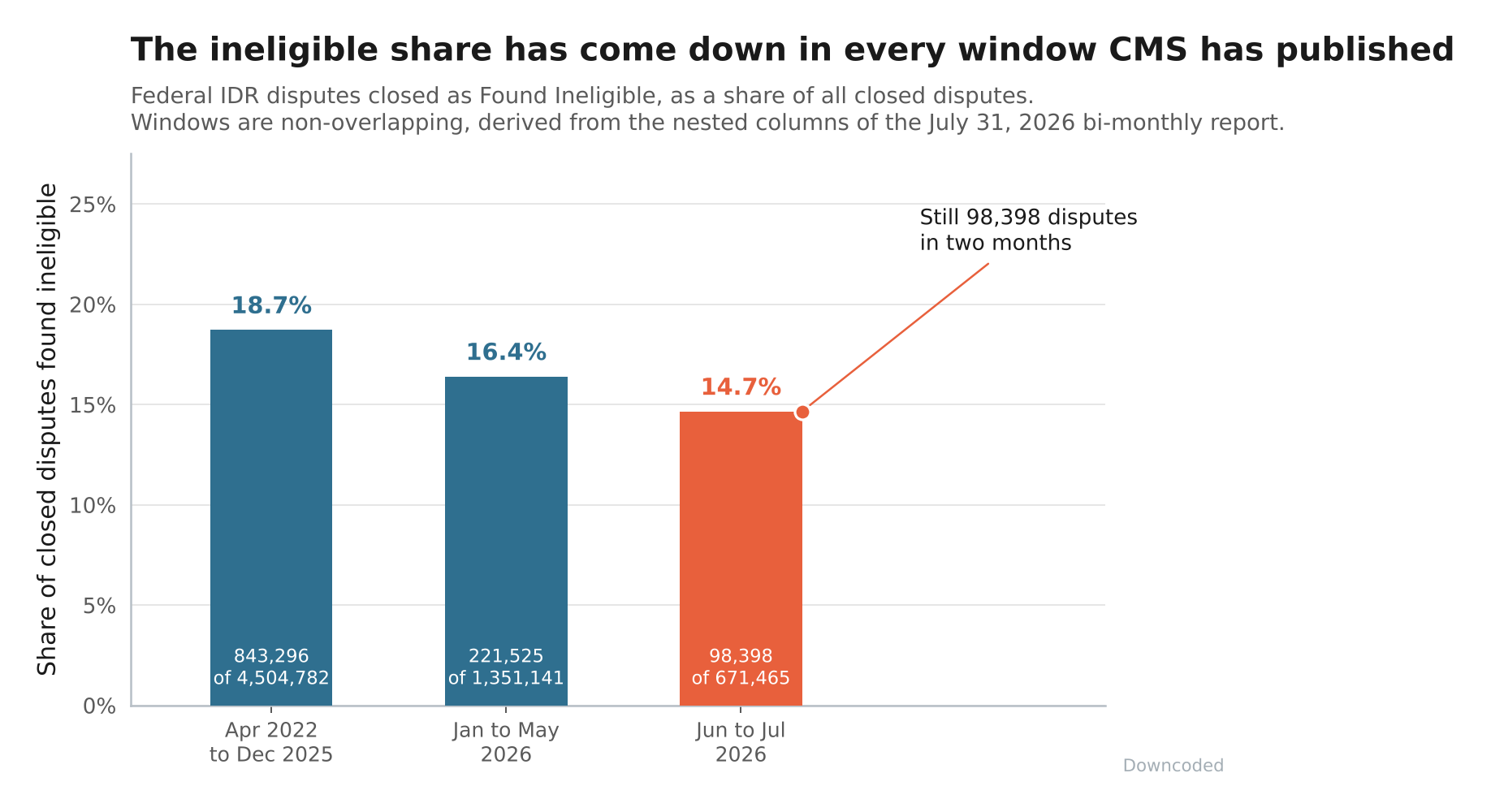
Of the 6,527,388 closed through July 31, 1,163,219 closed as found ineligible. No payment determination, no decision, just a dispute that never should have been filed the way it was filed.
The share is falling in every window CMS has published, from 18.7% to 16.4% to 14.7% (chart below), and that last window is still 98,398 disputes in two months.
Ineligible disputes head the list of issues users raised when CMS convened all 17 certified IDR entities on October 1, with Administrator Oz and Labor's Daniel Aronowitz in the room. The alert out of that meeting named the Gateway as the next step.
Dashboards, email-scoped workspaces and a searchable payer registry are unglamorous answers to that. They are also the right ones.
A dispute filed against the wrong entity with the wrong contact is an eligibility failure manufactured upstream, and the fix for it lives in the plumbing.
Final Thoughts
Since April 2022 this process has run on forms that forgot you the moment you hit submit. The replacement is a system that remembers which disputes are yours, who on your team may touch them, and what phase each one sits in.
Treat the mapping exercise as a reconciliation rather than a chore. The Dispute Email Matching Report is the first time CMS has handed your organization its own open book in a single file, and comparing that file against your internal tracker will surface disputes neither side knew were orphaned.
Do it before mid-November, when the confirmed ones come online.
Thanks for reading.