 Downcoded
The Nudge in Your EHR Is Now a Query
AHIMA and ACDIS rewrote the compliant query practice brief on September 1 and published it free. The 2026 edition pulls prompts, nudges, advisories and AI-drafted query language inside the compliance line, hands accountability for all of it to the organization rather than the vendor, and tells external reviewers the brief is not a basis for denying a claim.
If anything in your EHR surfaces a named diagnosis to a physician mid-note, you are running a query program. Whether or not anyone on your org chart calls it that.
That is the position AHIMA and ACDIS took on September 1, when they released the 2026 update to Guidelines for Achieving a Compliant Query Practice and put it on the internet for free.
Thirty-two pages. No login, no account, no membership, no terms click-through. We pulled it this morning with one curl.
What Counts as a Query Now
The 2022 edition already said technology-generated queries had to meet the same standards as any other. It said so in 205 words, then pointed readers at a separate white paper.
The 2026 edition gives the subject a numbered section and 875 words, and it opens by naming the things people call something other than a query.
"Technology-generated or automated queries, including those referred to as prompts, nudges, advisories, alerts, or similar terms, must include all elements of compliant query practice outlined in this brief."
Then comes the test, which is the sentence to put in front of your compliance committee. A communication is a query when it "presents a provider with a specific diagnosis or documentation option for consideration in connection with a specific patient encounter, regardless of how the communication is labeled or where it appears within the technology platform."
Passive decision support that surfaces reference material sits outside the line. Anything that points a provider at a named diagnosis for a named patient sits inside it.
And where you cannot tell, the brief says treat it as a query.
The tool classes are named without euphemism: CAPD running live during the encounter, CAC working the record afterward, large language models and generative AI platforms "drafting or delivering query language," and EHR-integrated advisories and alerts.
The definitions section then does the thing your vendors will notice. A query professional now includes "any vendor or technology platform acting in a query-generating capacity on behalf of a covered organization."
Which does nothing to move the exposure off your desk:
"Organizational process owners retain accountability for every query delivered to a provider, including those generated through automated or AI-assisted processes."
And, for anyone sitting in a renewal cycle this quarter: "Organizations should not assume that a vendor-supplied or EHR-integrated tool produces compliant queries by default." Where there is no human review before delivery, the brief asks for structured auditing of the tool's output on a regular basis.
Where the Extra Pages Went
Four topics carry a standalone section of the same name in both editions. The rewrite landed almost entirely on one of them (chart below).
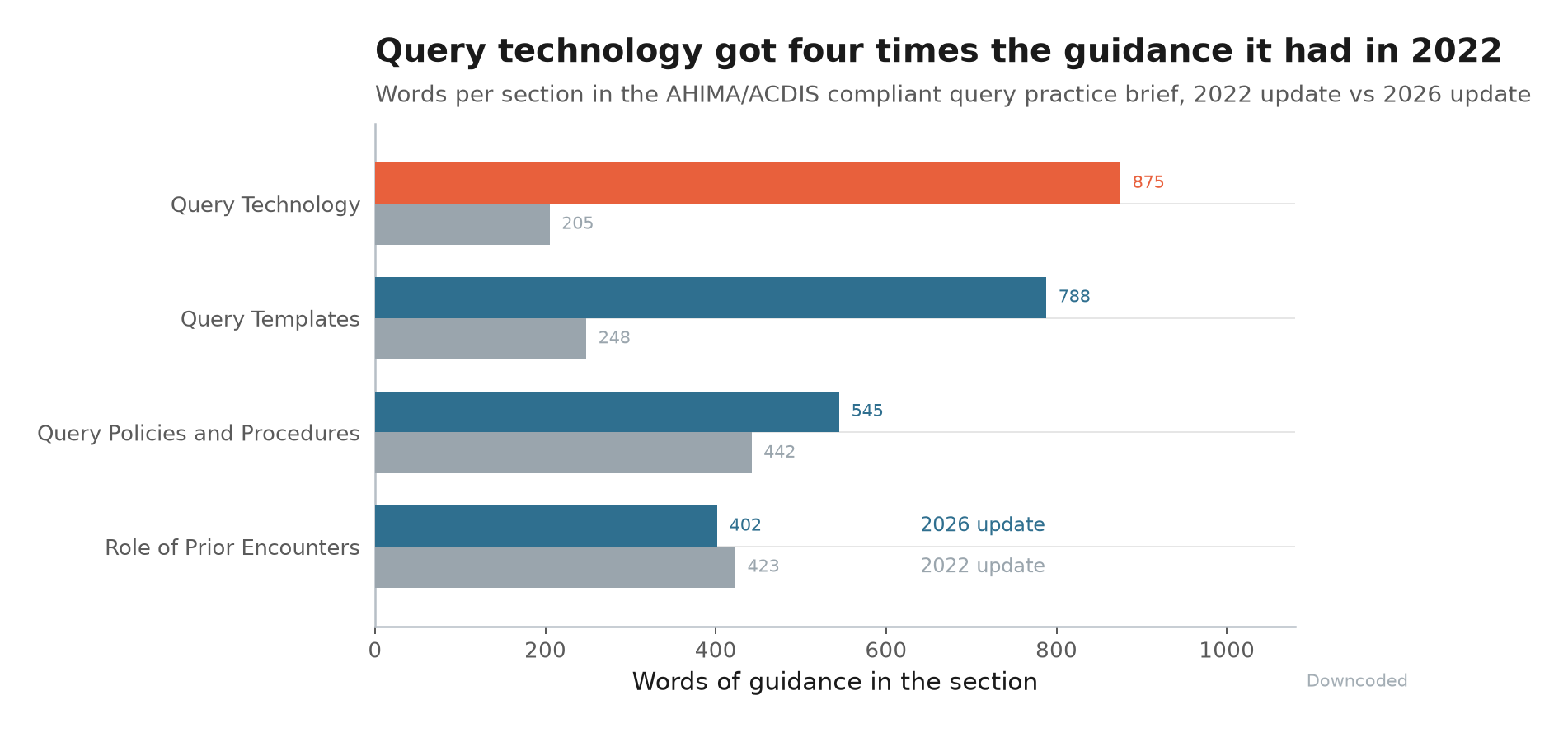
Query Technology grew more than four times over. Role of Prior Encounters came out roughly the size it went in, 402 words against 423, though its content moved: the 2026 text draws a line between a legitimate review of prior records and "systematically searching prior health records for diagnoses to import into the current encounter," which it calls mining and names as inappropriate.
Sending Multiple Queries, a lettered subsection in 2022, is now Section IX and 475 words of its own, on a standard worth quoting: "Noncompliance in the context of multiple queries is defined by intent and pattern, not by number alone."
The scope line at the front covers "inpatient, outpatient, ambulatory, and professional fee environments." HCC coders in risk-adjustment settings are inside the definition of a query professional for the first time.
The Sentence That Turned Around
Now the part for whoever writes your DRG-downgrade appeals.
Here is the 2022 edition on who uses the brief:
"The guidance is to be used by payers, auditors and compliance agencies in health record reviews impacting Diagnosis Related Group (DRG) re-assignment, claim denials, post-payment findings, risk adjustment, medical necessity of care, and code assignment."
Here is the 2026 edition, naming the same audience:
"Any use of this brief as a stand-alone rationale for claim denial, post-payment recovery, or adverse audit finding is inconsistent with its purpose and scope."
The standard it offers instead is substantial compliance: nonleading, clinical indicators sourced and cited, no reference to reimbursement or quality outcomes, the provider left free to exercise independent clinical judgment. The brief then names the deviations that do not on their own break a query, including a minor formatting inconsistency, a missing source date on a single indicator, and a descriptive query title that does not direct a diagnosis.
It goes one step further on clinical validation. A provider's selected response "represent[s] the provider's clinical judgment at the time of documentation" and is on its own neither grounds for post-payment recovery nor evidence of fraudulent billing.
Be precise about what that is, though. AHIMA and HCPro hold the copyright, CMS has not adopted the brief, and nothing in it binds a contractor.
It is the industry stating its own standard in its own document, addressed, in both editions, to the Office of Inspector General, government contractors and payer review agencies by name.
Final Thoughts
A draft went out in April and drew comment from roughly 200 individuals and organizations. The masthead on the finished document runs 68 named contributors: two co-chairs, ten authors, fifty-six acknowledgements, most of them working CDI and HIM people rather than association staff.
That is a lot of unpaid committee hours spent on a document the associations then gave away, at a moment when every vendor in the category is shipping something that writes query language for a living.
The free webinar walking through the changes is September 30 at 1 p.m. Eastern.
The honest read is that the 2026 edition does not tell you anything new about what a good query looks like. It tells you how many more things in your building are now one.
Thanks for reading.