 Downcoded
The One Year of Nursing Facility Visits Medicare Is Re-Reading
CMS republished the same optometry compliance notice on October 15 that it ran on July 16, word for word, on an OIG report it told the inspector general it would answer with education instead of claim reviews and system edits. Noridian is reviewing 99309 and 99310 anyway, dates of service 2023 only. CMS's own utilization file shows why 2023 is the year worth reading.
Today's MLN Connects carried a compliance item titled "Optometry Services at Nursing Facilities: Bill Correctly."
The July 16 edition carried the same item. Same heading, same body text, same link to the same OIG report.
Ninety-one days apart, republished without a word changed.
That is worth a minute, because CMS told the inspector general education was the remedy it was willing to fund. Education is what you are looking at, twice.
"If the education is the whole answer, who is reading the claims?"
What CMS Agreed To, and What It Refused
The report underneath both notices is A-05-24-00009, published in December 2025. OIG pulled Part B payments on specialty code 41 at place of service 32 and found Medicare paid $4.7 million to 200 optometrists for 99309 and 99310 across 2021 through 2023, with the top 15 billers taking 72 percent of it.
Then it sampled those 15. All 225 sampled enrollees had non-compliant lines. All 399 high-level E/M lines failed, every one. Most records described a chief complaint of dry or itchy eyes and a recommendation to follow up in a few months, which is not the unstable patient requiring immediate attention that 99310 describes. In four lines the optometrist's office produced nothing, having kept no records.
OIG's extrapolation: a point estimate of $3,272,823, lower limit $3,059,204 at 90 percent confidence.
OIG then made three recommendations. CMS concurred with the first two, with a caveat on the first that "due to resource limitations" it would review a sample rather than all the claims. On the third it split the difference: yes to provider education, no to increasing claim reviews, and no to building system edits. Its stated reason was that a limited number of optometrists accounted for most of the improper payments, so contractors "are required to use their limited resources on areas with the biggest impact on the Medicare trust fund."
Worth holding onto: CMS confirmed to OIG that it has no edit anywhere in the system limiting which E/M codes an optometrist can bill.
Two MACs built their own. The other five did not.
The Review That Is Running Anyway
Noridian, as the Supplemental Medical Review Contractor, has project 01-167 open right now, and it cites A-05-24-00009 by number.
It is a post-payment review of claims billed with 99309 and 99310, and the window is dates of service January 1 through December 31, 2023. One calendar year, the last year of OIG's audit period.
Read the project page closely, because the scope is narrower in the title than in the text. The title names optometry.
The reason for review and the claim sample detail name the two codes and the date range, with no specialty attached to either. We are not going to tell you which one governs, because the page does not say.
The ADR will ask for documentation supporting the level billed: history, examination, medical decision making, counseling, coordination of care, nature of the presenting problem, or the visit's minimum time. Claims paid in 2023 sit inside the four-year reopening window under 42 CFR 405.980(b)(2) until 2027.
Why 2023 Is the Interesting Year
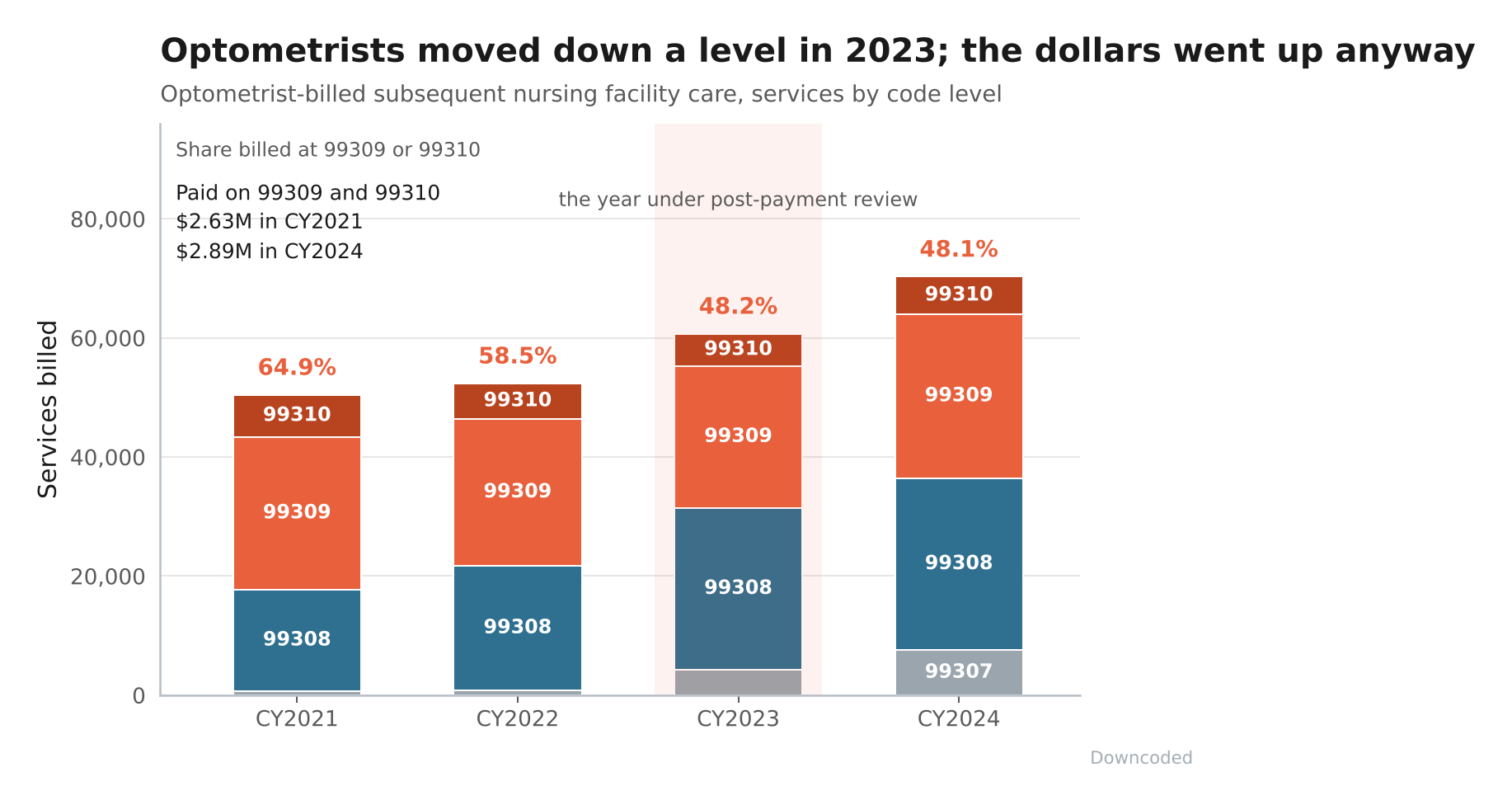
Pull CMS's own utilization file and the reason the review landed on 2023 shows up immediately (chart below).
Across CY2021 to CY2024, optometrist-billed subsequent nursing facility care moved down the level ladder, and the turn is at 2023. The share billed at 99309 or 99310 ran 64.9 percent, then 58.5, then 48.2 percent, then 48.1.
Code 99307, the bottom of the ladder, went from 680 services to 7,563, and the single-year jump is 2022 into 2023, up 440 percent.
So the behavior changed. Here's the catch: it changed in the year the code descriptors changed.
AMA's 2023 revision put a multiple-morbidities condition on all four codes and pushed the typical times for 99309 and 99310 from 25 and 35 minutes to 30 and 45. A mix that moves the same year the definitions move is not evidence of anybody's intent, in either direction.
And the dollars did not follow the mix down. Payments on 99309 and 99310 ran $2.63M in CY2021 against $2.89M in CY2024, the highest of the four years, on the highest service count of the four years.
Distinct optometrist NPIs on those two codes went 105, 85, 112, 126.
One honest limit on all of that: this file suppresses any provider-code row under 11 beneficiaries and reports only facility against non-facility, never the place of service code itself.
It is the concentrated-biller view, not a census, and it is not OIG's frame. We are not setting the two dollar figures against each other, and neither should you.
Final Thoughts
The useful read here has little to do with optometry.
A reviewable population got defined by a report, the agency declined to build the edit that would have stopped the billing at the front door, and a national contractor is now reading one year of records at the back door instead. The gap between those two decisions is where your 2023 claims are sitting.
If you bill 993xx in a nursing facility, put one question to your coding lead this week. Do your 2023 levels hold up under the descriptors that changed that January, the ones the reviewer will be reading them against?
Thanks for reading.