 Downcoded
The Other NPI List Your Claims Get Checked Against
CMS publishes the roster of practitioners its Part A shared system will take as attending and rendering on an institutional claim: 2,065,071 NPIs, rebuilt every 3.5 days, 344 editions still on the shelf. It is not the ordering and referring file, and on Thursday's builds the two rosters were 212,029 names apart.
Every revenue cycle office in the country knows the ordering and referring file. It is the one you check when a DME claim comes back saying the ordering provider is not eligible.
CMS publishes a second roster on the same shelf, on the same clock, and almost nobody opens it.
The Fiscal Intermediary Shared System Attending and Rendering dataset is the list of practitioners FISS will accept in the attending and rendering fields of an institutional claim. Thursday's build carries 2,065,071 distinct NPIs.
"Which list is the claim actually being checked against?"
Three Columns and a Rebuild Twice a Week
The file is plain. NPI, last name, first name, nothing else, 53,162,819 bytes of it, published under a public domain dedication with no login and no key.
CMS refreshes it on an R/P3.5D cadence, which is the catalog's way of saying
twice a week, and it keeps the old builds. There are 344 dated editions
sitting there right now, back to June 1, 2023, so the roster is a diffable series
and not just a snapshot.
The agency's own description tells you what the file is for, and it is worth reading closely:
"FISS edits require that the Line Item Rendering Physician information be transmitted when providers submit a combined claim. Claims that include both facility and professional components, need to report the rendering physician or other practitioner at the line level if it differs from the rendering physician/practitioner reported at the claim level."
So the roster is the answer key to a line-level edit on your own UB-04. CMS even warns you off Excel on the download page: the file "contains more records than most spreadsheet programs can handle," and it recommends a database.
Take that as the tell. A file this size is built to be joined.
Two Lists, Two Questions
Here is where it gets interesting. Pull the ordering and referring file from the same Thursday build, put the two NPI columns side by side, and they do not agree.
1,946,025 NPIs sit on both. 119,046 are on the FISS attending and rendering list and not on the ordering and referring list. Another 92,983 run the other way (chart below).
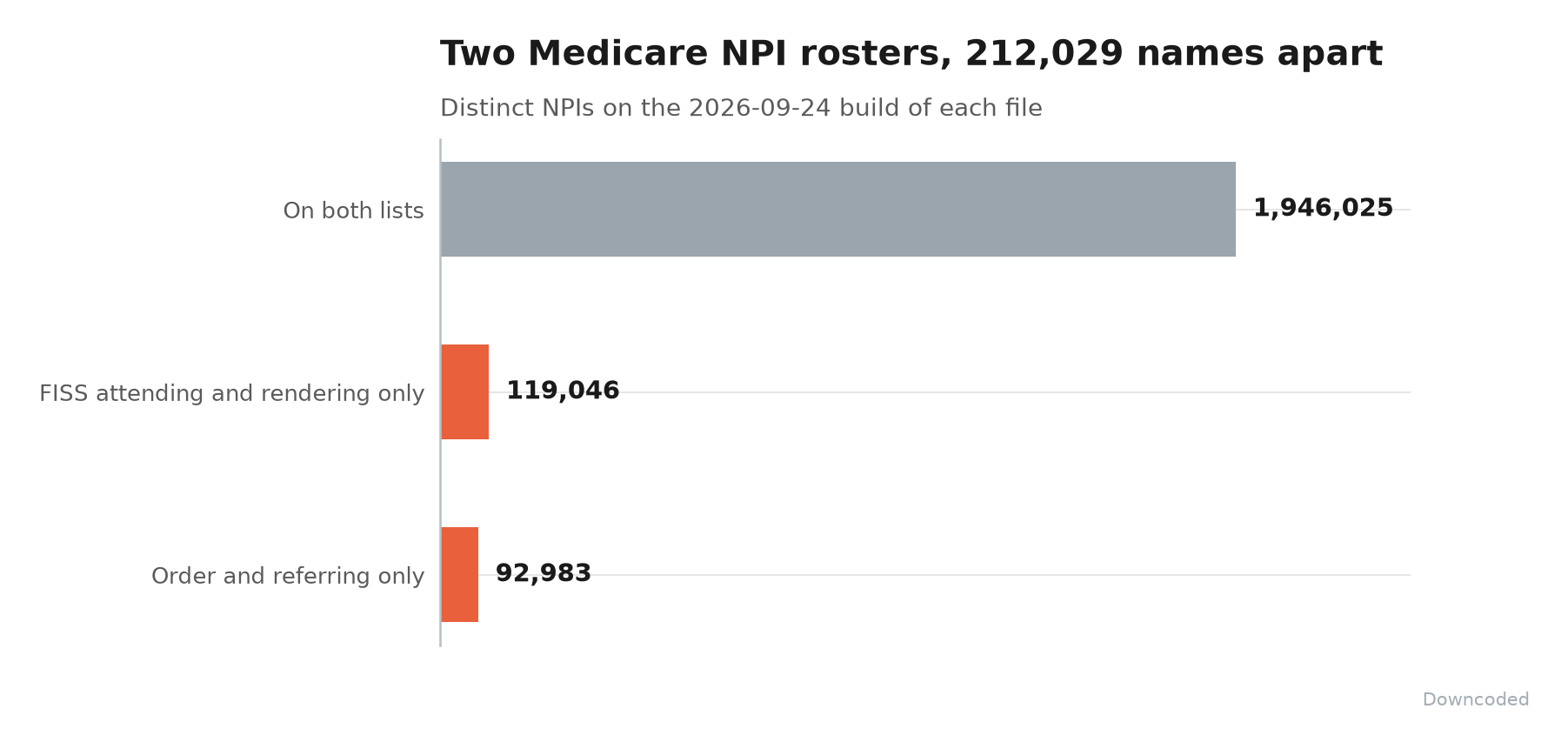
That is 212,029 names where knowing one list tells you nothing about the other.
The two files are answering different questions, and the ordering and referring
file carries the evidence in its own columns. Of the 92,985 rows on it whose NPI
is missing from the FISS roster, exactly 1,898 carry PARTB = Y.
The rest are DME and power-mobility orderers with no Part B ordering authority at all, 98.0% of that side of the gap. They were never going to show up as an attending physician on a hospital claim, because that is not the work they do.
Read it the other way and the practical point lands. A practitioner can be perfectly good as your attending of record and still not be on the list your DME supplier checks, and the reverse happens 92,983 times.
What It Buys You on a Tuesday
The useful version of this file is a join, not a lookup.
- Take your active medical staff roster, or the attending NPIs off last month's institutional claims, and left-join it to the FISS build.
- Anything that fails to match is a rejection you can see coming before the claim goes out.
- Run the same roster against the ordering and referring file separately, because as of Thursday those are two different questions with two different answers.
- Keep two consecutive builds. The set difference between them is a change log nobody publishes: who arrived on the roster this week, and who left it.
That last one is the part that compounds. With 344 editions retained, the history is already there; you just have to download it.
Final Thoughts
We wrote up the ordering and referring file's weekly churn on Monday, and this is its quieter sibling, sitting in the same directory with the same cadence and none of the attention.
Neither file is a policy. Neither one comes with a transmittal, a comment period, or an MLN article telling you to go read it.
Each is just a roster a shared system checks a claim against, published twice a week, free, for anyone who thinks to look.
The gap between the two is the shape of two different eligibility rules, sitting in public, in a format you can join in about four lines of SQL.
Thanks for reading.