 Downcoded
The Penalty Pool Is Now a Nurse Recruiting Budget
CMS launched Nurses for Nursing Homes on October 23 with $275 million in civil money penalty collections and no appropriation, then published the thing federal programs almost never publish: the selection function that decides which buildings qualify. We ran it. 9,181 of the country's 14,686 certified nursing homes are on the list, and the stipend picked up a wage index adjustment somewhere between launch day and this morning.
When CMS collects a civil money penalty from a nursing home, a dime of every dollar goes to Treasury and the other ninety cents has to come back out as something that improves residents' care. That is 42 CFR 488.433, and for years it has paid for resident councils, relocation costs and temporary management.
On October 23 CMS decided the something was student loans.
What Actually Launched
Nurses for Nursing Homes is a $275 million recruiting program: $100 million committed by CMS, at least $175 million by the states, and all of it penalty money collected from the industry it is being spent on. An RN or LPN/LVN who commits three years at a qualifying facility, averaging 30 hours a week, can collect up to $40,000 in student loan repayment plus a retention stipend. Applications opened October 26. CMS expects the money to carry more than 4,000 nurses and nursing students.
All 50 states and DC are participating. The two workforce partners doing the recruiting are the National League for Nursing and the Colorado Center for Nursing Excellence, A limited number of state agency nursing home inspector roles qualify too, which puts the surveyors inside the same incentive as the nurses they inspect.
Now the part worth your morning.
CMS Published the Selection Function
A program this size normally ships a fact sheet. This one shipped its arithmetic in a two-page PDF, then shipped the output as a 98-page list carrying every qualifying CCN, name and street address in the country.
The arithmetic runs in order:
- Take the state's combined federal and state CMP pool.
- Divide it by $35,000, the average incentive CMS assumes per nurse. That gives the state's estimated recruit count.
- Multiply by 1.5. That is the target number of qualifying facilities.
- Cap the target at 80% of the total nursing homes in the state.
- Fill the target: every rural-designated home first, then urban homes the state nominated under its own CMS-approved methodology, then urban counties ranked worst to best on general population per registered nurse, off Census population counts and BLS labor data.
Eight jurisdictions skip the cap because they have too few buildings for a percentage to mean anything: Alaska, Delaware, DC, Guam, Hawaii, Puerto Rico, Vermont and Wyoming.
CMS also wrote down the thing it declined to use.
Staffing star ratings are out, on the reasoning that a one-star staffing rating can come from a local labor shortage or from "budgeting decisions, corporate culture, or other management decisions," and the data cannot tell them apart. Geography can be measured, so geography decides.
What the List Looks Like Against the Universe
The list carries 9,181 facilities. CMS's own Provider Information file counts 14,686 currently active certified nursing homes, so 62.5% of the country's buildings made it, holding 941,903 of 1,567,009 certified beds.
The design shows up in the split (chart below). Rural homes are on the list at 96.5%, 3,866 of 4,005.
Urban homes are on it at 49.7%, 5,309 of 10,681. Rural is close to automatic, and urban is where the funding arithmetic does its work.
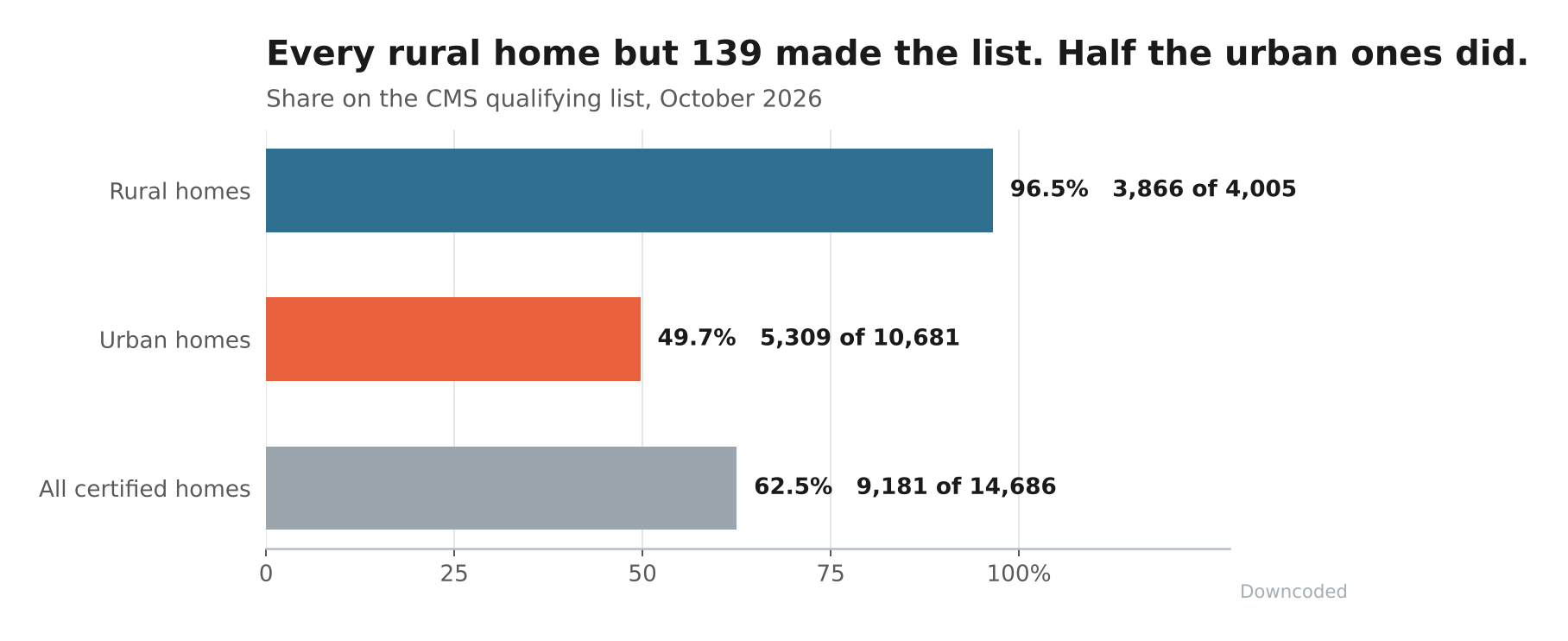
A detail for anyone checking their own building: 139 rural-flagged homes are missing from the list, and every one of them sits in four states. Kansas accounts for 77, Minnesota 32, Oklahoma 29, Maine 1.
A rural flag in CMS's own provider file does not guarantee a place on the list, so go look up the CCN.
A Small Pool Makes a Short List
Run the arithmetic backward and the state spread becomes a rough read on penalty collections. Maryland put 218 of its 221 buildings on the list.
Arizona put 20 of 140, Nevada 11 of 66, New York 121 of 592. The median jurisdiction sits at 75% (chart below).
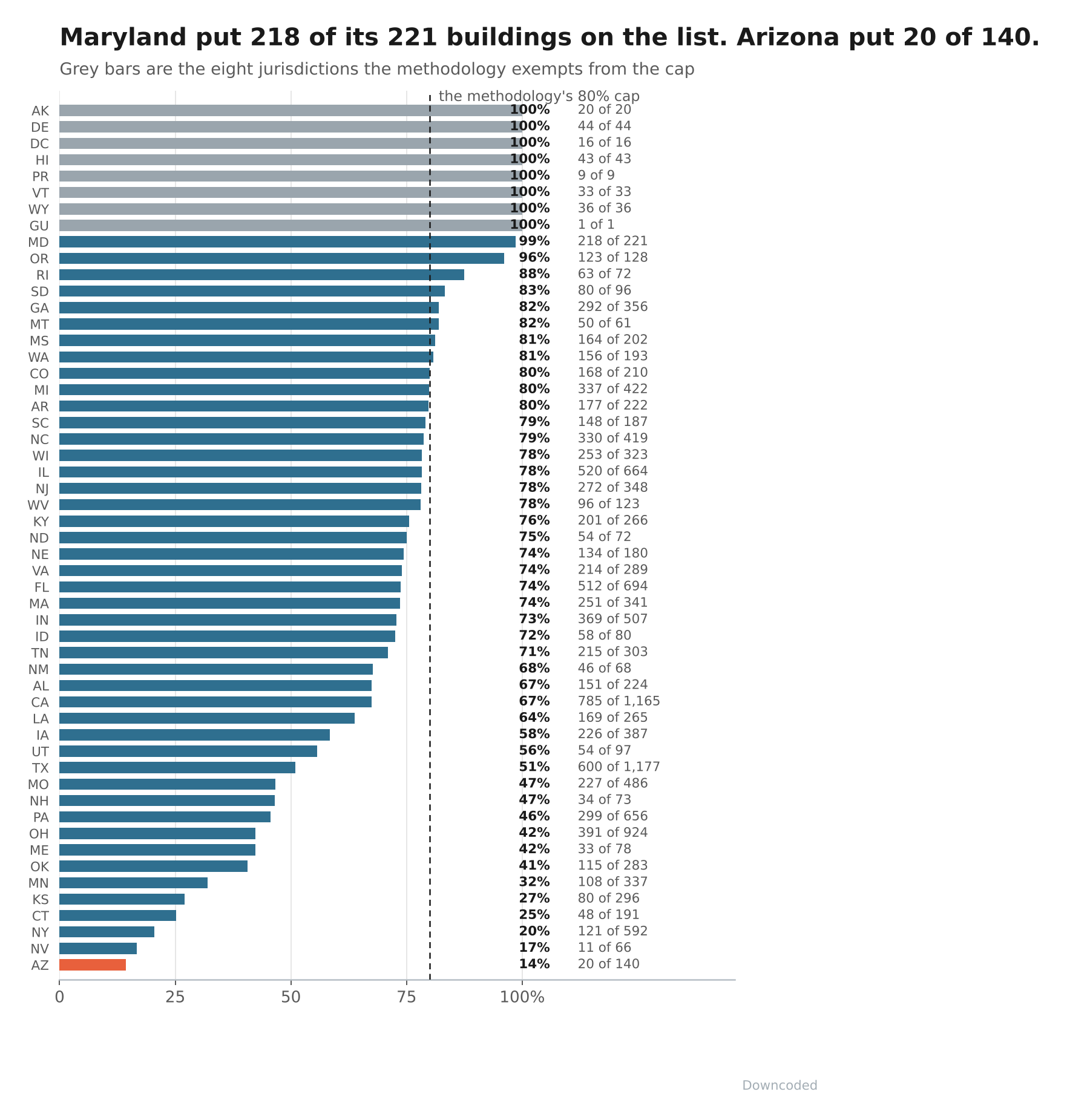
And the money moves first come, first served inside each state's allocation. CMS says it flatly: when a state's funds are gone, "no more nurses will be recruited through this initiative for that state."
A nurse in Phoenix is drawing on a smaller pool, from a shorter list of eligible buildings, than a nurse in Baltimore.
If You Run One of These Buildings
The operational footprint on the facility is unusually light:
- You cannot apply. CMS builds the list and updates it on its own clock, and qualifying facilities sign no agreement with the agency.
- You have no obligation to hire anyone in the program, and CMS has no part in your hiring process.
- The nurse must be your direct W-2 employee, so agency and contract staff are out.
- The money never touches your payroll. CMS pays the nurse quarterly and directly, on a Form 1099-NEC with nothing withheld, after verifying the 30-hour average across the quarter.
- A participant can move to another qualifying facility with CMS approval and 90 days to land.
Final Thoughts
One thing has already moved. The October 23 press release and the FAQ PDF of the same date both describe a flat $10,000 stipend under a $50,000 ceiling. The live program site this morning describes "a retention stipend based on a $10,000 national-average amount, adjusted up or down for your facility's area using the CMS wage index," and the ceiling is gone from the page. CMS has published no revision note, so treat the amount as the site states it.
Sit with what that does. The wage index that prices the Medicare dollars going into a building now prices the retention bonus going to the nurse standing in it.
We flagged this program in August, when it was a Privacy Act notice, a Facility Portal and nothing you could touch.
It is running now, and what makes it unusual sits beside the $275 million. CMS published the formula, the inputs and the answer key, so anyone can check the arithmetic on the list their building is or is not on.
Thanks for reading.