 Downcoded
The Rate Sheet Your Competitor Already Published
Trilliant Health consolidated every hospital machine-readable file it could parse into one free DuckDB lake: 7,698,910,156 negotiated rates this morning, no license and no sales call. Nine of every ten files are on the CMS 3.0 template, which is the version that carries real remittance-derived allowed amounts.
7,698,910,156 negotiated rates.
That is the counter on a public web page this morning, printed above a SQL shell that runs inside a browser tab. No login, no procurement, no license fee.
The page is the Hospital MRF Data Directory. A Brentwood, Tennessee analytics firm called Trilliant Health built it out of the machine-readable files your hospital and everyone else's already post under 45 CFR 180, and then gave the whole thing away.
"What does every other hospital in the state get paid for the code you are about to sit down and renegotiate?"
Who Gave It Away
Trilliant announced the consolidated dataset on November 18, 2025, with more than 5 billion negotiated rates pulled from more than 5,000 hospitals. Hal Andrews, the company's president and chief executive, framed the reason plainly in the release: "A cottage industry has emerged charging substantial fees for access to data that's supposed to be public... The first step in reducing healthcare waste is to stop spending money on things that are free."
By July 14, 2026 the count was past 7.2 billion rates across 2.04 TB, and Trilliant put a compliance number on the corpus: 90.3% of the files conformed to the CMS 3.0 schema.
It has kept growing since. This morning the directory reports 7,916 files and 2.22 TB.
The banner across the middle of the page reads "Others sell it. Oria shares it."
What Is Actually Sitting In There
Roughly 972,600 negotiated rates per file, on average, and the spread across files is enormous: 8.0 GB for Ascension Seton at the top, 210 bytes at the bottom.
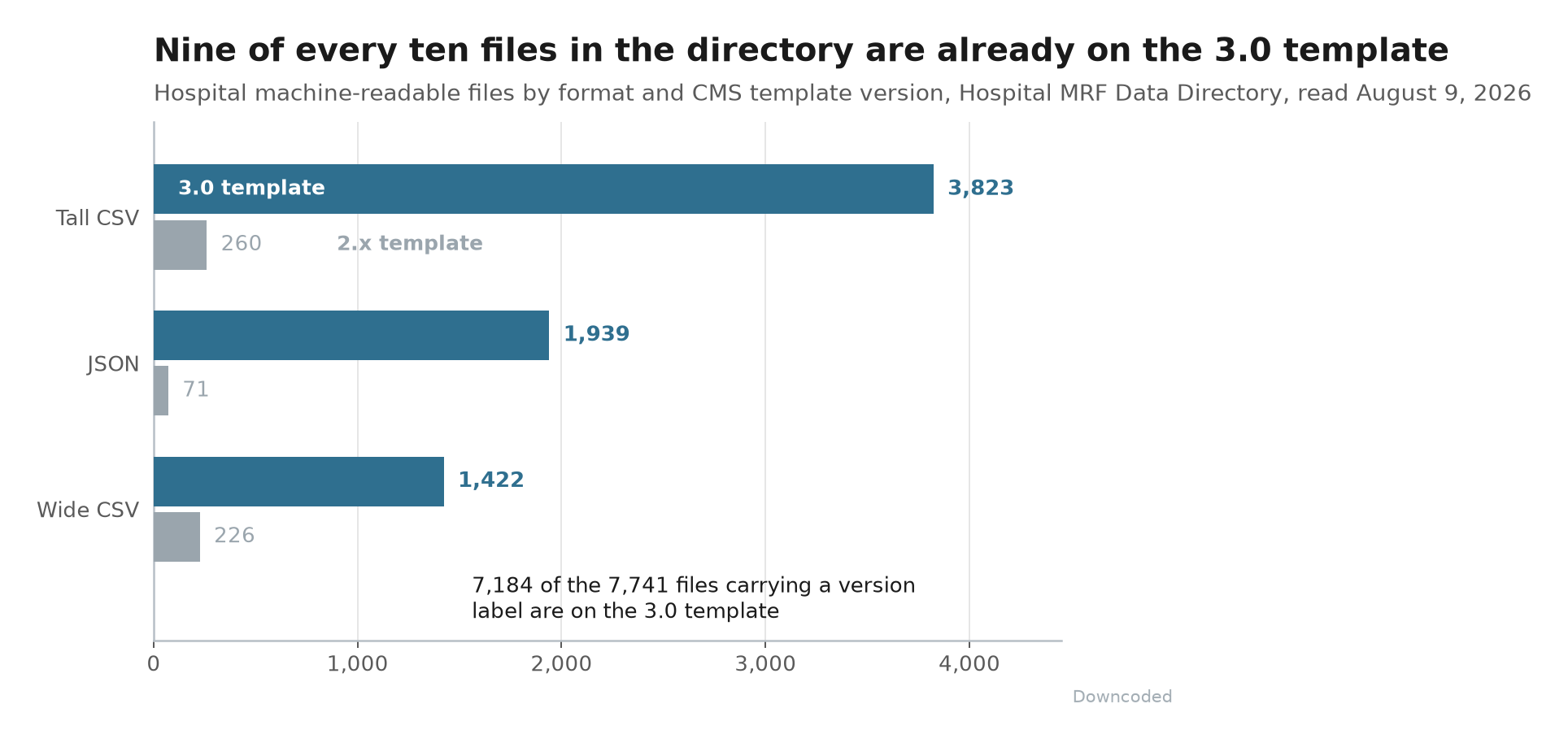
The version mix is the part that matters, and it is the tell (chart below). Of the 7,741 files the directory tags with a template version, 7,184 are on 3.x, and the single largest bucket is Tall CSV 3.x at 3,823 files.
Each hospital entry carries three things: the hospital's own cms-hpt.txt index, a link to the raw MRF, and a parsed .duckdb copy of that file. The whole corpus is available as one portable DuckLake archive behind a free account.
The parsed schema is the reason a revenue-cycle team can use this in an afternoon. The standard_charge_details table runs one row per payer per service and carries payer_name, plan_name, standard_charge_dollar, and code columns for cpt, hcpcs, ms_drg and rc. The documentation's own worked example is exactly the query you would write:
SELECT payer_name, AVG(standard_charge_dollar) as avg_rate FROM standard_charge_details WHERE cpt = '99213' GROUP BY payer_name ORDER BY avg_rate DESC;
Why the 3.0 Files Are the Ones You Want
CMS rebuilt the template in the CY2026 OPPS final rule (90 FR 53448, published November 25, 2025). The requirements took effect January 1, 2026 and enforcement started April 1, 2026.
Here is the change that moves a rate benchmark. The old Estimated Allowed Amount is gone, replaced at 45 CFR 180.50(b)(2)(ii)(C) by four elements: Median Allowed Amount, 10th Percentile Allowed Amount, 90th Percentile Allowed Amount, and Count of Allowed Amounts.
CMS builds all four off observed remittances. Each is defined as the relevant percentile of "the total allowed amounts the hospital has historically received from a third party payer," drawn from a window of no less than 12 and no more than 15 months before the file is posted.
The count element is the number of remittances behind the math, encoded as a whole number at 11 or more, as the literal string "1 through 10" below that, and as "0" with a written explanation when there were none.
And the trigger is the interesting part: the four elements are required when the negotiated charge is expressed as a percentage or an algorithm rather than a dollar. CMS's own example is 87% of total billed charges where the amount is unknowable until after the service is rendered.
So the contract terms that were always hardest to benchmark, percent-of-charges and algorithm pricing, are the ones that now ship with an observed distribution and a remittance count attached.
One practical note on the free directory: its published data dictionary lists the old estimated_amount column and does not list the four new elements. The raw 3.x file for any hospital is downloadable from that hospital's page, so the elements are one file away.
What To Do With It This Week
Pull your own organization's file first and read it the way an outsider would. Your attester's name is in there now, along with your Type 2 NPIs, and if any of your contracts are percentage-priced, so is the median your own remittances produced.
Then run the codes you are renegotiating this fall.
There is a clock on the policy side too. The CY2027 OPPS proposed rule (91 FR 41734) carries an RFI on strengthening the standardization and comparability of this exact data, and comments close August 31, 2026. Anyone who has actually queried the corpus has something to say that a comment letter written from a conference room does not.
Final Thoughts
Nothing about this is a leak. Every rate in that 2.22 TB was published by a hospital that was required to publish it, and most of the industry has spent five years treating it as technically public and practically unreachable. Somebody did the parsing, ate the storage cost, and posted the result with a query box on top.
Whatever you think of where price transparency policy goes next, the version where nobody could get the data is over.
Thanks for reading.