 Downcoded
The Reassignment Map Medicare Gives Away
CMS publishes the full reassignment graph of Part B once a month, free and without an account: 3,373,759 rows tying 1,692,686 practitioners to 205,490 billing groups, with both revalidation clocks printed next to each other. Half of those groups have exactly one person in them.
Somewhere in your organization there is a list of every practitioner currently billing under your TIN, with each one's Medicare enrollment status next to their name.
It is maintained by hand. It is a little out of date.
CMS maintains the same list, for every group in the country, and republishes it on the first of every month as a 537 MB CSV that downloads without an account, a login, or a sales call.
What is actually in the file
The dataset is the Revalidation Clinic Group Practice Reassignment file, which is a long name for a simple object: the reassignment graph of Part B, written down.
The August 1, 2026 edition carries 3,373,759 rows. Each row is one practitioner tied to one group they reassign billing to, and it brings fifteen columns with it, including both sides of the relationship:
- the group's PAC ID, enrollment ID, legal business name and state
- the individual's NPI, enrollment ID, name, state and specialty
- the group's revalidation due date and the individual's revalidation due date, side by side
- the group's total count of reassignments and physician assistants
- the individual's total count of employer associations
Deduplicated, that is 205,490 distinct group PAC IDs and 1,692,686 distinct individual NPIs.
The legal spine underneath it is 42 CFR 424.80, which starts by banning the whole arrangement: Medicare "does not pay amounts that are due a supplier under an assignment to any other person under reassignment, power of attorney, or any other direct arrangement." Then come the exceptions, at (b)(1) for an employer and (b)(2) for an entity billing under a contractual arrangement.
Every row in this file is one of those exceptions, enumerated.
The shape of the graph is not what people assume
102,956 of the 205,490 groups have exactly one practitioner reassigning to them. That is 50.1%, and it is the longest bar on the chart below by a factor of nearly two.
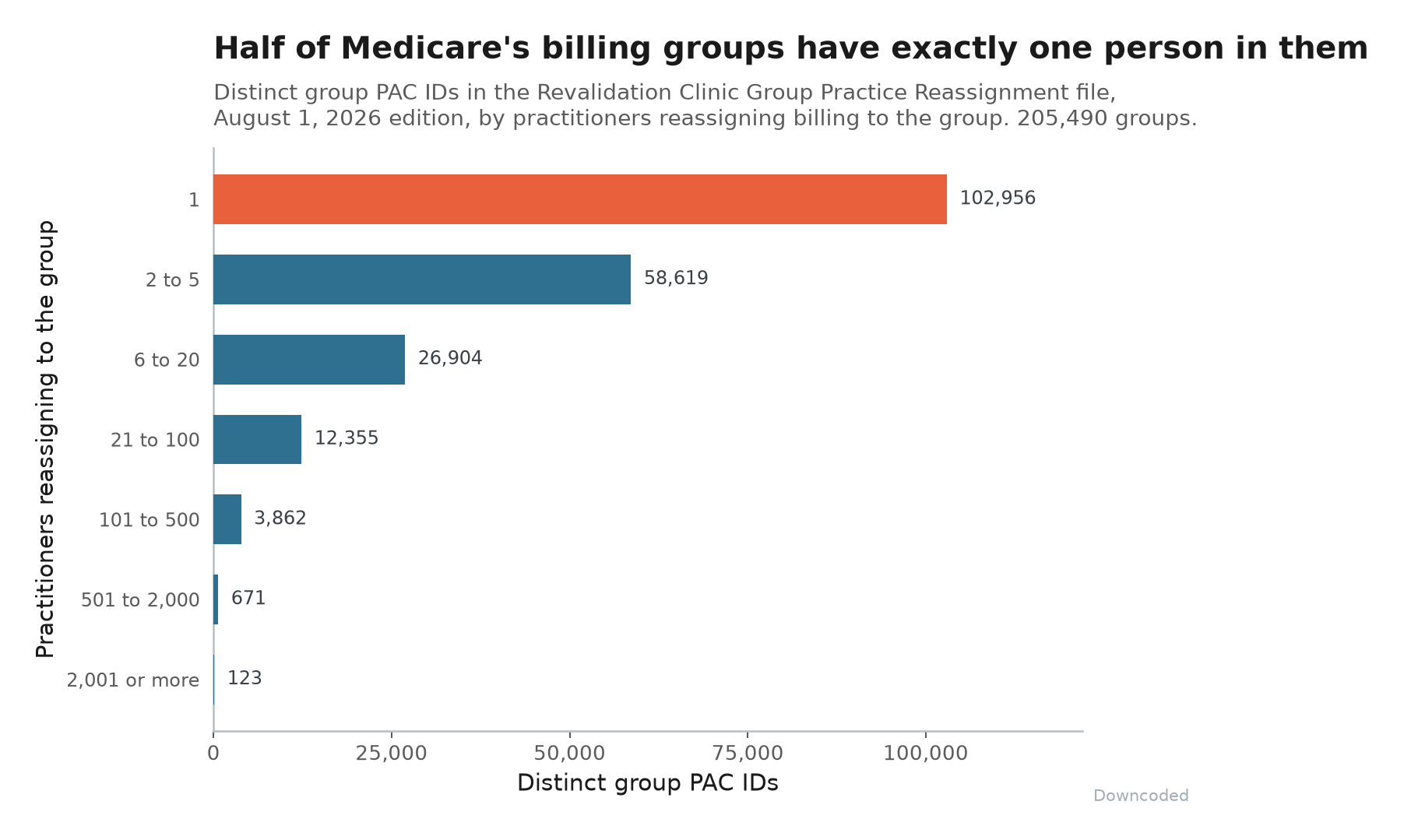
The other tail is real too. 671 groups sit between 501 and 2,000 practitioners, 123 carry 2,001 or more, and the largest single group PAC ID in the file collects 19,943 reassignments.
From the practitioner side, the distribution is tighter than the trade conversation about moonlighting and locums suggests. Of the 1,692,686 NPIs:
- 61.9% reassign to exactly one group
- 21.8% reassign to two
- 13.7% reassign to three, four or five
- 307 reassign to 26 or more
And the largest specialty in the file is not a physician specialty. Nurse practitioners account for 705,963 reassignment rows, well ahead of internal medicine at 240,423, CRNAs at 204,455 and family practice at 200,333.
The due-date columns are the part to steal
Revalidation runs on a five-year cycle for most enrollments and a three-year cycle for DMEPOS suppliers. CMS posts due dates seven months in advance and the enrollment contractor mails or emails a notice three to four months out.
Miss it and CMS is blunt about the consequence: failing to revalidate on time "could result in a hold on your Medicare reimbursement or deactivation of your Medicare billing privileges."
A deactivated enrollment does not get restored with a phone call. It takes a complete new enrollment application.
So the useful thing here is the adjacency. Your group's due date sits in the same row as the due date of every person reassigning to it, and those two clocks run independently.
A group can be current while a third of its practitioners are inside their notice window, and nothing on a remittance advice tells you that until a claim stops paying.
Two companion files ship on the same monthly clock. The Revalidation Due Date List carries 2,931,409 rows at the enrollment level.
The Revalidation Reassignment List carries 3,581,498 and adds the individual PAC ID, which is the join key most credentialing systems actually key on.
Prior editions stay published. The July 1 edition is still sitting there, which means a month-over-month diff of your own group is a diff command rather than a project.
Final Thoughts
Enrollment data is the least glamorous thing CMS publishes, and it is one of the few public datasets that maps directly onto an operational failure mode you can price.
A reassignment you think is active and isn't is a claim that denies. A revalidation you missed is a payment hold with a re-enrollment application behind it.
CMS ships the whole graph, monthly, with a REST API and a versioned archive, and asks nothing for it. That deserves saying out loud more often than it gets said.
Thanks for reading.