The Sentence Medicare Left Open in 1978
Medicare's national coverage determination on therapeutic embolization is one sentence long and has not been touched since December 1978. UnitedHealthcare just wrote the list that sentence never contained: hemorrhoids and musculoskeletal pain are unproven from December 1, across the commercial, exchange and Medicaid books. The code it lands on pays $6,675 in the office, and 94 cents of every dollar is spent before the claim leaves the building.
On December 15, 1978, Medicare decided how it would pay for therapeutic embolization. The operative text of NCD 20.28 runs to one sentence:
"Therapeutic embolization is covered when done for hemorrhage, and for other conditions amenable to treatment by the procedure, when reasonable and necessary for the individual patient."
Forty-eight years later that is still the national policy, word for word. The NCD names exactly one non-hemorrhage use case in any detail, renal embolization for renal adenocarcinoma, and leaves everything else inside "other conditions amenable to treatment by the procedure."
Nobody ever went back and said which conditions those are.
UnitedHealthcare just did, for its own members, in the September Medical Policy Update Bulletin. New policy, Vascular Embolization: Select Procedures, effective Dec. 1, 2026.
The List Medicare Never Wrote
The code that carries this is 37242, the arterial embolization code for everything that is neither bleeding nor a tumor. It has a status of A on the fee schedule, a 000-day global, and no local coverage determination waiting behind it in most jurisdictions. A claim goes in, the 1978 sentence is the only national text on point, and the claim pays.
So look at what happened to it.
In 2018, Medicare paid for 503 office-based 37242 services nationally, out of 212 billing providers. In 2024 it paid for 6,215, out of 434 providers.
That is 12.4x in six years, and +117% in the single year from 2023 to 2024 (chart below). Over the same window the hospital and facility line went from 8,196 services to 8,505, which is to say it did not move.
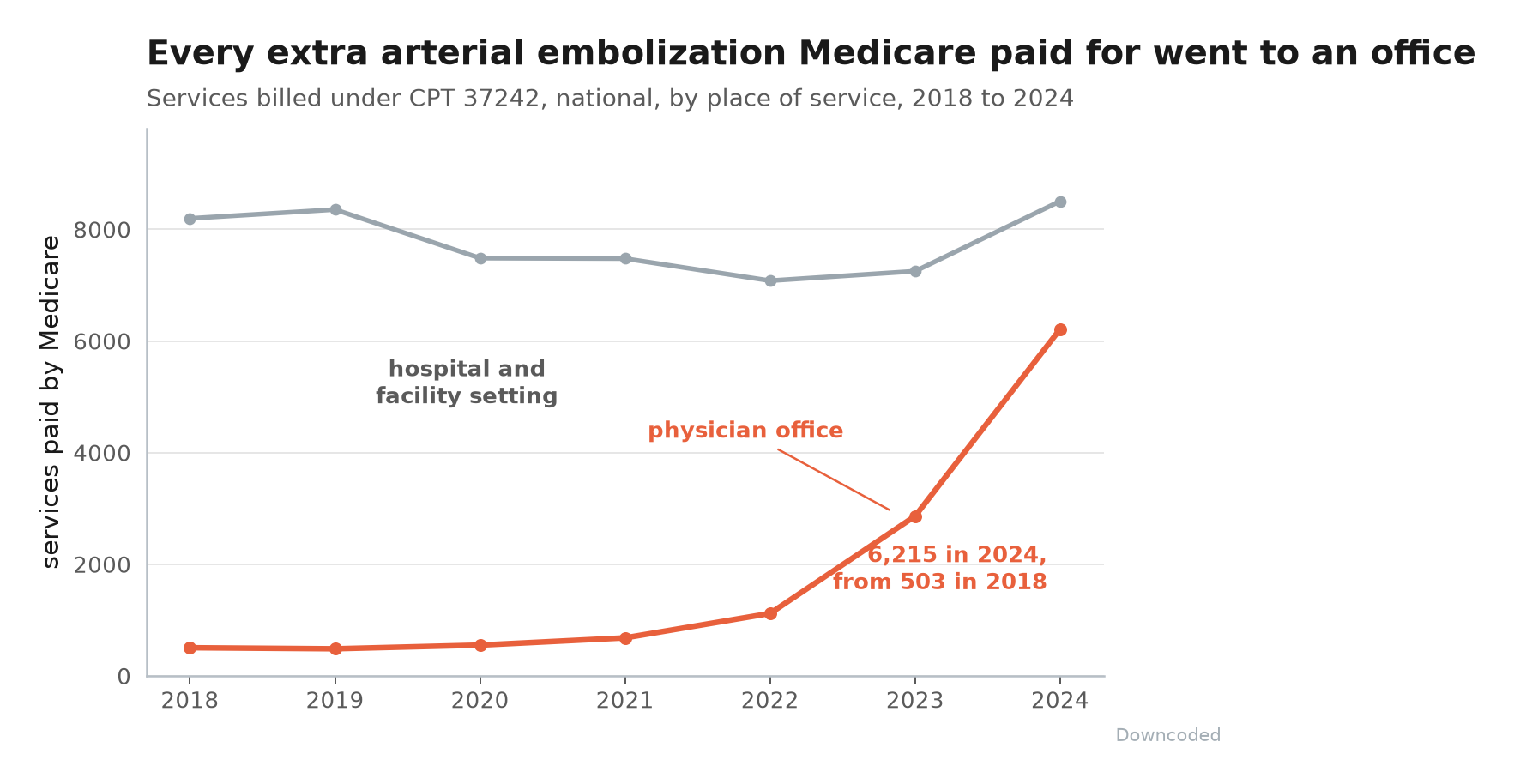
One honest limit on that chart: the CMS utilization files carry no diagnosis, so nobody outside a payer's own data warehouse can split those 6,215 office cases by indication. What can be said is that the growth is entirely in the setting where the physician bills globally, at 14.3 cases per billing provider per year, which is a service line rather than an occasional case.

The rest of this brief is for subscribers.
The impact tables, the code-level detail, and the rest of the analysis sit past this line.
$50 a month, or $500 a year.
Already a subscriber? Sign in