The SNF Exclusion List Has Been Wrong Since January
Forty-four therapy codes sit on the CMS file that tells an outside provider to send the claim to the Part B MAC for a resident in a covered Part A stay. CMS says they never belonged there, pulls them October 5, and will not go looking for the claims that already paid.
Medicare publishes four HCPCS lists for skilled nursing facility consolidated billing, and two of them give opposite instructions about the same 44 codes.
File #1 is the list for a beneficiary in a Part A covered SNF stay. Its header:
"These codes are not subject to SNF consolidated billing. They should be submitted to the Part B Medicare Administrative Contractor or Durable Medical Equipment Medicare Administrative Contractor as appropriate for payment consideration."
File #4 is the therapy list, and it says its codes "are subject to SNF consolidated billing and must be billed through the SNF."
Bill the MAC, bill the SNF, take your pick.
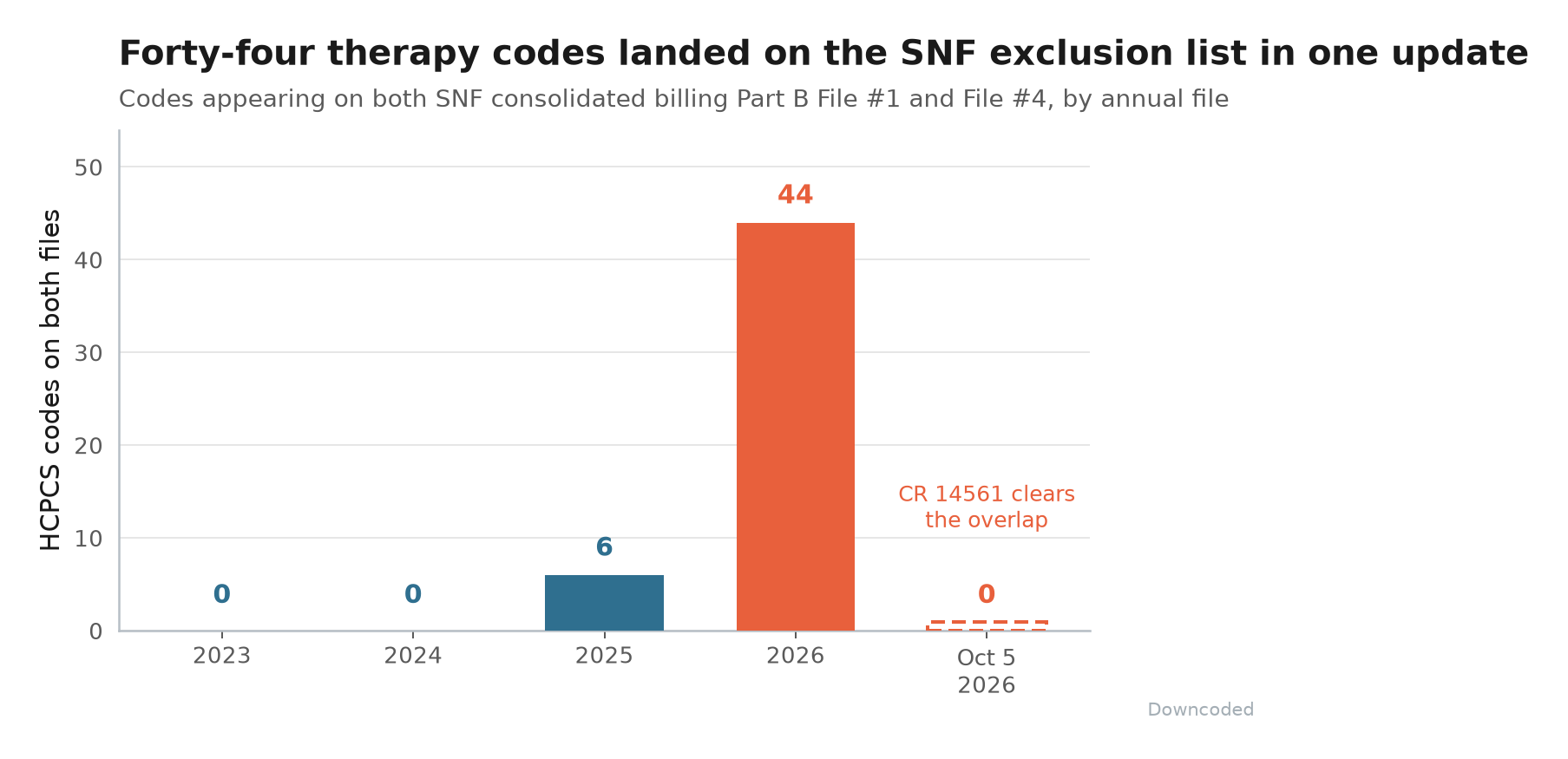
The overlap is new (chart below). Zero codes in the 2023 annual file, zero in 2024, six in 2025, and 44 in the file that has been live since January.
The Rule Both Files Are Supposed to Follow
CMS states the governing rule in the Background section of MM14561, the article carrying this quarter's update:
"SNF CB only applies when a SNF resident gets services during a covered Part A stay. However, SNF CB applies to physical and occupational therapies and speech-language pathology services whenever you provide them to a SNF resident, regardless of whether Part A covers the stay."
Read that against File #1's job and a therapy code can never appear on it. The exclusion list exists to name what survives a covered Part A stay, and therapy survives nothing.
CMS agrees, in the same article: "we're correcting the assignment of certain therapy HCPCS codes that we incorrectly included in both the Part B SNF CB Files #1 and #4."
Change Request 14561, transmittals R13881CP and R13943CP, revised release September 1. Table 8 pulls 45 codes off File #1 with an implementation date of October 5, 2026.

The rest of this brief is for subscribers.
The impact tables, the code-level detail, and the rest of the analysis sit past this line.
$50 a month, or $500 a year.
Already a subscriber? Sign in