 Downcoded
Thirteen Comorbidities That Lower Your Mortality Index
AHRQ's Elixhauser comorbidity software prices 38 conditions into a risk-of-death score, and thirteen of them carry a minus sign. The crosswalk is 4,567 ICD-10-CM codes, the coefficients are printed in a free PDF, and ten of the thirteen flip positive the moment you switch to the readmission index. Until September the whole thing ran only in SAS.
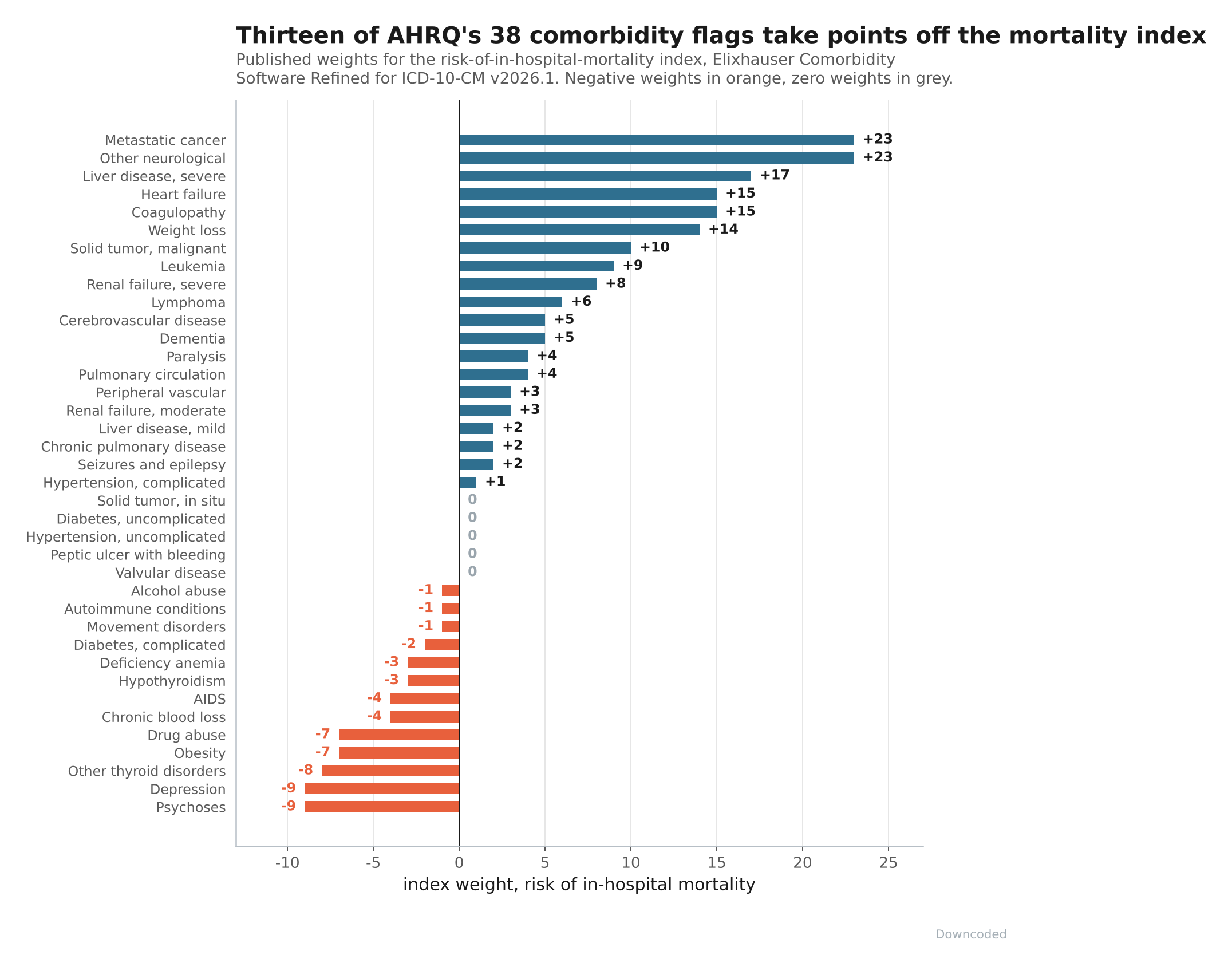
Code depression as a secondary diagnosis on an adult inpatient stay and the federal government's own comorbidity index takes nine points off that patient's predicted risk of dying in your hospital.
Psychoses, the same nine. Other thyroid disorders, eight. Drug abuse and obesity, seven apiece.
Thirteen of the thirty-eight flags run negative (chart below), and none of it is a bug.
The index belongs to AHRQ, the download is free, and every coefficient in it is printed in a PDF on a public website.
We opened the CCSR on the same HCUP shelf back in September and left this one closed. This is the tool on that shelf with the arithmetic in it.
Thirty-Eight Flags, 4,567 Codes
The Elixhauser Comorbidity Software Refined for ICD-10-CM sits at v2026.1, fiscal year 2026, and the measure count went from 29 to 38 in the refinement: three measures added, five split into twelve more specific ones, one retired.
The reference workbook is the part worth keeping open. One row per ICD-10-CM code, 4,567 of them, one column per measure. 4,445 codes trigger exactly one flag, 121 trigger two, and a single code trips three: I13.2, hypertensive heart and chronic kidney disease with both heart failure and stage 5 CKD, which lands on heart failure, complicated hypertension, and severe renal failure at once.
Eighteen of the thirty-eight measures read the present-on-admission indicator. The other twenty assume the condition predates the stay.
Measure size is wildly uneven and that is the useful part:
- Malignant solid tumor pulls from 601 codes, autoimmune conditions 599, lymphoma 447.
- Chronic blood loss has exactly one trigger: D50.0, iron deficiency anemia secondary to blood loss.
- Moderate renal failure has six. AIDS has nine.
The change log from v2025.1 to v2026.1 is similarly small: no measures added, redefined or dropped, 26 diagnosis codes in (the eight new multiple sclerosis codes, four thyroid orbitopathy codes, four Fontan-circulation codes), and exactly one code out. R93.9, diagnostic imaging inconclusive due to excess body fat of the patient, no longer counts as obesity.
Where the Minus Signs Come From
AHRQ built the mortality weights off the 2018 State Inpatient Databases: 100 bootstrapped replications on 5 percent samples, backward stepwise logistic regression, then each coefficient divided by the smallest absolute coefficient in the model and rounded.
Two measures were held out before the regression ran, uncomplicated diabetes and uncomplicated hypertension, for low mortality and high correlation with a neighbor. Three more survived fewer than 20 percent of the replications and got cut: in-situ solid tumor, peptic ulcer with bleeding, valvular disease.
Thirty-three measures made the final model.
So five of the published weights are zero because the measure never earned one.
AHRQ's own sentence on the rest of it:
"Some comorbidity weights carry a negative sign, reflecting a protective relationship with in-hospital mortality in the context of the model."
Validation on 5.6 million discharges, c-statistic 0.777. That is a working model, and inside it, holding the other 32 measures constant, the patients carrying a depression code die in-house less often.
The Two Indices Disagree About the Same Patient
There is a second index in the same ZIP, for 30-day all-cause readmission, built on 12.3 million index events from the 2018 Nationwide Readmissions Database at an overall 13.0 readmissions per 100. Thirty measures in that final model, c-statistic 0.634.
Run the same thirteen flags through it and ten of them change sign (chart below).
Psychoses swings from minus nine to plus six. Drug abuse, minus seven to plus six. Depression, minus nine to plus two.
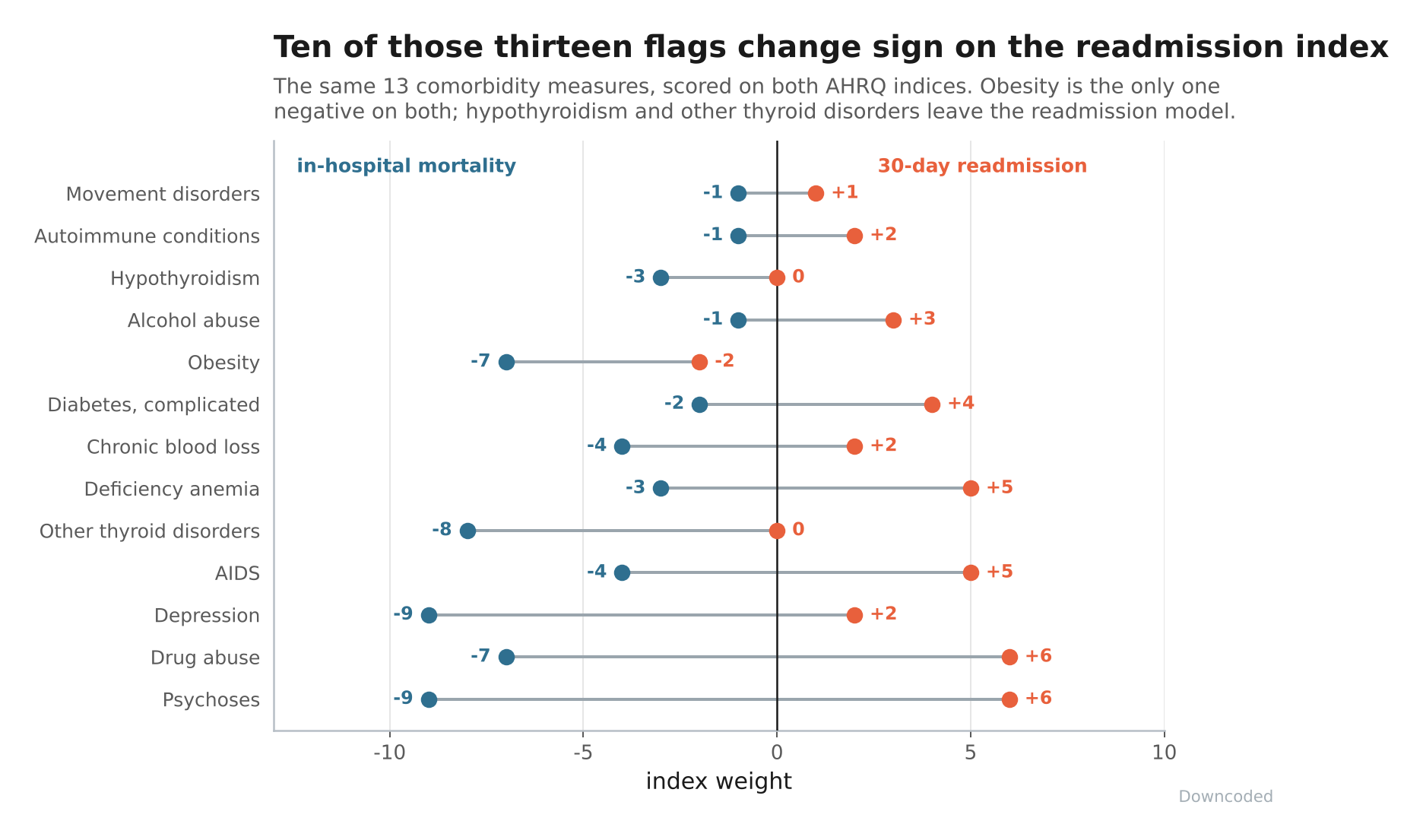
Obesity is the only one of the thirteen that stays negative on both. The two thyroid measures drop out of the readmission model entirely.
Both indices demand all 38 measures coded, with POA indicators. Short the input data and the score comes out simply wrong.
It Only Ran in SAS
From AHRQ's own download page, verbatim: "At this time, the Elixhauser Comorbidity Software Refined for ICD-10-CM tool is only available as a SAS program." The ZIP holds a format program, a mapping program, an index program, and the documentation.
On September 17 and 18, elixhauser-ahrq went up on PyPI under an MIT license.
A 236 kB wheel, Python 3.8 and up, ElixhauserMapper returning the 38 flags off
a diagnosis list and ElixhauserScorer taking mortality or readmission.
The crosswalk went up the same weekend as a public dataset, and a browser calculator alongside it.
The PyPI record names the author as Frank G. Opelka, MD, FACS, with Episodes of Care Solutions as maintainer. HHS's own panelist bio for a March 2025 federal advisory meeting describes him as "a surgeon and former medical director for quality and health policy with the American College of Surgeons."
A career spent on the policy side of surgical quality, and the contribution this fall was a pip install.
Final Thoughts
Observed-over-expected is the number that decides how your facility looks in a payer's network analytics, in a bundled-payment reconciliation, and in whatever scorecard your service-line chief brought to the last meeting. The expected half of that ratio is a model, and somebody chose its coefficients.
Here, the choosing is public. You can read why valvular disease scores zero, see that depression and psychoses carry the two largest negative weights in the whole table, and check whether the model your vendor built agrees.
Worth a morning. The download has never cost anyone a dollar.
Thanks for reading.