 Downcoded
Twelve Volunteers Repriced Five Codes in Friday's Outpatient Rule
The Advisory Panel on Hospital Outpatient Payment met for one Monday in August, took ten public presentations, and sent CMS five service-level recommendations. Friday's CY2027 outpatient final rule adopted three of them, and those three moved five CPT codes off the proposed rate by $286.06 to $1,900.00 a service. The twelve people who voted are unpaid hospital employees, and the meeting is open to anyone who registers.
If you have ever read an APC assignment and thought somebody at CMS ought to hear why it is wrong, twelve people spent a Monday in August doing exactly that.
They convened at 9:48 a.m. on August 24, partly in a room at 7500 Security Boulevard in Baltimore and partly on a videoconference bridge. Eight topics, ten presentations, lunch at noon, scheduled adjournment at 2:45.
Eleven numbered recommendations came out of it. Five of them were about real services with real rates.
Friday's CY2027 outpatient final rule answered all five in writing, and took three.
The Panel Your Rate Analysis Never Mentions
The Advisory Panel on Hospital Outpatient Payment exists because section 1833(t)(9)(A) of the Social Security Act says it has to. Its charter allows up to 15 members, every one a full-time employee of a hospital or health system paid under the OPPS, serving terms of up to four years.
The charter is blunt about the terms of service: members "shall serve on a voluntary basis, without compensation." CMS reimburses travel and per diem.
Twelve served on August 24, and the transcript prints all of them: Jennifer Artigue, Becky Bean, Nancy Dawson, Blake Dirksen, Brandon Fazio, Adam Levin, Scott Manaker, Douglas O'Brien, Rahul Seth, Wendi Smith Lloyd, William Tettelbach and Caroline Zeller. Edith Hambrick, MD, JD presided.
The mechanism is simple enough to state in one line: a company or a clinician asks for a slot, presents to the Panel, the Panel discusses it on the record and votes, and CMS prints its answer in the next final rule.
CMS says so itself, in the ratesetting section, about cases where the Panel's advice would break the agency's own 2 times rule:
"we frequently accept the HOP Panel's recommendation because those recommendations are based on explicit consideration of resource use, clinical homogeneity, site of service, and the quality of the claims data used to determine the APC payment rates."
Three of Five
The three CMS adopted cover five CPT codes, and all five came back above the rate the July proposed rule had set for them (chart below).
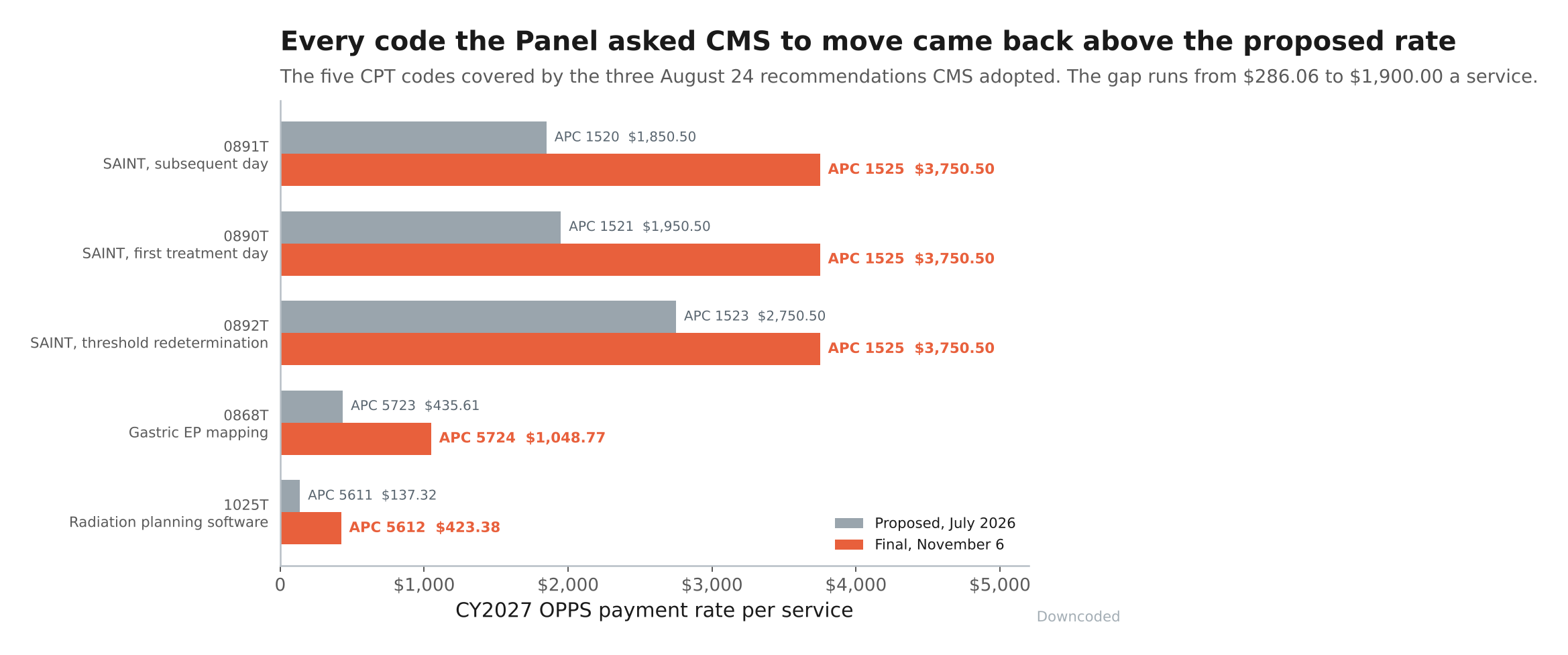
The biggest of them went to Magnus Medical, whose Brandon Bentzley presented on the SAINT treatment for major depressive disorder. CMS had proposed pulling three of the four SAINT codes down into lower New Technology APCs, which commenters put at a 25 to 50 percent cut. The Panel recommended leaving them in APC 1525 where they were. CMS used its equitable adjustment authority under section 1833(t)(2)(E) and did that, which is $1,900.00 a treatment day on 0891T against what July proposed.
Alimetry's Greg O'Grady presented on gastric electrophysiology mapping, CPT 0868T, which CMS had proposed to pay $435.61 against a geometric mean cost of $2,497.78. The Panel recommended one APC level up. The final rate is $1,048.77.
And Daniel Kim of Inova Schar Cancer Center presented on CPT 1025T, the alternating electric fields planning software, proposed at $137.32 in its first year with no claims data behind it at all.
The Panel recommended Level 2. CMS wrote that it is "finalizing an APC assignment for CPT code 1025T to APC 5612 in line with the HOP Panel's recommendation," at $423.38.
What the Other Two Tell You
The two recommendations CMS declined are worth reading for anyone planning a presentation.
The first asked CMS to create a new APC 5156, Level 6 Airway Endoscopy, so that CPT 31647 could leave the Level 5 bucket.
It was the only contested vote of the day. Scott Manaker recused himself, then noted for the record that the data showed no 2 times violation with significant volume in that APC.
Two members voted nay. The chair re-polled and ruled the ayes had it.
CMS declined, citing the volume: a Level 6 APC would carry fewer than 1,000 claims, and 31647 has 95 single frequency claims.
The second asked for CPT 29445, the rigid total contact leg cast, to move from status indicator T to S. CMS compared it to the short leg cast and the Unna boot, both sitting at T, and kept it there at $326.07.
One more topic produced nothing at all. Neuralace Medical asked for a reassignment on the peripheral nerve stimulation codes 0766T and 0767T, and the rule records that the Panel made no recommendation on the request.
Final Thoughts
The Panel's own charter was filed on November 21, 2024, and it expires two years from that date unless it is renewed. Recommendations 6 through 11 from August read like a group that expects to be back: keep both subcommittees running, give the Data Subcommittee the list of APCs whose costs move more than 10 percent between the CY2027 final rule and the CY2028 proposed rule, and name Adam Levin and Jennifer Artigue as the 2027 subcommittee chairs.
Nominations for membership go through a module in MEARIS. The meetings are public, the agendas and the decks and the full verbatim transcript go up on the CMS site afterward, and the Panel meets up to three times a year.
Five rate arguments got a hearing in August. Three of them are in the rate book that takes effect January 1.
Thanks for reading.