 Downcoded
What Does a $1.60 Copay Cost Medicare?
CMS filed the rule that takes the low-income subsidy generic copay to zero in 2028 and priced it at $1.337 billion over ten years, for roughly 6 million enrollees. That is 65 times the compliance bill in the same document, and the rule's third section carries no CMS estimate at all. Comments close December 15.
Medicare's low-income subsidy charges a generic copay of $1.60 this year.
That is the entire charge. A full-benefit dual eligible at or below 100 percent of the federal poverty level pays a dollar sixty for a generic, with no deductible, and the plan absorbs the rest.
Every other covered drug runs $4.90.
Section 6219 of the Consolidated Appropriations Act, 2026 takes the generic number to $0 for plan years beginning on or after January 1, 2028. CMS filed the conforming regulation text at 4:15pm Eastern Friday, inside the same 265-page document that carries the Medicare Advantage provider directory overhaul we read this morning.
"What does it cost Medicare to stop collecting a dollar sixty?"
$1.337 billion, and CMS showed its work.
The Arithmetic CMS Showed
Table IV.2 of CMS-4214-P runs the window from 2028 to 2037, quantified off 2025 Prescription Drug Event data. Benefit impact of $1.461 billion, premium impact of $124 million flowing the other way as Part D plan premiums rise to partly cover it, and a net federal cost of $1.337 billion.
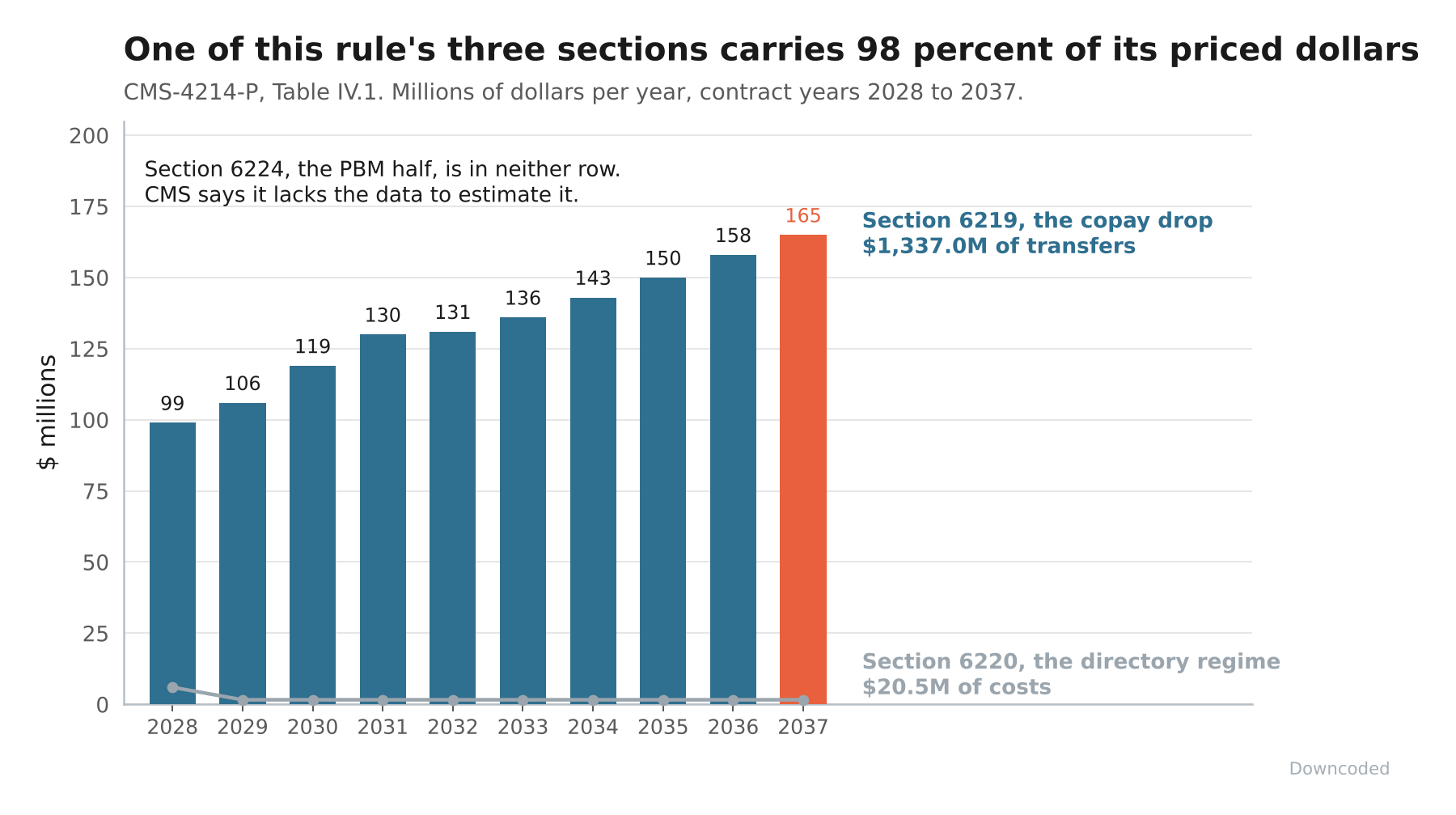
The ramp is the part worth stealing for your own deck. The copay is $0 in every one of those years, and the line still climbs 67 percent, from $99 million in 2028 to $165 million in 2037, on drug prices and utilization and the size of the dual population alone (chart below).
Now put the other line next to it.
The REAL Health Providers Act regime in section 6220, the directory verification cycles and accuracy scores and ten-year archives that every Medicare Advantage organization is about to budget for, costs $6,025,071 in 2028 and $1,608,453 a year after that. Across the same decade: $20.5 million.
The copay line is 65 times the compliance line. Of every dollar CMS put a number on in this rule, 98 percent sits in section 6219.
Six Million People, Eleven Fills
CMS says roughly 6 million enrollees are affected, off 2026 enrollment data. Divide the 2028 benefit impact by that and you get $17.67 per enrollee for the year.
At $1.60 a fill, that is about eleven generic prescriptions. Treat it as a ceiling, because CMS's benefit impact also carries the induced-utilization and brand-to-generic switching effects, and the agency says the switching piece is small given how modest the current copay differential is under the $1/$3 structure.
Where the money lands is the detail nobody will quote. Table IV.1 books the whole $1.337 billion as a transfer from the Medicare Trust Funds to MA organizations and Part D sponsors.
Beneficiaries never appear in that row. The plan stops collecting the dollar sixty and the trust fund makes it whole.
Two things about the design are worth knowing before you model anything off it:
- The CPI adjustment that has been walking the $1 statutory copay up to $1.60 is switched off for generics only, for plan years after 2027. Brand and other covered drugs keep indexing.
- Nothing else moves. CMS calls the change a conforming amendment to § 423.782(a)(2)(iii) and says it alters no eligibility criterion, no subsidy structure, and no other cost-sharing parameter.
The Section With No Number
There is a third section in this rule, and it is the one with the biggest contracts behind it.
Section 6224 limits remuneration to pharmacy benefit managers and their affiliates, in connection with Part D drug utilization, to bona fide service fees at fair market value, beginning plan year 2028. CBO scored that provision at roughly $444 million of reduced federal direct spending over 2026 to 2035.
CMS declines to quantify it. The agency says it lacks sufficient data on how its proposed fair market value definition relates to current fee structures, names vertical integration and Part D bid offsets as the reasons the effect is unknowable from where it sits, and then does the thing worth circling: it asks for the number.
"We welcome comments regarding the quantification of the impact of these provisions."
Section 6224 appears nowhere in Table IV.1. The table has exactly two data rows.
Final Thoughts
CMS expects about 20,000 people to review this rule, the same number of comments its last one drew. As of Saturday morning, the Federal Register's public inspection page for it had been viewed 114 times.
The comment window closes at 5pm Eastern on December 15, on docket CMS-2026-2533, and the three sections will not get equal letters. The directory regime will collect the volume, because it is the one that sends an operating bill to 708 MA organizations and those organizations have people whose job is to write that letter.
The section where a comment actually moves an estimate is the one where CMS printed no estimate and asked for help. That asymmetry is the whole reason to read a regulatory impact analysis before you read the preamble: the blank cells tell you where the agency is still negotiable.
Thanks for reading.